
Straight tuck end and reverse tuck end layouts are practical for lightweight products. Auto-lock bottom, snap-lock bottom, roll end mailer, sleeve, and lid-and-base layouts give buyers more choices in strength, speed, display, and unboxing value.
What is Unfolded Layout
An unfolded layout shows the full structure of a carton box before it is assembled. It includes panels, flaps, locking parts, glue areas, folding lines, and bottom structure.
A clear layout helps suppliers control production accuracy. It also helps buyers check whether the box can hold the product securely and whether the packing team can fold it efficiently.
Poor layout design may cause loose flaps, weak bottoms, difficult assembly, or wasted paperboard. In C-end packaging, these small problems can quickly affect customer satisfaction.
Carton Box Layout Types
| Layout Type | Suitable Products | Main Benefit | Key Buying Check |
| Straight Tuck End | Cosmetics, tea, small electronics | Clean retail look | Flap tightness and product weight |
| Reverse Tuck End | Daily consumer goods | Lower production cost | Display direction and folding accuracy |
| Auto-Lock Bottom | Candles, jars, mugs | Fast packing speed | Glue quality and bottom strength |
| Snap-Lock Bottom | Food, hardware, pet products | Strong base | Assembly time and folding steps |
| Roll End Mailer | E-commerce products | Better delivery protection | Product fit and inner support |
| Sleeve Layout | Gift and premium retail items | Better display effect | Sliding smoothness |
| Lid-and-Base Layout | Gifts, clothing, keepsakes | Strong unboxing value | Lid fit and board thickness |

Straight Tuck End Layout: Clean Look for Lightweight Products
A straight tuck end box uses top and bottom closing flaps that fold toward the same side. Many skincare boxes, tea boxes, small electronics boxes, stationery boxes, and health product cartons use this structure.
Its biggest advantage is the neat front and back appearance. Retail shelves look cleaner because the tuck lines stay less noticeable from the main display side.
This layout suits lightweight products better than heavy ones. If the product is too heavy, the flaps may become loose during handling or shipping.
| Pros | Cons |
| Clean front display | Not for heavy items |
| Easy to open | Flaps may loosen |
| Good for retail shelves | Limited bottom strength |

Reverse Tuck End Layout: Practical Choice for Daily Products
A reverse tuck end box uses flaps that close in different directions, with one folding from the front and the other from the back. It is widely used because it saves material and keeps production simple.
Toothpaste, medicine, cosmetics, toys, and small food products often use this layout. Brands that need large-volume carton packaging at a controlled cost usually consider it first.
The display effect may not look as clean as a straight tuck end box. Still, for daily consumer products, the balance between cost and function is often strong enough.
| Pros | Cons |
| Saves material | Less premium look |
| Easy to produce | Flap direction differs |
| Good for large orders | Not ideal for gifts |

Auto-Lock Bottom Layout: Faster Packing for Heavier Items
An auto-lock bottom layout comes with a pre-glued bottom. Once the box is opened, the bottom locks into place automatically.
Candles, glass jars, mugs, bottled products, and small appliances benefit from this stronger base. During seasonal sales or e-commerce promotions, the fast assembly speed can save real labor time.
Buyers need to check glue quality, board strength, and bottom load capacity before mass production. A large carton box with an auto-lock bottom may need thicker paperboard to avoid deformation.
| Pros | Cons |
| Fast assembly | Higher production cost |
| Stronger bottom | Glue quality matters |
| Good for heavier items | Needs accurate creasing |

Snap-Lock Bottom Layout: Strong Base Without Extra Glue
A snap-lock bottom layout uses several folding flaps that lock together manually. The structure creates a stronger bottom without requiring extra glue during final packing.
Food cartons, drink carriers, hardware packaging, pet product packaging, and medium-weight goods often use this design. It gives better support than basic tuck-end structures.
Assembly takes more time than an auto-lock bottom. Before placing a bulk order, buyers can ask workers to test the folding process and confirm whether it fits the packing line.
| Pros | Cons |
| Strong base | Slower to fold |
| No extra glue needed | Needs folding skill |
| Good load support | Not best for fast lines |

Roll End Mailer Layout: Made for E-Commerce Delivery
A roll end mailer layout folds into a self-locking shipping box. Many online sellers like this structure because it protects the product and creates a better delivery experience.
Clothing, books, handmade goods, beauty kits, subscription products, and influencer packages commonly use mailer boxes. The same structure can be adjusted into a small carton box for accessories or a larger version for gift bundles.
The product needs a stable inner fit, so it will not shift easily during packing, transport, or display. Inserts, paper fillers, or size adjustments may be needed when the product is fragile or irregular in shape.
| Pros | Cons |
| Good shipping protection | Uses more board |
| Better unboxing feel | Size fit matters |
| No tape often needed | Bulky for storage |
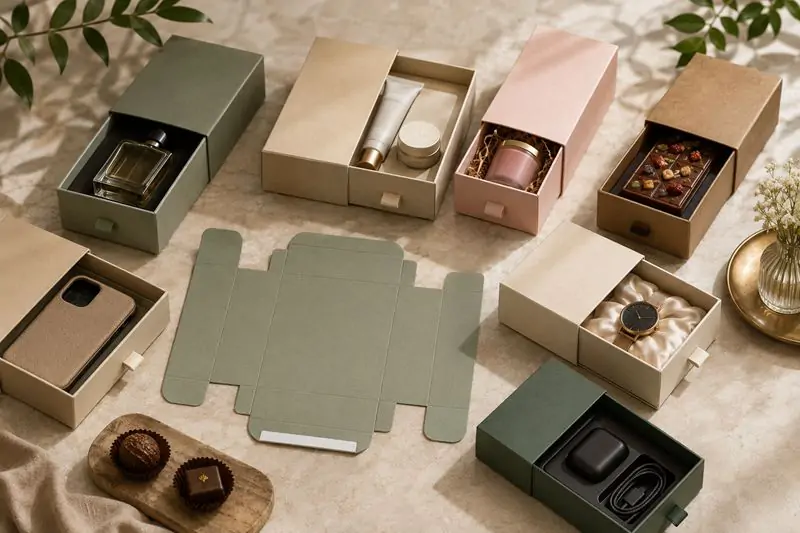
Sleeve Layout: Better Display with a Sliding Opening
A sleeve layout creates an outer cover that slides over an inner tray or box. The structure adds a layered opening experience without making the whole package too complicated.
Chocolate, perfume sets, tech accessories, skincare boxes, phone cases, and gift products often use carton sleeves. The sleeve also gives brands more surface area for printing and visual design.
Sliding feel matters a lot. A sleeve that is too tight can frustrate customers, while a loose sleeve may make the packaging feel cheap.
| Pros | Cons |
| Premium sliding feel | Fit must be precise |
| More display space | Can slide too loose |
| Good for gift products | Less protective alone |

Lid-and-Base Layout: Stronger Gift Feel and Better Reuse
A lid-and-base layout uses two separate parts: one lid and one bottom base. Gift boxes, clothing boxes, toy sets, premium retail packaging, and home storage boxes often use this structure.
Customers usually connect this opening style with better quality. After purchase, many people keep the box for storage, especially when the paperboard feels strong and the surface finish looks attractive.
Size control is very important. A large carton box needs enough thickness to stay stable, while a small carton box needs precise lid fitting so it opens smoothly without feeling loose.
| Pros | Cons |
| Strong gift feeling | Higher material use |
| Easy to reuse | Takes more space |
| Good product display | Lid fit must be exact |
How Buyers Choose the Right Layout
Product weight comes first. Light retail products can use tuck-end layouts, while heavier items may need auto-lock or snap-lock bottom structures.
Sales channel also matters. E-commerce packaging needs stronger protection, so roll end mailers or reinforced bottoms often work better than simple retail cartons.
Gift products require more attention to opening experience. Sleeve layouts and lid-and-base layouts can make the product feel more valuable when customers receive it.
Common Mistakes to Avoid
Some buyers only focus on artwork and ignore structure. Good printing cannot fix weak flaps, poor folding lines, or an unstable bottom.
Another mistake is using the same layout for every product. A small carton box for makeup and a large carton box for household products usually need different board thickness, folding design, and support structure.
Before mass production, ask for a dieline review, sample test, and real product packing test. A free carton box sample or free carton box structure check can help confirm whether the layout works before paying for bulk production.