
If a gift box’s magnetic clasp loses strength or gets broken, it will be cumbersome to open and close and hurt the box’s aesthetic appeal. In most scenarios, just replacing the magnet can easily get the box working normally, with no requirement to change the entire box.
Grab this practical manual! It teaches you how to spot defective magnetic latches, pick well-suited substitute magnets, and smoothly finish every stage of the magnet replacement work.
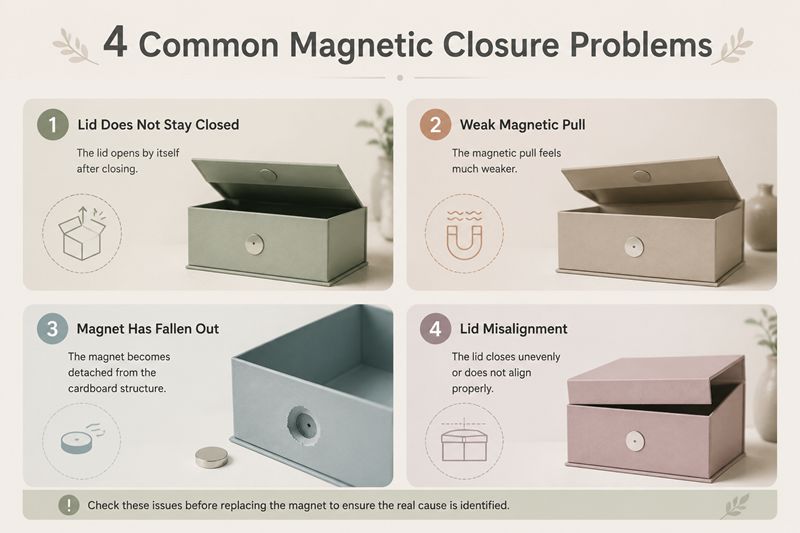
Common Signs That a Magnetic Closure Needs Replacement
Not every closure issue means the magnet must be replaced. Sometimes the problem comes from alignment, damaged materials, or accumulated dirt. Prior to initiating the replacement procedure, verify the conditions listed below.
1. The Lid Does Not Stay Closed
The most obvious sign is that the lid opens by itself after closing.
The malfunction generally takes place under these conditions:
- The magnet has lost strength
- The magnet has moved from its original position
- The opposite magnet is damaged
- The magnetic poles are incorrectly matched
For frequently used packaging boxes, a weak closure can affect both product protection and user experience.
2. The Magnetic Pull Feels Much Weaker
A magnetic box should normally close smoothly with a noticeable attraction force.
If the closing feeling becomes loose or inconsistent, possible reasons include:
- Aging magnets
- Excessive distance between magnets
- Damaged internal layers
- Incorrect replacement parts
Testing the magnetic force before replacement helps confirm whether the magnet is actually the problem.
3. The Magnet Has Fallen Out
In some cases, the magnet may become detached from the cardboard structure.A loose magnet may result from weak adhesive, impact, humidity, or repeated use. Repairing it promptly helps prevent further damage and restores proper magnetic closure performance.
4. The Box Lid Is Misaligned
A magnetic closure depends on accurate positioning. If the lid closes unevenly, the issue may come from:
- Incorrect magnet placement
- Deformed cardboard
- Loose hinge connection
- Damaged supporting layers
Replacing the magnet without checking alignment may not solve the problem.
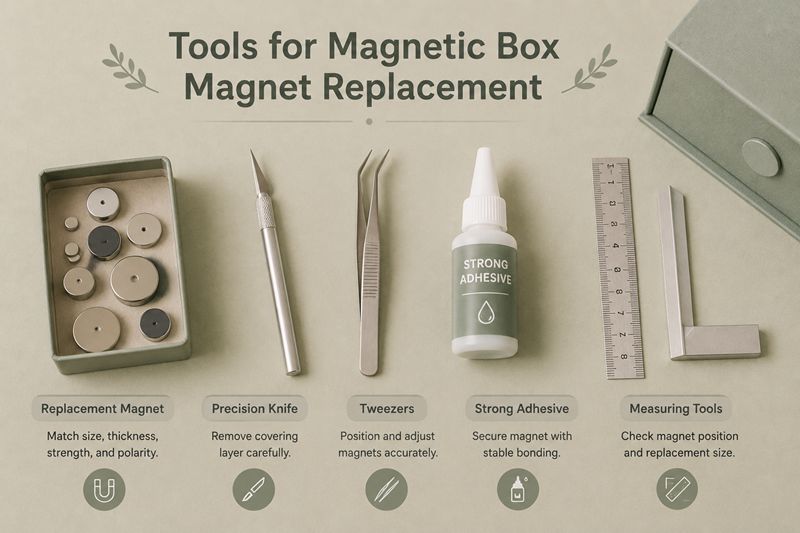
Tools and Materials Needed Before Replacement
| Tool / Material | Purpose |
| Replacement Magnet | Match size, thickness, strength, and polarity |
| Precision Knife | Remove covering layer carefully |
| Tweezers | Position and adjust magnets accurately |
| Strong Adhesive | Secure magnet with stable bonding |
| Measuring Tools | Check magnet position and replacement size |
Step 1: Identify the Magnetic Closure Type
1. Embedded Magnetic Closure
The magnet is hidden inside the cardboard layers.
- Clean appearance
- Invisible closure system
- Common in luxury rigid packaging
Replacement requires carefully opening the surface layer.
2. Surface-Mounted Magnetic Closure
The magnet is attached closer to the surface.
- Easier access
- Simpler replacement
- More common in functional packaging
3. Hidden Metal Plate and Magnet System
Certain boxes are equipped with a magnet on one side and a metal sheet on the opposite side. Before replacing, confirm whether both components need inspection.
Replacing only one side may not restore the original closing performance.
Step 2: Remove the Old Magnetic Closure Carefully
1. Open the Covering Layer
Use a precision knife to gently separate the wrapping paper around the magnet area. Avoid cutting deeply into the paperboard. The goal is to expose the magnet while keeping the box structure intact.
2. Remove the Existing Magnet
After exposing the magnet:
- Lift it carefully
- Remove old adhesive residue
- Check whether the surrounding cardboard is damaged
3. Clean the Installation Area
A clean surface ensures better bonding.
Remove:
- Dust
- Old glue
- Loose paper fibers
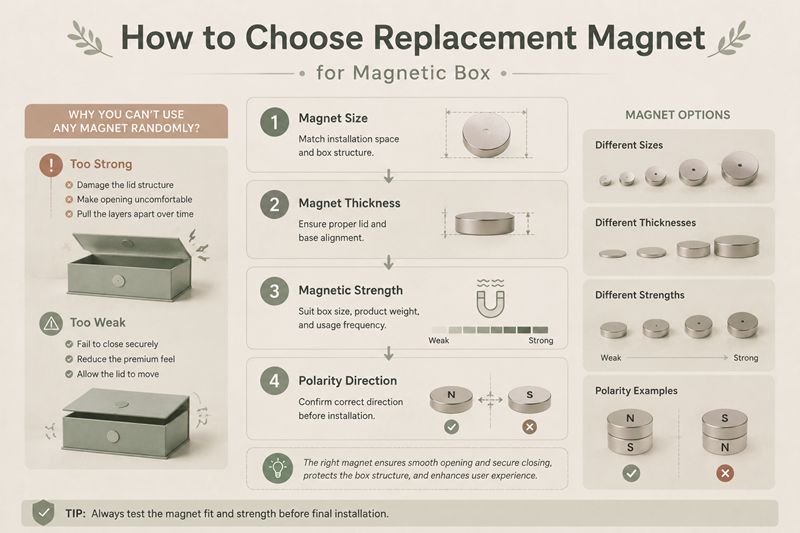
Step 3: Select the Correct Replacement Magnet
One of the core procedures lies in choosing a matching magnet. If the magnet’s pulling force is overly strong, it could result in the following conditions:
- Damage the lid structure
- Make opening uncomfortable
- Pull the layers apart over time
If the magnet is too weak, it may:
- Fail to close securely
- Reduce the premium feel
- Allow the lid to move
| Selection Factor | Key Considerations |
| Magnet Size | Match installation space and box structure |
| Magnet Thickness | Ensure proper lid and base alignment |
| Magnetic Strength | Suit box size, product weight, and usage frequency |
| Magnetic Polarity | Confirm correct direction before installation |
Step 4: Install the New Magnetic Closure
1. Position the Magnet
Place the new magnet in the original location.
Check:
- Alignment with the opposite magnet
- Lid movement
- Closing distance
2. Apply Adhesive
Use a suitable amount of adhesive.
Too much glue may:
- Increase thickness
- Affect appearance
- Reduce positioning accuracy
Too little glue may:
- Allow movement
- Cause future failure
A thin and even adhesive layer is usually sufficient.
3. Fix and Allow Drying Time
Keep the magnet fixed during adhesive curing. Avoid opening or closing the box too early, as movement may shift the magnet position and affect closure performance.
Step 5: Test the Magnetic Box After Replacement
| Test Item | Check Points |
| Closing Performance | Smooth closing, secure attachment, proper alignment |
| Opening Experience | Easy opening, balanced magnetic force, stable movement |
| Structural Condition | No wrinkles, lifting, damage, or deformation |
Common Mistakes When Replacing Magnetic Closures
- Using Random Magnets
- Ignoring Magnet Direction
- Applying Too Much Glue
- Cutting the Surface Material Too Large
- Replacing Only One Side Without Checking the Other
When Repair Is Not Enough: Consider a New Custom Magnetic Box
In some situations, replacing the magnetic closure may not restore the original quality.
For example:
- The cardboard structure is damaged
- The lid has changed shape
- The hinge is broken
- Multiple components have worn out
In these cases, creating a new packaging solution may be more practical.
A Custom Magnetic Box allows adjustments to:
- Magnet size
- Closure strength
- Box dimensions
- Material selection
- Insert design
- Surface finishing
For brands requiring consistent packaging performance, custom development ensures that the magnetic system matches the product requirements from the beginning.
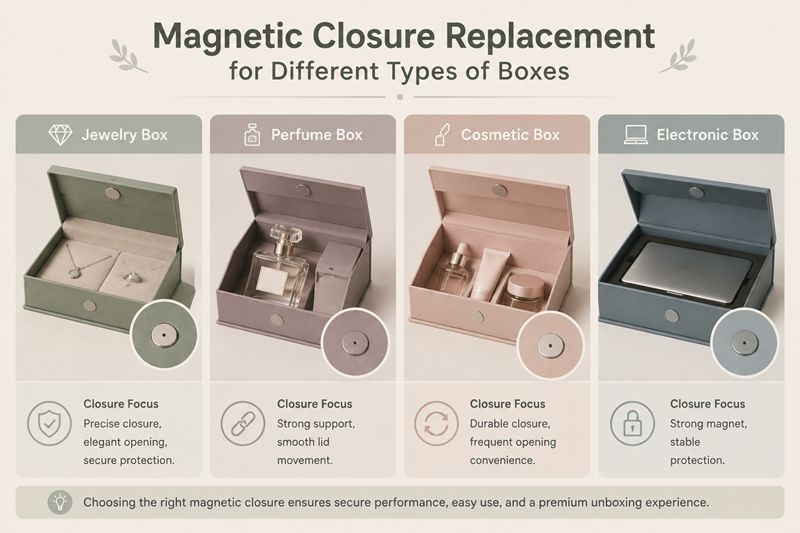
Magnetic Closure Replacement for Different Types of Boxes
| Box Type | Closure Focus |
| Jewelry Box | Precise closure, elegant opening, secure protection |
| Perfume Box | Strong support, smooth lid movement |
| Cosmetic Box | Durable closure, frequent opening convenience |
| Electronic Box | Strong magnet, stable protection |
Can a Magnetic Closure Be Upgraded Instead of Replaced?
Yes, in some cases the closure system can be improved.
Upgrading may include:
- Stronger magnets
- Better positioning
- Improved adhesive
- Reinforced internal structure
This approach is useful when the original design works well but needs better performance.
For businesses developing new packaging, Custom solutions can also integrate improved magnetic structures during the design stage instead of modifying existing boxes later.
A magnetic closure replacement can restore box performance and extend service life. With proper magnet selection and installation, the box maintains secure closing, smooth opening, and a premium user experience.