
If you source collapsible rigid boxes in bulk, it is common to get greatly divergent pricing from vendors for boxes that appear the same. The price difference typically lies in specifications left out of the quotation.
A folding structure, board thickness, magnetic closure, wrapping paper, or insert can change both the manufacturing cost and the finished result. Prior to comparing per-unit rates, purchasers should verify all suppliers are quoting against identical specifications.
1. Folding Structure: Are You Comparing the Same Box Design?
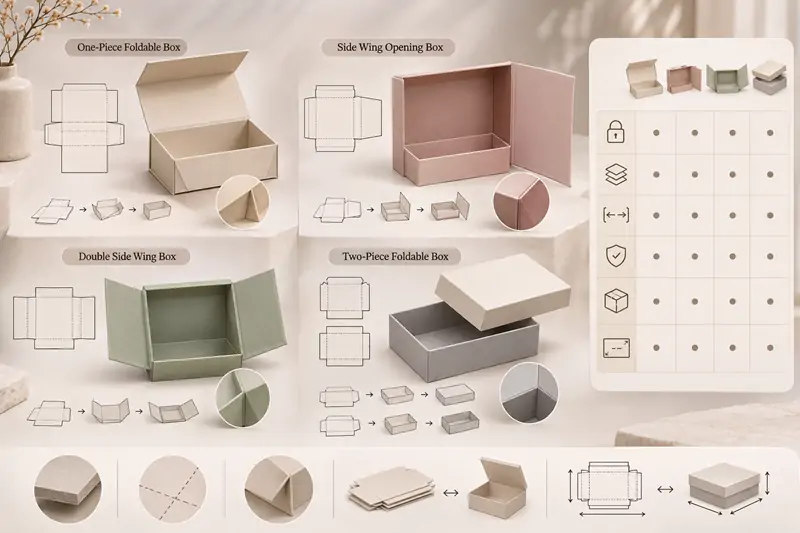
Not all collapsible rigid boxes fold and assemble in the same way. The box’s structure impacts its production method, shipping footprint, and the ease of assembly prior to product packing.
For wholesale orders, this is particularly important. A box that takes several extra steps to assemble may require more packing labor, even if its initial purchase price is lower.
The custom collapsible rigid box range includes four folding structures:
| Folding structure | Design characteristics | What to confirm in the quote |
| One-piece foldable box | Single-piece construction with folding panels | Locking method and assembly steps |
| Side wing opening box | Foldable side panels that form the box walls | Side panel attachment and stability |
| Double side wing box | Reinforced wings on both sides | Reinforcement materials and construction |
| Two-piece foldable box | Two separate parts assembled together | Whether both components are included |
For example, a promotional gift set may work well with a simple one-piece structure. A heavier electronics kit could require reinforced side wings to prevent the assembled box from losing its shape.
The quotation should identify the actual folding structure rather than simply stating “foldable rigid box.”
Before comparing prices, request:
- A structural drawing showing the folding panels.
- Photos or a video of the box being assembled.
- Confirmation of any additional assembly materials.
- The box dimensions in both assembled and flattened form.
These details help buyers understand what they will receive and how much preparation the boxes will require after delivery.
2. Box Dimensions and Board Thickness: What Is Included in the Structure?
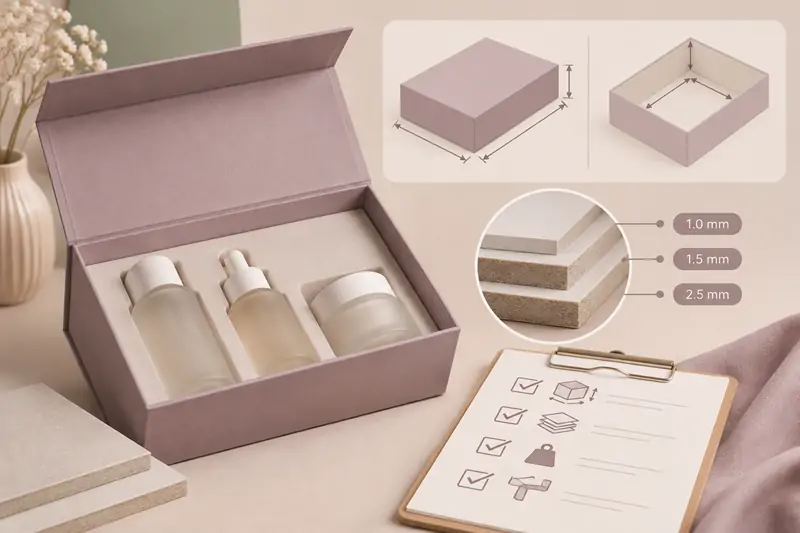
A quotation stating “300 × 200 × 100 mm rigid box” may look complete, but it leaves two important questions unanswered: Are these internal or external dimensions? What thickness of paperboard is being used?
Both affect the actual packaging.
Internal size versus external size
A box designed around external measurements may leave less usable space than expected once the rigid board, wrapping paper, and insert are added.
Consider a skincare gift set containing three bottles. If the supplier only works from the outside dimensions, the bottles may fit too tightly, especially when a foam insert is installed.
Box dimensions should be based on the full product layout, with extra allowance for easy removal of every item.
Board thickness and reinforcement
Seven Rainbow’s rigid box material range includes grey chipboard and duplex chipboard, with core material thicknesses commonly offered from 1 mm to 2.5 mm. The appropriate specification depends on box size, product weight, and structure.
A thicker board is not automatically the better option. For a lightweight apparel gift box, additional thickness may increase material use without bringing much practical benefit.
For a larger gift set, however, the base and folding corners need closer attention.
When requesting wholesale quotes, specify:
- Internal length, width, and height, in millimeters.
- Board type and thickness.
- Product weight when fully packed.
- Whether additional reinforcement is included.
If two suppliers recommend different board thicknesses, ask them to explain the difference using the intended product load and assembly structure.
3. Closure System: Are Magnets, Locking Tabs, and Reinforcements Included?
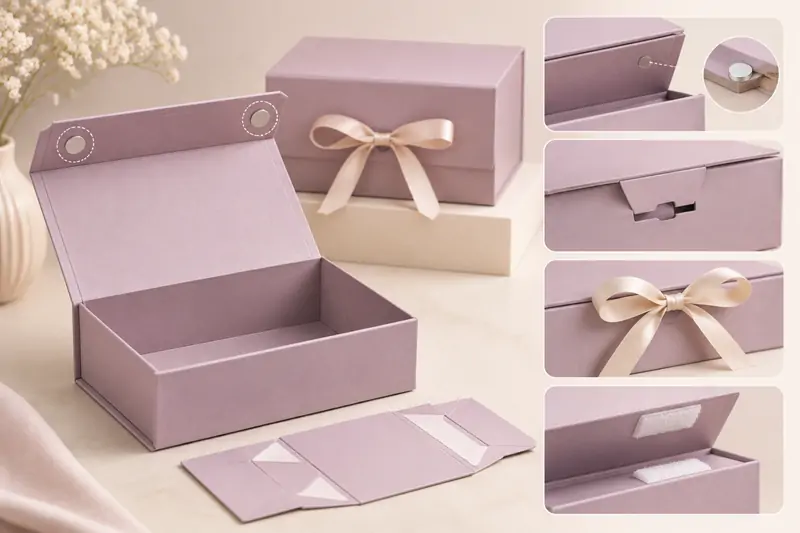
A collapsible rigid box needs to stay assembled after folding. The method used to secure the side panels and the method used to close the lid are not necessarily the same. This distinction matters when evaluating magnetic gift boxes.
A quotation may include magnets for the front lid but use a different method to keep the side walls upright. Another supplier may include additional magnetic panels or reinforced locking tabs.
Both products can be described as magnetic collapsible boxes, although their construction and assembly experience differ.
Common closure options
- Magnetic closure: Hidden magnets secure the flap and provide a smooth opening and closing experience.
- Snap-lock closure: Folding tabs fit into slots to secure the structure without magnets.
- Ribbon closure: Tied ribbons provide a decorative closing method, sometimes combined with magnets.
- Hook-and-loop closure: Reusable fastening tabs secure the flap or panels through pressure.
These options are available within Seven Rainbow’s foldable rigid packaging customization range. For a premium cosmetics gift box, magnetic closure may be the preferred choice because the opening experience is part of the product presentation. For a promotional kit assembled in large quantities, a simpler locking system may be more practical.
Ask suppliers to identify the closure components separately from any structural reinforcement. A useful sample check is to assemble and close the box repeatedly. Look for uneven flap alignment, loose corners, or side panels that move when the box is lifted with the intended product inside.
For additional closure design options, see the custom magnetic rigid box range.
4. Wrapping Paper and Printing: What Will the Finished Surface Look Like?
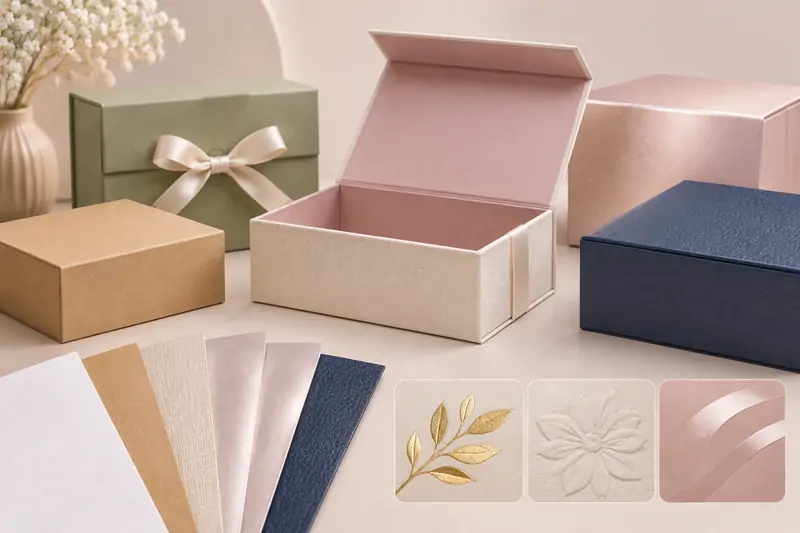
Much of a collapsible rigid box’s appearance comes from its outer wrapping paper. Two boxes can use identical greyboard structures yet look noticeably different because of their paper and printing specifications.
This is especially relevant for cosmetics, fashion accessories, and corporate gift packaging, where the box is expected to support a particular brand presentation.
Different wrapping papers serve different purposes:
| Wrapping material | Appearance and practical use |
| Coated paper | Smooth surface suitable for detailed graphics and color printing |
| Kraft paper | Natural appearance for understated packaging |
| Textured specialty paper | Linen, felt, or other tactile surfaces for premium gift boxes |
| Metallic or pearlescent paper | Reflective appearance for decorative packaging |
| Leather-textured paper | Embossed texture that creates a leather-like surface |
A simple logo printed on textured paper, for example, may achieve the intended appearance without additional decorative processes.
For designs featuring photographs, gradients, or several colors, coated paper with CMYK printing may be more suitable.
When comparing quotations, confirm the paper specification and printing method separately. CMYK, Pantone spot-color printing, and screen printing represent distinct printing methods and should not be swapped for one another.
The quote should clearly state:
- Outer wrapping paper type and specification.
- Printing method and number of colors.
- Whether the inside surfaces are also printed or wrapped.
- Whether the quoted price includes artwork preparation.
If FSC-certified paper is required, request the applicable certification details rather than relying on a general sustainability claim. The Forest Stewardship Council’s packaging guidance explains how chain-of-custody certification supports responsible sourcing and verified product claims.
5. Surface Finishing: Is the Entire Box Finished or Only Selected Areas?
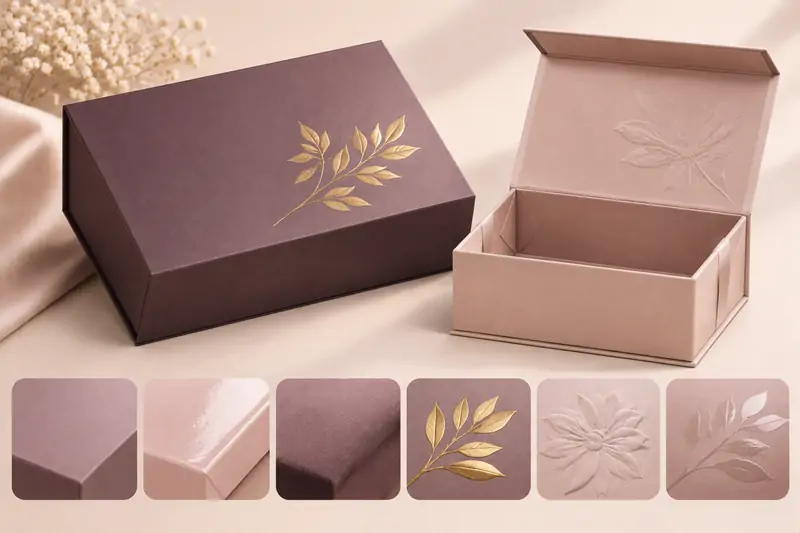
A quotation describing a box as “matte with gold foil” is not specific enough for accurate price comparison.
Does the matte finish cover the entire exterior? Is the gold foil applied only to the logo, or does it extend around the lid? These details affect material consumption, production steps, and the final appearance.
Seven Rainbow supports several finishing methods for custom rigid packaging, including:
- Matte or gloss lamination: Provides a consistent surface appearance and additional protection.
- Soft-touch lamination: Creates a smoother, velvet-like feel.
- Anti-scratch lamination: Offers improved resistance to surface marks.
- Foil stamping: Creates metallic accents on logos, text or decorative artwork.
- Embossing and debossing: Creates raised or recessed details.
- Spot UV coating: Highlights selected printed areas with a contrasting gloss.
Consider a dark-colored collapsible box intended for a luxury gift set. Matte stock with a small foil-stamped logo may achieve a pleasing effect without coating every face of the box. However, the supplier must know whether the foil appears on the lid, the front flap, or both.
For foldable boxes, the placement also deserves attention. Decorative finishes near folding lines should be reviewed on a physical sample to check for cracking, distortion, or visible wear after assembly.
Ask the supplier to mark the finishing areas on the artwork or dieline before approving the quotation. This avoids paying for a finishing process that does not produce the intended visual result.
6. Inserts and Accessories: Is the Price for an Empty Box or a Complete Packaging Set?
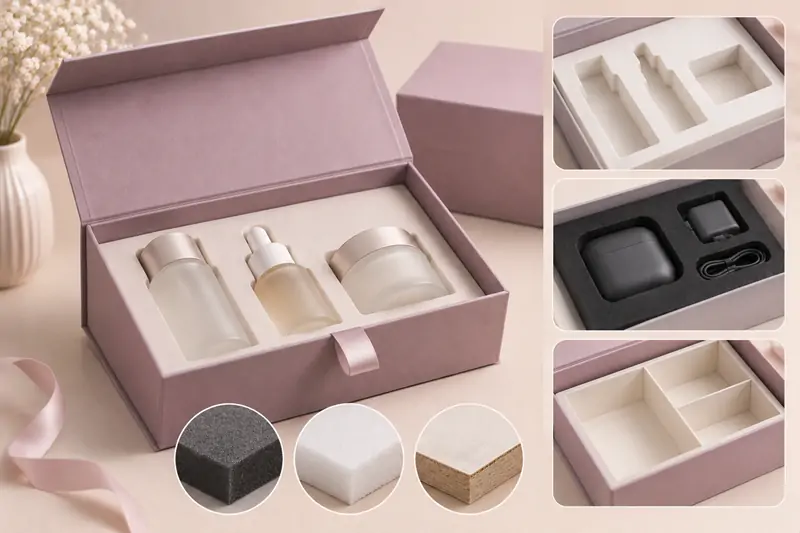
An empty collapsible rigid box and a finished gift box with a fitted insert are two different purchasing specifications. It is simple to disregard this variance during wholesale price comparisons.
A supplier might quote only the outer box. Another quotation may already include a foam insert, ribbon pull, or internal divider.
For products such as skincare bottles, electronics accessories, and promotional collections, these components can be essential to the packaging design. Seven Rainbow offers several insert options, including EVA foam, sponge, and paperboard dividers. The suitable choice depends on the product.
For a skincare gift set: Individual cutouts may be needed to hold glass bottles upright, while a ribbon pull can help customers remove tightly fitted products.
For an electronics accessory kit: A fitted foam insert can separate the main device from smaller accessories and help prevent movement inside the assembled box.
For a fashion gift box: A simple paperboard divider may provide enough organization without the additional cost of custom-cut foam.
The quotation should identify the insert material, thickness, cavity arrangement, and whether insert installation is included.
A practical detail is how inserts will be shipped. Some inserts can be packed separately, while others may need to remain assembled or retain their shape.
Ask for a sample containing the actual products, not just an empty box. Check whether the insert fits properly and whether the assembled box closes without pressure.
7. Order Quantity, Flat-Pack Cartons, and Delivery: What Does the Quoted Price Cover?
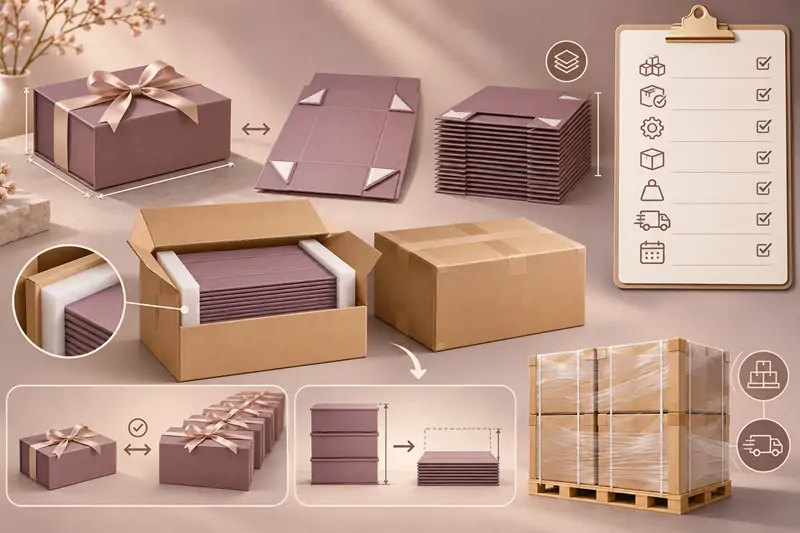
The final comparison should address how the boxes will arrive and what costs remain after manufacturing.
A key factor behind the selection of collapsible rigid boxes is that they may be transported flat. However, the freight advantage depends on the actual packing dimensions, carton quantity, and order volume.
Seven Rainbow’s collapsible rigid box page highlights flat-pack transportation and reduced storage requirements. Its online quotation form currently specifies a minimum quantity of 1,000 pieces.
For bulk orders, ask each supplier to provide a complete packing specification.
| Quotation item | Information to request |
| Order quantity | Unit price at the same order volume |
| Sampling | Sample cost, revision policy, and approval process |
| Tooling | Whether cutting dies and finishing dies are included |
| Master cartons | Quantity per carton and carton dimensions |
| Carton weight | Gross and net weight |
| Freight | Shipping terms, destination, and included charges |
| Lead time | Production period after sample approval |
Flat-pack cartons should also be checked for protection during transport. A folding box that arrives with damaged corners or scuffed wrapping paper may no longer meet retail presentation requirements.
For sensitive or high-value products, buyers can discuss suitable package testing with the supplier. Accessible at ista.org, this platform delivers industry-recognized test protocols for evaluating how packaged products hold up amid different distribution-related conditions.
One final question is worth asking: Does the quotation include the same approved sample specification for mass production?
This helps establish a clear reference for checking structure, color, finish, and assembly quality before shipment.
Compare Wholesale Quotes Using One Specification Sheet
Before selecting a supplier, consolidate the seven specifications into a single request:
- Folding structure and assembly method.
- Internal dimensions, board material, and thickness.
- Closure system and structural reinforcement.
- Wrapping paper and printing specifications.
- Surface finishing methods and application areas.
- Inserts, accessories, and their installation.
- Order quantity, packing details, sampling, and delivery terms.
Share an identical specification sheet with every supplier, and ask them to clearly mark any proposed substitutes separately.
This makes it easier to recognize genuine price differences instead of comparing quotations based on different materials or manufacturing requirements.
For more information about individual cost components, see What Affects the Cost of Collapsible Rigid Boxes?
Comparing collapsible rigid boxes wholesale requires more than checking unit prices. Clear specifications for structure, materials, finishes, inserts, and shipping help buyers understand what each quotation actually includes.
For custom bulk packaging, explore Seven Rainbow’s collapsible rigid box options and request a quotation based on your product dimensions, design, and order requirements.