
A collapsible rigid box may look perfect in a design file but behave differently once assembled. Small errors in folding lines, panel sizes, or closure positions can affect the finished box.
Before approving samples, it is necessary for buyers to review the compatibility of the dieline with the specified board, wrapping paper, inserts and assembly approach. These six checks can help identify problems before bulk production.
1. Check the Internal Dimensions, Not Just the Box Size

A dieline starts with measurements, but the dimensions shown on a drawing do not always represent the usable space inside the finished box.
Unlike ordinary folding cartons, collapsible rigid boxes use thick greyboard or chipboard covered with decorative paper. The board thickness, wrapping layers, and folding construction all influence the final dimensions.
For example, a skincare gift box may need to accommodate three bottles, a paper divider, and a printed information card. Even when the outside dimensions appear correct, the internal space may be insufficient once these components are assembled.
Start by confirming three measurements:
- Internal length and width:Enough room for the products and inserts without forcing the side walls outward.
- Usable depth:Sufficient clearance for the tallest product, including caps, pumps, or protective inserts.
- Finished external dimensions:Suitable for the intended retail display, storage space, or shipping carton.
The distinction matters when choosing a structure from Seven Rainbow’s custom collapsible rigid box range. Its one-piece, side-wing, double-side-wing, and two-piece designs have different folding arrangements, so the same external size does not necessarily produce the same internal space.
Where do dimensional mistakes usually appear?
Pay particular attention to the corners and the junction between the base and side panels. If a side panel folds inward, its thickness and position must be accounted for. Otherwise, the assembled box may become narrower than expected or develop uneven corners.
For boxes with inserts, request separate dimensions for the box cavity and the insert itself. A well-fitting tray should hold the contents without pushing against the folding walls.
Before approval: Ask the manufacturer to confirm whether every dimension on the dieline refers to the inside, outside, or individual board component. Check the finished sample with the actual products rather than relying only on the drawing.
2. Check Whether the Fold Lines Match the Box Structure
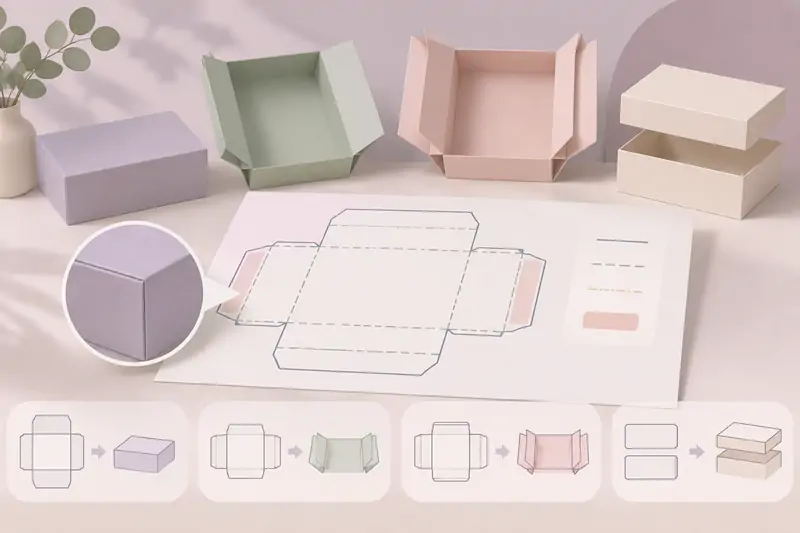
A collapsible box must perform two different jobs: lie flat during transportation and form a stable box when opened.
The dieline controls both. Cut lines determine the shape of each component, while grooves and folding lines determine how the panels move during assembly.
A folding line in the wrong position may leave a visible gap, distort a corner, or prevent the box from lying flat.
Different structures need different checks
Seven Rainbow offers several folding configurations, each with its own design considerations.
| Folding structure | What to check on the dieline |
| One-piece foldable box | Whether the connected panels fold without overlapping or obstructing the closure |
| Side-wing opening box | Whether the side wings meet the adjoining panels neatly |
| Double-side-wing box | Whether the reinforced wings fold into position without creating excessive thickness |
| Two-piece foldable box | Whether the separate components fit and interlock correctly |
For rectangular boxes, check upright corners and even lid alignment. Hexagonal designs require closer inspection of angled joints, where small folding errors can affect the final shape and overall appearance.
Cutting, folding, grooving and adhesive sections should be distinctly indicated on the dieline. Test assembly without instructions to ensure panels fold naturally, fit correctly, and maintain their shape without repeated manual adjustments.
3. Check the Closure Position After Assembly

Closure details are easy to misunderstand when reviewing a flat dieline. A magnetic flap, for instance, may appear correctly positioned on the drawing. After the side panels are folded and the wrapping paper is applied, however, the magnets may no longer meet precisely.
That can leave the lid slightly raised or cause one side to close more tightly than the other. Seven Rainbow offers magnetic, snap-lock, ribbon, and Velcro closures for its collapsible rigid boxes. Each option requires different positioning and assembly considerations.
What should you inspect?
For magnetic closures:
- Confirm that the magnet positions on the flap and receiving panels match after folding.
- Check that the magnets do not interfere with grooves, edges, or glued sections.
- Test whether the lid closes evenly without having to press down on one corner.
For snap-lock closures:
- Make sure the tabs enter their corresponding slots without bending.
- Check whether the slots remain accessible once the box is assembled.
- Confirm that the locking sections hold the box securely during normal handling.
For ribbon closures, check attachment points and ensure the ribbon closes without twisting or pulling against panels. Velcro closures need sufficient contact between fastening surfaces after assembly.
Always assess closures on the assembled box, not just the flat dieline. For hidden magnets and flip-top designs, explore the custom magnetic rigid box options.
Before approval: Close and reopen the finished sample several times. Watch for uneven gaps, loose locking tabs, displaced ribbons, or panels that shift as the closure engages.
4. Check Board Thickness, Grooves, and Wrapping Allowances
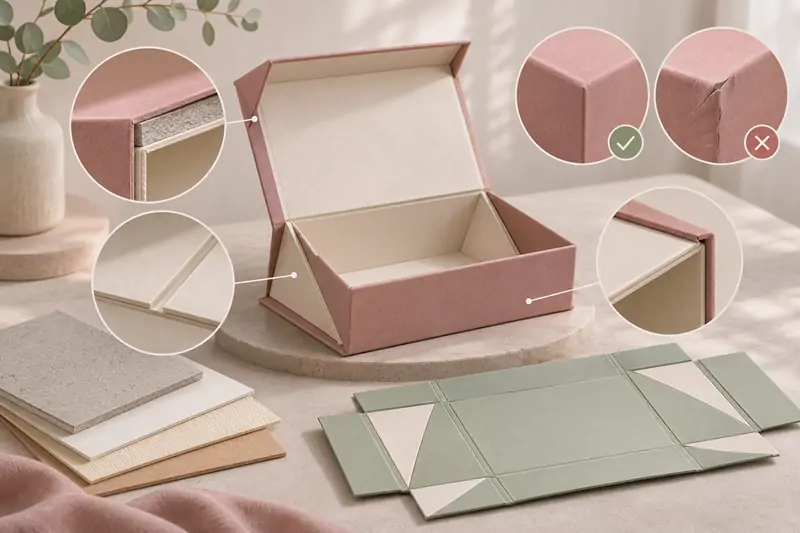
A dieline developed for one material combination may need adjustment when the board or wrapping paper changes. Seven Rainbow’s rigid box customization options include greyboard and chipboard, along with coated paper, art paper, kraft paper, and textured wrapping materials.
These materials influence more than appearance. They also affect how the box folds and how neatly the corners can be finished.
Board thickness and folding grooves
Thicker board can provide greater rigidity, but it also needs appropriate groove dimensions and panel spacing.
If the groove is too narrow for the selected material, the panel may resist folding. A poorly positioned groove can also leave the finished corner uneven.
Check the sample for these problems:
- Cracking or visible damage along the fold.
- Side panels that do not stand straight after assembly.
- Bulging where several wrapped edges meet.
- Excessive resistance when folding the box flat.
Paper grain direction is worth discussing as well. The University of Utah’s explanation of paper grain notes that paper generally folds more easily along its grain and responds differently to moisture depending on fiber direction.
For collapsible packaging, the manufacturer should consider the selected wrapping paper and its folding behavior when preparing the construction.
Don’t overlook the wrapping edges
A rigid box dieline must account for both board components and wrapping paper. Insufficient wrapping exposes greyboard at corners, while excessive overlap creates unwanted thickness around folding joints and edges.
Textured paper may fold differently from smooth coated paper, especially around tight corners. Check the finished sample for clean edges, secure adhesion, and consistent wrapping where panels meet and fold.
Before approval: Confirm the actual board thickness and wrapping material used in the sample. If either material changes, review the affected grooves and wrapping allowances again.
5. Check Artwork and Finishing Against the Folded Dieline

A logo can be perfectly centered on a flat artwork file and still appear off-center on the assembled box.
This happens when graphic placement is checked without considering visible panels, wrapping edges, and folding positions.
Consider a rectangular collapsible gift box with a large front flap. The artwork must account for the visible front section, the lid position, and any material that folds around the edges.
Review the printed areas separately
Check the following before approving the final artwork:
- Front and top panels: Are logos and design elements centered on the visible surfaces?
- Folded edges: Do background colors and patterns continue where needed?
- Interior surfaces: Will any important text disappear beneath folded or glued sections?
- Print orientation: Will the artwork face the correct direction when the box is assembled?
- Bleed and safe areas: Are graphics and text positioned according to the manufacturer’s production requirements?
The Arizona State University print guidelines explain the importance of checking bleed, fonts, colors, and print-ready files. For a custom box, the manufacturer should confirm the exact requirements for its dieline and printing process.
Finishing positions need their own review
Seven Rainbow offers CMYK and Pantone printing, lamination, foil stamping, embossing, and spot UV. Keep decorative finishes clear of folding grooves, magnets, and structural components to prevent distortion.
Test finishes across moving folds and avoid placing barcodes near creases. The GS1 barcode quality guidelines explain requirements for contrast, quiet zones, and print quality.
Before approval: Review the artwork on a fully assembled sample with the intended finishing processes. A flat printed sheet cannot confirm every aspect of the final appearance.
6. Check the Complete Assembly Before Releasing the Dieline
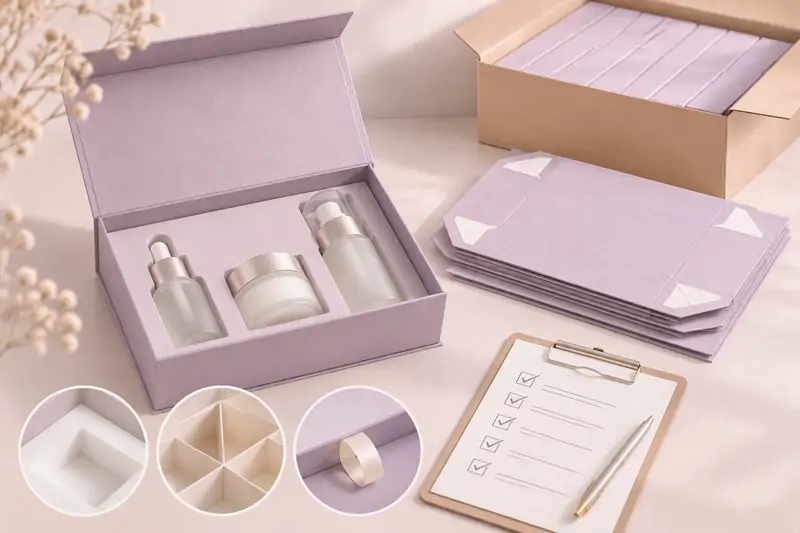
The final review should not focus solely on the box’s aesthetic quality. It is whether the approved structure works with the real product, the selected inserts, and the way the packaging will be delivered and assembled.
For collapsible rigid boxes, that means examining both the finished shape and the flat-packed condition.
Test the box with its actual contents
Seven Rainbow offers EVA and sponge inserts, paper dividers, and ribbon pull tabs. Check their fit during sampling to prevent pressure on folding walls or movement when products are placed inside.
Check that:
- Each product sits securely in its intended position.
- The insert does not distort the box walls.
- Closure of the lid must not create compression against the packaged contents.
- Products should be retrievable without causing damage to the insert or neighbouring panels.
Test the flat-packed condition, too
Collapsible rigid boxes save shipping space when folded flat. Check how samples fit inside master cartons, and confirm flat-pack dimensions, carton quantities, and packing arrangements before comparing freight costs.
Thick corner overlaps or poorly positioned accessories can increase packing volume. The International Safe Transit Association’s packaging testing guidance provides useful principles for evaluating packaging performance during transportation.
Record what the sample actually proves
Not every sample confirms the same details. A white structural sample may establish dimensions and folding behavior. A printed sample helps assess artwork and surface appearance. A final pre-production sample should reflect the agreed production specifications as closely as possible.
Seven Rainbow’s rigid box sampling process includes structural design, material selection, printing tests, manual sample making, inspection, adjustment, and customer approval.
Before releasing the final dieline, record the following:
| Approval item | What should be confirmed? |
| Dieline version | The drawing matches the approved sample |
| Materials | Board thickness and wrapping paper are confirmed |
| Structure | Assembly, folding, and closure operate correctly |
| Printing | Artwork placement and finishing are approved |
| Product fit | Actual contents and inserts have been tested |
| Shipping form | Flat-pack arrangement and carton specifications are agreed |
Avoid approving a new drawing solely because it resembles an earlier sample. Even a small change to the groove position, panel dimensions, or insert layout can affect the finished box.
The final approval should identify the drawing version and any remaining changes clearly enough for the production team to follow.
Check dimensions, folds, closures, materials, artwork, and assembly before approving your collapsible rigid box dieline. Contact Seven Rainbow Packaging to review your design and sampling requirements before production.