
One approved sample cannot predict how thousands of foldable rigid boxes will assemble. Small differences in grooves, wrapping, and closures can turn smooth setup into repeated packing delays or rejects.
Assembly Tolerance Matters in Foldable Gift Boxes
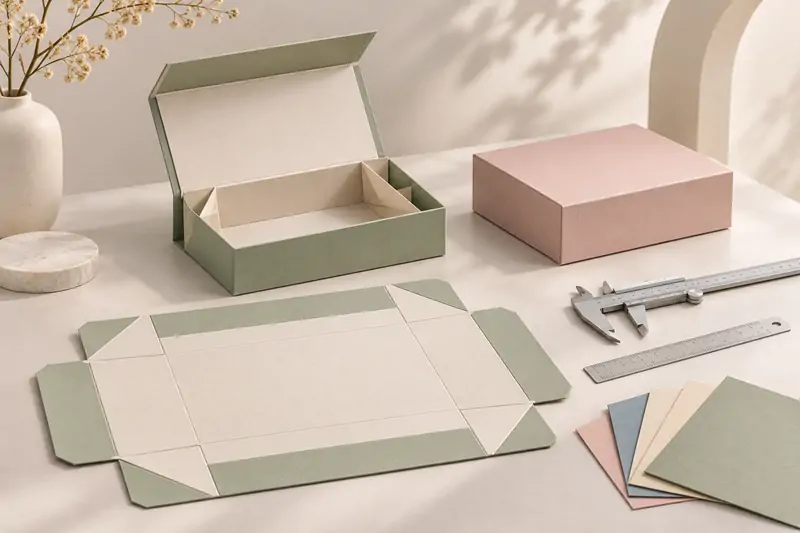
A foldable rigid box must open from a flat position, form straight walls, and stay securely assembled. Each movement depends on several connected parts working together.
Assembly tolerance describes the acceptable variation in those parts without affecting the finished box. It covers more than measurements: folding resistance, corner alignment, and closure performance also matter.
For bulk packaging orders, four areas deserve particular attention:
- Panel alignment: Side walls meet without leaving visible gaps or creating uneven corners.
- Folding resistance: Panels move into position without excessive pressure or damage to the wrapping.
- Closure positioning: Magnets, tabs, or fastening surfaces engage correctly after assembly.
- Finished dimensions: Internal space remains suitable for the product and any custom inserts.
A box can meet its specified length, width, and height yet still be difficult to assemble. This happens when small variations accumulate across connected panels.
For buyers sourcing custom collapsible rigid boxes, testing should therefore evaluate the complete assembly, rather than relying entirely on individual panel measurements.
Collapsible Rigid Boxes Wholesale Orders Need More Than One Approved Sample
A handmade prototype receives individual attention during cutting, wrapping, and assembly. Bulk production introduces repeated operations, where small changes in materials or processing can affect consistency.
Seven Rainbow’s sampling process includes structural design, material selection, manual sample making, and quality adjustments before approval. These steps establish the intended result, not every possible production variation.
What changes during mass production?
| Production factor | Possible variation | Assembly consequence |
| Greyboard grooving | Groove position or depth changes | Panels fold with different resistance |
| Die-cutting | Slight dimensional variation | Corner overlaps become inconsistent |
| Paper wrapping | Different edge overlap or adhesive thickness | Panels catch or press against each other |
| Magnet placement | Positions shift slightly | Closing flaps sit unevenly |
| Insert production | Insert dimensions vary | Interior walls become compressed |
These differences may appear individually minor. However, a corner that folds tightly and a slightly oversized insert can create a noticeable problem when combined.
That is why collapsible rigid boxes wholesale orders should be checked using multiple finished production samples. One carefully assembled box cannot represent an entire manufacturing batch.
Different Foldable Rigid Box Structures Require Different Tolerance Checks

Not every folding structure develops the same problems. A design with separate components behaves differently from one relying on connected panels and reinforced side wings.
Seven Rainbow offers one-piece, side-wing, double-side-wing, and two-piece foldable gift boxes. Each structure calls for a slightly different testing approach.
One-Piece Foldable Gift Boxes
The connected panels must fold in sequence without creating pressure at the corners. If one groove is incorrectly positioned, the entire structure may become difficult to square.
Check whether the walls stand upright naturally and whether locking tabs or magnets hold the intended shape without forcing the panels together.
Side-Wing Collapsible Gift Boxes
Side-wing structures depend on the wings folding into their intended positions. Minor dimensional changes can cause overlapping panels to sit unevenly or resist assembly.
Test both sides independently, then assemble the complete box. Neither wing should require noticeably greater force than the other.
Double-Side-Wing Rigid Boxes
Reinforced wings introduce additional overlapping areas. These structures need sufficient clearance to accommodate multiple material layers while maintaining stable corners.
Testing should focus on the meeting points between reinforced panels, particularly when heavier products or thicker wrapping materials are involved.
Two-Piece Foldable Gift Boxes
Separate components create another concern: compatibility between the finished pieces. Each component may assemble correctly on its own but fit poorly when paired.
Randomly interchange lids and bases from different production samples. This helps reveal whether the design depends on unusually precise pairing.
Foldable Magnetic Boxes: Why Closure Alignment Needs Separate Testing
A foldable magnetic box combines a collapsible structure with concealed closure components. A small change in panel position can affect how the magnets meet.
The problem is not necessarily weak magnetism. The closing flap may simply sit at the wrong angle after the surrounding panels have been assembled.
For a collapsible gift box with magnetic closure, inspect the following:
- Magnet position: Opposing components align when the flap reaches its natural closing position.
- Flap contact: The front flap closes evenly without lifting at either corner.
- Closure effort: Light hand pressure should be sufficient to engage the magnets.
- Repeated operation: Opening and closing should not gradually disturb the assembled walls.
Testing should include boxes assembled by different operators. A closure that works only after careful manual adjustment may slow down packaging operations later.
Seven Rainbow also offers snap-lock, ribbon, and hook-and-loop closures. Each requires its own functional check, since the acceptable movement and engagement differ.
For example, a snap-lock closure needs suitable tab clearance, while a ribbon closure must avoid pulling the assembled walls out of alignment.
Custom Printed Collapsible Rigid Boxes: How Materials Affect Assembly Tolerance

The finished appearance of custom printed collapsible rigid boxes depends on more than printed artwork. Greyboard thickness, wrapping materials, adhesive, and surface treatments influence how panels move.
Seven Rainbow offers greyboard or chipboard structures with coated, kraft, art, and textured paper wrapping, alongside finishes including matte lamination, soft-touch, foil stamping, and spot UV.
Board thickness and wrapping allowances
Thicker board can increase structural rigidity, but it also changes the space required around folding points. The groove design must accommodate the selected material combination.
Likewise, wrapping paper adds thickness around folded edges. Excessive overlap near a joint can prevent two panels from meeting cleanly.
Paper grain direction and folding behavior
Paper grain affects how wrapping materials respond to bending. Cornell University’s paper preservation guidance explains why folding against the grain can produce uneven creases.
For rigid boxes, the wrapping material and grooved board need to be tested together to ensure smooth folding. Changing the covering paper without retesting may produce different folding behavior.
Surface finishes and corner appearance
Decorative finishes must withstand the movement required during assembly. Pay particular attention to areas where wrapping bends tightly around corners or grooves.
Recommended checks include:
- Inspecting laminated surfaces for stress marks after folding.
- Checking textured paper around narrow corner overlaps.
- Confirming that foil decorations remain clear of highly stressed areas.
- Looking for lifting paper edges after repeated assembly.
A visually approved flat sample does not guarantee that its finished surfaces will remain undamaged once the box is assembled repeatedly.
Six Assembly-Tolerance Tests Before Bulk Production
Testing should reflect how the boxes will actually be used. The receiving warehouse or packing team may assemble hundreds of units without specialized packaging tools.
A clear inspection process helps catch assembly issues before the finished boxes are packed for delivery.
Compare production samples with the approved reference
Select finished boxes from the production process and compare them with the approved sample. Check panel dimensions, corner positions, groove placement, and overall appearance.
Any measurable difference should be reviewed against agreed tolerances, rather than judged solely by whether the finished boxes look similar.
Assemble boxes without correcting their shape
Follow the intended assembly sequence without trimming materials, pressing corners excessively, or manually adjusting individual parts beyond the normal instructions.
Record where additional force is needed. If several samples repeatedly resist the same movement, the problem may originate from the structure or production settings.
Test multiple operators
Ask different people to assemble the same design using the approved instructions. This reveals whether successful assembly depends on individual experience.
Compare assembly effort, recurring mistakes, and finished appearance. The purpose is consistent usability, not simply achieving the fastest possible assembly time.
Inspect corners and base stability
Place assembled boxes on a level surface. Check whether the base sits flat and whether all walls maintain the intended position.
For larger foldable gift boxes, use the intended product weight during the test. Empty boxes may conceal weaknesses that become apparent once loaded.
Add the actual inserts and products
Seven Rainbow offers EVA and sponge inserts, paper dividers, and ribbon pull tabs. Their final positioning can influence assembly and internal clearance.
Check whether inserts press against folded walls, whether products remain correctly positioned, and whether the lid closes without touching the contents.
Repeat assembly and flattening
For designs intended to be opened, flattened, and reused, perform several complete folding cycles. Observe whether the same panels remain aligned afterward.
Watch for loosening corners, damaged wrapping, changing closure resistance, or adhesive movement. Record the results rather than assuming every reusable design performs identically.
How to Sample Collapsible Gift Boxes During Bulk Manufacturing?
A useful test depends on which boxes are selected. Inspecting only the first completed pieces may miss variations introduced later in production.
For larger orders, samples should come from different production intervals, material batches where applicable, and finished cartons. This provides a broader view of consistency.
A practical sampling plan can include:
| Production stage | Testing focus |
| Initial production | Confirm the approved structure can be reproduced |
| During production | Detect changes in folding resistance and panel alignment |
| After process adjustments | Confirm that corrections have not introduced new problems |
| Final packed cartons | Verify assembly performance of shipment-ready units |
The sample quantity and acceptance limits should be agreed upon before manufacturing. There is no universal dimensional tolerance suitable for every collapsible rigid box.
A small jewelry gift box and a large apparel box have different panel sizes, material requirements, and assembly demands. Their acceptance criteria should reflect those differences.
Record problems that can be reproduced
A photograph of an uneven corner is useful, but a clear inspection record makes corrective action easier. Include the affected part, sample identification, and assembly condition.
- Location: Which panel, groove, corner, or closure is affected?
- Frequency: How many inspected samples show the same issue?
- Severity: Does the problem affect appearance, usability, or product protection?
- Action: Is material adjustment, process correction, or structural revision required?
If the same defect appears repeatedly, separate the affected production quantity for review. Continuing without investigation may turn a manageable adjustment into substantial rework.
Can Flat-Pack Shipping Affect Assembly Tolerance?
Flat-pack packaging saves storage and transportation space, but tightly packed cartons still require suitable protection. Pressure during stacking can affect exposed edges or delicate components.
This is especially relevant for collapsible gift boxes wholesale shipments, where many flattened units are packed into master cartons before reaching the buyer.
Inspect the shipping arrangement for three potential problems:
- Uneven stacking: Thick overlaps create pressure points between flattened boxes.
- Component movement: Separate lids, inserts, or accessories shift inside the carton.
- Surface contact: Decorative finishes rub against adjacent packaging during handling.
After a representative shipping simulation, assemble selected boxes again. Compare their performance with samples that have not undergone transportation testing.
The International Safe Transit Association’s testing guidance explains how distribution testing evaluates packaging against handling and transportation conditions. Such testing complements, rather than replaces, assembly inspection.
ISTA also recommends retesting when relevant packaging materials, components, or manufacturing processes change. The same principle supports reassessing assembly behavior after meaningful production revisions.
What Should Buyers Confirm Before Ordering Custom Foldable Rigid Boxes?

Agreeing on assembly tolerances before production helps avoid fitting issues during bulk manufacturing. Buyers should share how the packaging will be assembled, filled, stored, and distributed.
For example, a promotional gift supplier assembling boxes manually may prioritize straightforward folding, while an automated packing operation may require more tightly controlled dimensions.
Before approving a bulk order, confirm:
- Approved reference: One finalized sample representing the intended finished structure.
- Material specifications: Agreed board, wrapping, finishing, and closure components.
- Assembly method: Clear instructions reflecting the actual packing operation.
- Acceptance criteria: Agreed limits for fit, appearance, and assembly performance.
- Inspection procedure: Sampling points and corrective actions for repeated defects.
- Shipment configuration: Confirmed flat-pack arrangement and carton quantities.
Seven Rainbow’s custom foldable rigid box options cover different structures, closures, materials, and inserts. These choices should be finalized before setting meaningful inspection criteria.
Where a design requires unusually tight clearances, request production-representative samples rather than relying solely on the first prototype. This reduces uncertainty when moving from sampling to larger quantities.
Assembly-tolerance testing helps foldable rigid boxes maintain consistent fit, reliable closures, and straightforward assembly across bulk orders. Checking production variation early reduces rework and improves packaging efficiency.