
Planning inserts for custom jewelry gift boxes wholesale starts with the collection, not individual boxes. Rings, earrings, necklaces, and bracelets need different supports beneath a consistent packaging design across SKUs.
Map Your Jewelry Collection Before Designing the Inserts
A jewelry collection may include several product categories, yet not every item needs a completely different box. The first decision concerns which products can share the same packaging structure.
Start by grouping jewelry according to its shape, size, and display requirements. This makes it easier to identify reusable insert designs and avoid unnecessary packaging variations during wholesale production.
Prepare a product list covering:
- Jewelry category: Rings, earrings, necklaces, bracelets, or matching sets.
- Size variations: Small, standard, oversized, or adjustable designs.
- Display position: Flat, raised, centered, or arranged in pairs.
- Holding method: Slots, loops, recesses, holes, or supporting tabs.
- Product quantity: Single pieces, pairs, or multiple coordinated items.
A ring collection, for example, may contain slim bands and large gemstone rings. Both can use similar packaging, although the height and position of their supports may differ.
For custom jewelry packaging, this early classification helps determine which inserts should be standardized and which require individual designs. It also simplifies later discussions with the packaging manufacturer.
Standardize Box Sizes Without Forcing Every Product into One Insert
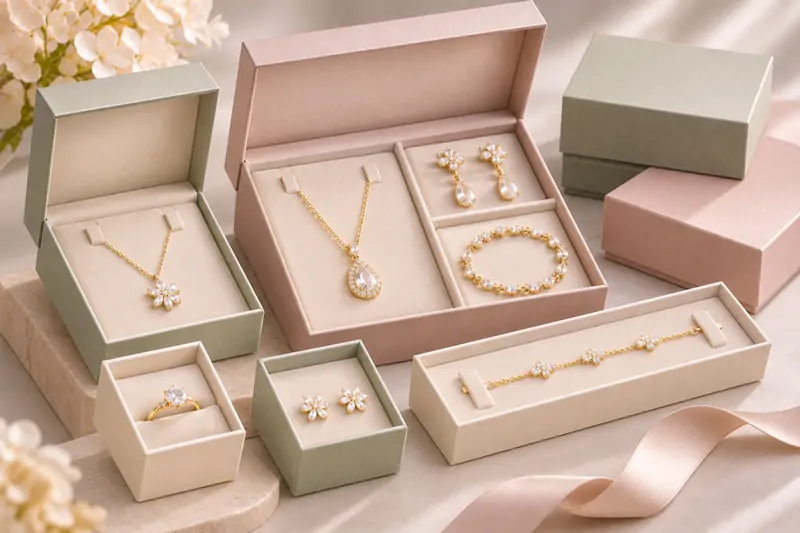
Using a different box size for every jewelry item can complicate purchasing, inventory, and packaging assembly. A more practical approach is to standardize selected outer dimensions while customizing the interior.
Seven Rainbow offers custom two piece rigid boxes with adjustable dimensions, depths, and insert materials. This structure allows buyers to develop coordinated packaging for different jewelry categories.
Example: Planning shared box formats across a jewelry collection
| Product group | Box arrangement | Insert variation |
| Rings | Small square box | Slotted ring holder |
| Stud earrings | Same square format | Paired earring holes |
| Pendant necklaces | Medium rectangular box | Chain tabs and pendant recess |
| Chain bracelets | Medium rectangular box | Loops or retaining slots |
| Jewelry sets | Larger presentation box | Multiple separated compartments |
The formats above are illustrative rather than fixed product specifications. Actual dimensions should follow the jewelry samples and the manufacturer’s available production options.
For wholesale jewelry boxes, sharing an outer format can simplify wrapping paper selection, logo placement, and carton organization. However, insert dimensions must still match each product’s actual shape.
Choose Insert Materials According to Their Function
The material beneath the jewelry determines how securely it stays positioned and how the interior looks when opened. An attractive lining alone cannot compensate for a poorly designed holding structure.
Seven Rainbow provides EVA, sponge, paperboard, and fabric insert options, including velvet and satin finishes. These materials can be combined or customized to suit different jewelry presentations.
Common insert options for jewelry cardboard boxes include:
- EVA Foam Inserts: Precision-cut cavities that provide defined support and help restrict unwanted movement.
- Sponge Inserts: Compressible cushioning suitable for selected delicate jewelry shapes and smaller accessories.
- Paperboard Inserts: Folded partitions, retaining tabs, and compartments for straightforward product organization.
- Velvet-Covered Inserts: Soft-looking display surfaces that complement fine jewelry and premium gift packaging.
- Satin-Lined Inserts: Smooth fabric finishes for decorative interiors and selected jewelry presentation layouts.
Material selection should also consider the jewelry’s finish. Polished metals, pearls, and delicate stones may require different contact surfaces, even when the exterior packaging remains identical.
The Gemological Institute of America recommends separating jewelry to reduce scratching and using appropriate protection for sensitive materials. Insert samples should therefore be checked against the actual pieces.
Plan Different Inserts for Rings, Earrings, Necklaces, and Bracelets
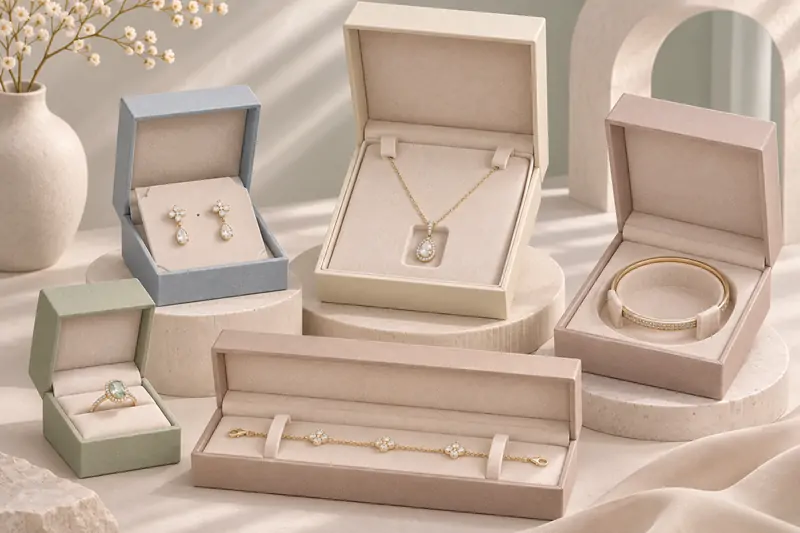
Even within the same jewelry collection, different pieces require different holding methods. Ring box packaging needs compact support, while necklace packaging must control loose chains and pendant placement.
The objective is not to assign one material to each jewelry category. Instead, choose an insert structure that supports the jewelry without making removal difficult.
| Jewelry type | Recommended insert features | Key consideration |
| Rings | Slotted pads, recessed holders | Band thickness and gemstone height |
| Earrings | Paired holes, card supports | Post length and backing clearance |
| Necklaces | Upper tabs, pendant recesses | Chain movement and tangling |
| Bracelets | Retaining loops, curved supports | Chain flexibility and clasp position |
| Bangles | Shaped recesses, soft supports | Internal diameter and rigid shape |
Ring Box Packaging: Allow for Different Ring Profiles
A narrow slit may hold a simple band securely but place unwanted pressure on a larger gemstone setting. Test the slot width and supporting material before approving production.
For custom ring boxes wholesale, consider whether multiple ring designs can share one insert. A flexible holding arrangement may accommodate variations without requiring a separate cavity for every SKU.
Earring Packaging Boxes: Check the Space Behind the Display
An earring packaging box should hold both earrings at a balanced height. Studs, hoops, and dangling designs may require different hole positions or supporting arrangements.
The back of the insert matters, too. Earring posts and fasteners need sufficient clearance so they do not press against the box bottom or distort the display.
Necklace Packaging Boxes: Control the Chain and Pendant Separately
A necklace packaging box should keep the pendant visible while limiting chain movement. Upper retaining tabs can hold the chain, with a separate recess supporting the pendant.
For bulk necklace boxes, test the arrangement using the shortest and longest necklace designs. Adjustable chain lengths may require additional space beneath the display surface.
Bracelet Box Packaging: Consider Flexible and Rigid Designs
Chain bracelets naturally follow the insert surface, while rigid bangles retain their shape. Their holding arrangements should reflect these differences without changing the collection’s overall presentation.
For bracelet packaging boxes, inspect the clasp location and removal method. Narrow retaining loops may look discreet, but they should not make the bracelet difficult to lift.
Calculate Insert Depth Before Finalizing the Box
Product dimensions alone cannot determine the required insert depth. The supporting material, decorative lining, and raised jewelry components all influence how much internal space the finished box needs.
For instance, a gemstone ring sitting above its insert needs more vertical clearance than a flat pendant. The lid must close without pressing against either product.
Four dimensions worth checking:
- Product height: Include raised stones, clasps, and decorative components.
- Insert thickness: Account for the supporting layer and fabric covering.
- Recess depth: Keep jewelry stable without hiding its important details.
- Lid clearance: Allow sufficient space above the highest product point.
A thicker insert is not automatically better. Excessive padding can make jewelry appear buried, particularly when small pieces are displayed inside relatively deep luxury jewelry boxes.
Before choosing a larger box, adjust the cavity depth or supporting position. A modest insert modification may provide the clearance needed without changing the complete packaging structure.
Match the Insert Design to the Rigid Box Structure
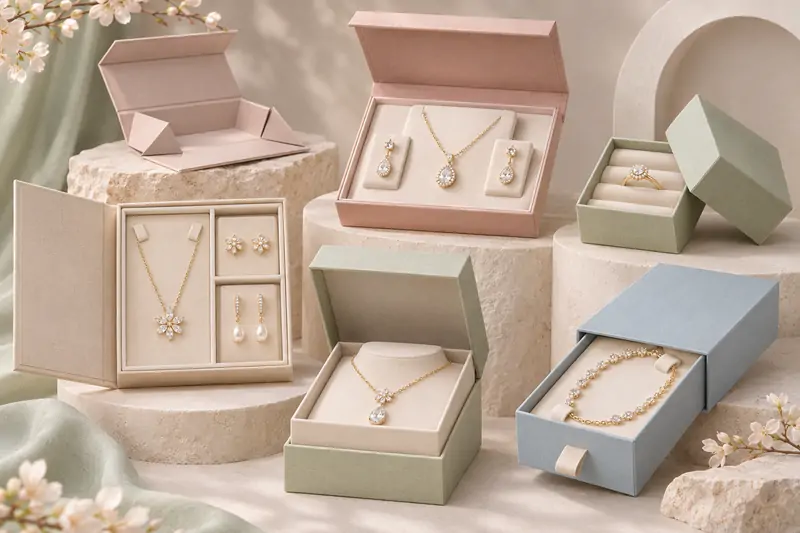
Not every rigid box structure presents its contents in the same way. The opening direction, lid clearance, and available interior space influence how inserts should be positioned.
Seven Rainbow manufactures several rigid box styles with customizable interiors. Buyers planning custom rigid jewelry boxes can compare these structures before settling on one collection-wide packaging format.
- Two Piece Rigid Boxes: Removable lids provide straightforward access to inserts, making them suitable for coordinated single-item jewelry packaging.
- Magnetic Closure Rigid Boxes: Hinged magnetic flaps require clearance around the closing area and careful positioning of raised jewelry.
- Drawer Rigid Boxes: Inserts must remain stable during tray movement without catching against the outer sleeve.
- Book Style Rigid Boxes: Side-opening presentation can accommodate organized jewelry sets, with inserts arranged around the hinged opening.
- Shoulder Neck Rigid Boxes: The inner shoulder creates a layered presentation and affects the available insert space.
A collection containing rings and earrings may use smaller lid-and-base designs. Larger coordinated sets could use magnetic or book-style packaging with dedicated compartments for each piece.
For collapsible rigid boxes, consider insert installation after assembly. Removable inserts should fit without interfering with folding panels, side wings, or corner connections.
Organize Jewelry Sets Without Creating Crowded Interiors
Matching jewelry sets introduce another concern: several pieces must share one box without touching or covering one another. Their arrangement should follow the intended opening and display sequence.
For example, a necklace and earring set may feature a central pendant with matching earrings positioned symmetrically above it. Other collections may benefit from separate compartments.
Consider these arrangements for jewelry presentation boxes wholesale:
- Necklace and Earrings: Central pendant display with paired earring positions.
- Ring and Bracelet: Separate retaining points with adequate space between products.
- Three-Piece Jewelry Sets: Dedicated compartments for each jewelry category.
- Gift Sets with Accessories: Additional space for certificates, pouches, or care cards.
The insert should also support convenient removal. Placing a necklace beneath another component may create an attractive display but complicate access when the customer opens the box.
A successful multi-piece layout balances presentation with practical handling. Before approving a shared design, test whether each item can be removed without disturbing the others.
Maintain a Consistent Appearance Across Custom Jewelry Packaging
Different insert structures do not require completely different interior finishes. Consistent lining colors and surface textures can visually connect boxes of different shapes and sizes.
Seven Rainbow supports custom wrapping materials, CMYK and Pantone printing, foil stamping, embossing, and debossing. These options can establish a coordinated appearance across jewelry packaging collections.
Elements that can remain consistent include:
- Interior fabric color and texture
- Logo placement and decorative finish
- Exterior wrapping paper and color
- Jewelry positioning within the display
- Insert edge finishing and visible borders
For custom jewelry boxes with logo wholesale, consistency is particularly useful when expanding an existing collection. New packaging variations can follow approved artwork and material references.
However, identical colors do not guarantee identical results across materials. Compare velvet, satin, and paperboard samples under the same lighting before approving a shared interior palette.
Test Inserts with Actual Jewelry Before Bulk Production
A digital layout cannot reveal every fitting problem. Physical jewelry samples are necessary to check slot tension, chain positioning, fabric contact, and clearance inside the completed box.
Sampling becomes especially important when ordering jewelry boxes in bulk. Small fitting problems repeated across several product variations can complicate packing and assembly.
Check the following during sample approval:
- Product positioning: Does each item remain centered when the box is moved?
- Holding pressure: Can jewelry be secured without excessive force?
- Removal: Can customers lift the item without pulling or bending components?
- Lid closure: Does the highest point remain clear of the closed lid?
- Material contact: Does the lining leave marks, fibers, or unwanted residue?
- Insert stability: Does the complete insert stay seated during handling?
Examine representative samples from each product category rather than testing only one jewelry item. A ring insert that fits one band may not accommodate every design.
When finished packages will enter parcel distribution, the International Safe Transit Association provides testing procedures for evaluating packaging under relevant transport conditions. Select testing according to the actual shipping arrangement.
Compare Wholesale Jewelry Box Costs by Insert Variation
For custom jewelry boxes wholesale, insert materials, cutting details, and assembly requirements can affect pricing, even when the exterior box dimensions remain identical.
When comparing quotations for jewelry packaging boxes wholesale, focus on four cost factors:
- Shared Components: Box sizes, wrapping materials, and printing.
- Insert Cutting: Custom cavities, slots, and openings.
- Fabric Covering: Velvet, satin, and finishing work.
- Order Quantities: Different insert designs and SKU volumes.
Request a quotation that separates shared packaging costs from individual insert variations. Also confirm the MOQ for each design before placing a bulk order.
Prepare One Insert Specification Sheet for the Entire Collection
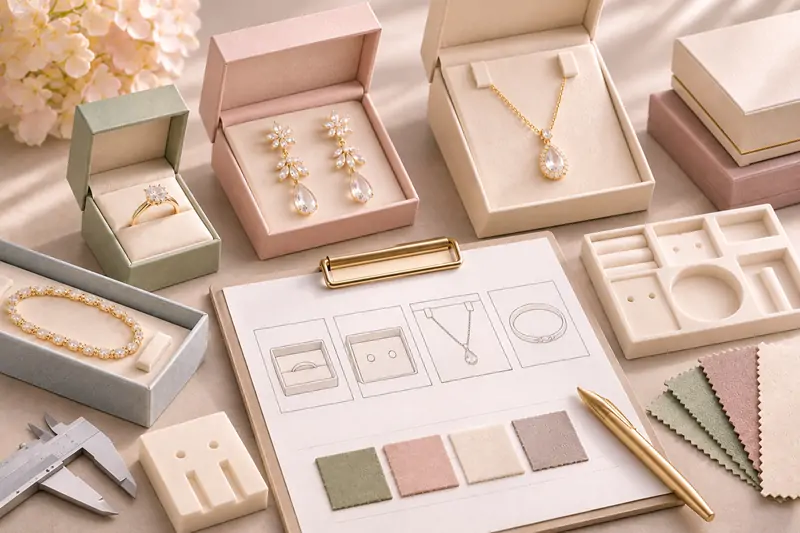
A consolidated specification sheet helps manufacturers coordinate custom jewelry packaging across multiple SKUs, reducing confusion over dimensions, insert designs, and production quantities.
| Specification | Information to Provide |
| Jewelry Details | SKU, type, dimensions, photographs |
| Box Structure | Style, size, opening direction |
| Insert Design | Material, slots, cavities, lining |
| Order Details | Quantity per SKU, delivery requirements |
For custom rigid jewelry boxes, provide actual jewelry samples when possible. Test representative insert variations before approving the entire collection for wholesale production.
Planning inserts across a jewelry collection makes wholesale packaging more consistent and easier to manage. Standardize suitable box components, customize product supports, and approve every variation before bulk production.
Explore Seven Rainbow’s custom rigid box packaging options or contact the manufacturer to discuss inserts for your jewelry collection.