
For a Custom Hinged Lid Rigid Box, choosing the right thickness is not just a technical decision—it directly affects user experience, perceived value, and product safety.
It breaks down everything you need to know about selecting the right grayboard thickness, from material basics to product matching, structural logic, and real-world applications.
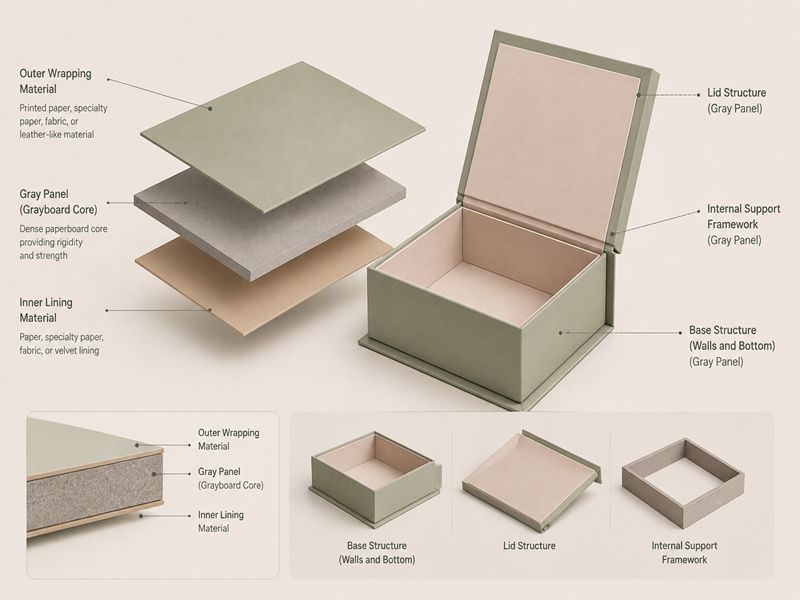
What Is a Gray Panel in a Hinged Lid Rigid Box?
A gray panel refers to the dense paperboard core used to form the rigid structure of the box. In a hinged lid rigid box, it is used for:
- The base structure (walls and bottom)
- The lid structure
- The internal support framework
It is usually covered by printed paper, specialty paper, fabric, or leather-like materials to create a premium exterior.
The gray panel is the “skeleton” of the box. Even if the outside design is beautiful, without proper thickness and density, the box will feel weak, collapse easily, or fail to protect the product inside.
Why Thickness Matters More Than You Think?
Choosing grayboard thickness is not only about strength. It influences multiple aspects of the packaging experience:
- Structural Stability
- Product Protection
- Luxury Perception
- Hinge Performance
- Manufacturing Precision
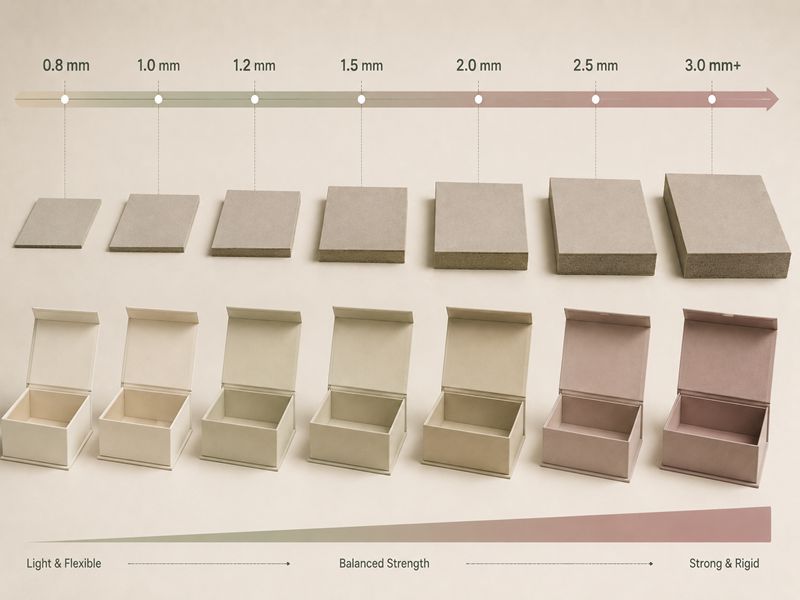
Standard Grayboard Thickness Options
In most Custom rigid packaging production, grayboard thickness typically ranges from:
- 0.8 mm
- 1.0 mm
- 1.2 mm
- 1.5 mm
- 2.0 mm
- 2.5 mm
- 3.0 mm+
Each thickness level serves different packaging needs. The key is not choosing the strongest option, but the most suitable one.
How Product Weight Influences Thickness Selection?
| Product Weight | Typical Use | Recommended Thickness |
| 0–200g | Jewelry, samples | 0.8–1.2 mm |
| 200g–1.5kg | Skincare, candles | 1.2–2.0 mm |
| 1.5kg+ | Gifts, electronics | 2.0–3.0 mm+ |
Light products do not require high compression resistance. A thinner board keeps the box elegant, lightweight, and cost-efficient while maintaining structure.
Medium-weight products need balanced rigidity. Too thin will deform; too thick may feel bulky or unnecessary.
Heavy items require strong load-bearing capacity. The box must resist compression during stacking and transportation.
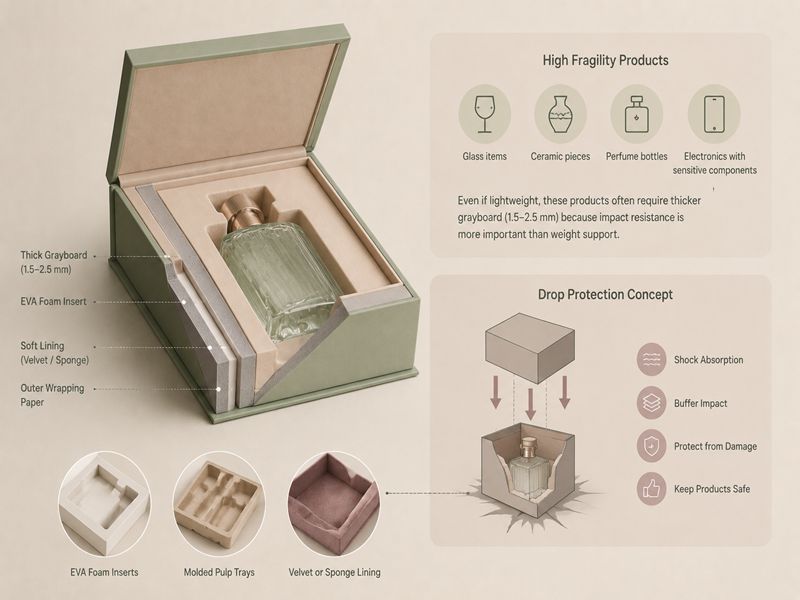
Product Fragility: Another Key Factor
Weight alone is not enough. Fragility plays a huge role in determining grayboard thickness.
High Fragility Products:
- Glass items
- Ceramic pieces
- Perfume bottles
- Electronics with sensitive components
Even if lightweight, these products often require thicker grayboard (1.5–2.5 mm) because impact resistance is more important than weight support.
A Custom hinged lid rigid box for fragile goods often includes:
- EVA foam inserts
- Molded pulp trays
- Velvet or sponge lining
These internal structures work together with grayboard thickness to ensure full protection.
Relationship between Box Size and Thickness
| Box Size | Recommended Thickness | Key Benefit |
| Small (<20 cm) | 0.8–1.5 mm | Stable shape, cost-efficient |
| Medium (20–35 cm) | 1.2–2.0 mm | Balanced structure and durability |
| Large (35 cm+) | 2.0–3.0 mm+ / reinforced | Prevents bending and lid sagging |
Large Custom packaging often fails not because of design, but because the board is too thin for its dimensions.
Density vs Thickness: The Hidden Factor
Many people only focus on thickness, but grayboard density is equally important.
Even when thickness is the same, different board densities can lead to noticeably different performance.
Low-density board:
- Softer
- Easier to bend
- Lower cost
- Suitable for lightweight packaging
High-density board:
- Strong compression resistance
- Better durability
- Premium feel
- Ideal for luxury packaging
For high-end Custom hinged lid rigid boxes, high-density board often outperforms simply increasing thickness.
Surface Material Impact on Thickness Choice
| Surface Material | Thickness Requirement | Key Effect |
| Paper wrapping | Standard thickness | Flexible, well-balanced finish |
| Specialty textured paper | Slightly thicker board | Prevents surface unevenness |
| Fabric / leather wrap | 1.5 mm+ | Stronger support, premium feel |
| Soft-touch laminated paper | Standard to slightly thinner | Smooth touch with firm structure |
Surface material significantly influences grayboard thickness selection. Different wraps such as paper, textured paper, fabric, or soft-touch finishes require adjusted board strength to ensure stability, durability, and a refined tactile packaging experience.
Cost vs Performance Balance
Thicker grayboard means higher cost—not just material, but also:
- Higher transportation weight
- More difficult processing
- Increased production time
However, going too thin may damage brand perception.
A balanced decision should consider:
- Product value
- Target market positioning
- Shipping conditions
- Unboxing experience expectations
In many cases, optimizing structure is more effective than simply increasing thickness.
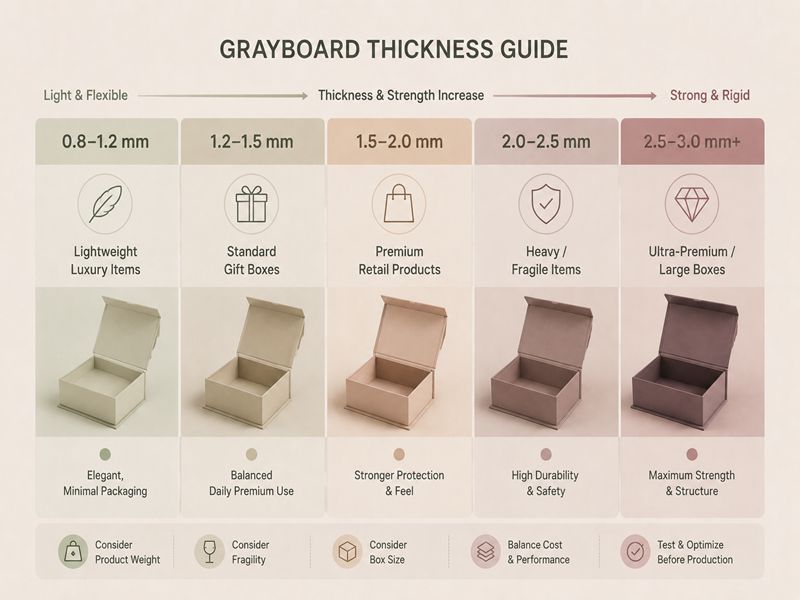
Grayboard Thickness Guide
| Thickness | Application | Positioning |
| 0.8–1.2 mm | Lightweight luxury items | Elegant, minimal packaging |
| 1.2–1.5 mm | Standard gift boxes | Balanced daily premium use |
| 1.5–2.0 mm | Premium retail products | Stronger protection & feel |
| 2.0–2.5 mm | Heavy / fragile items | High durability & safety |
| 2.5–3.0 mm+ | Ultra-premium / large boxes | Maximum strength & structure |
How to Select Grayboard Thickness for a Hinged Lid Rigid Box?
Instead of treating thickness selection as a fixed formula, it is more useful to understand it as a series of real design decisions. Each step reflects how the box will actually perform in daily use, from protection to unboxing experience.
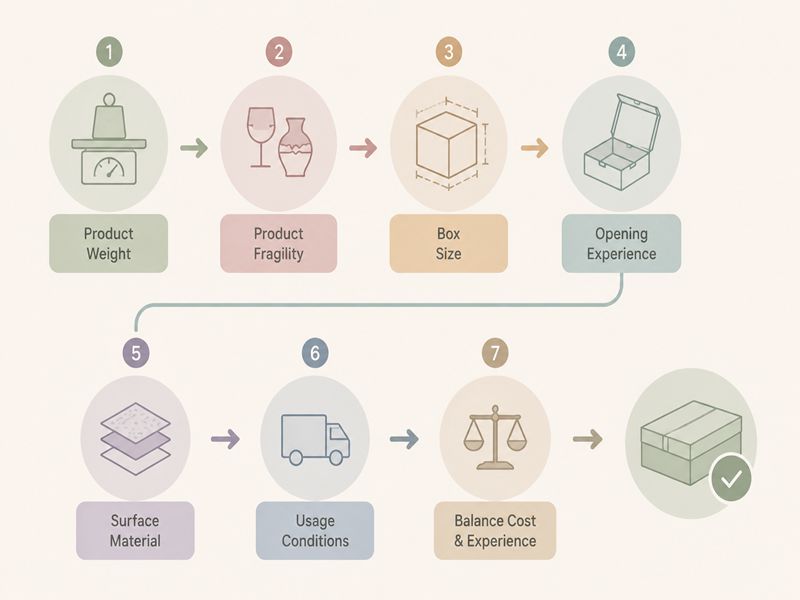
1. Product Weight Sets the Structural Baseline
The first thing to consider is how much the box needs to carry in real use. Weight directly determines the minimum structural strength required.
| Product Type | Weight Range | Structural Expectation |
| Light items | 0–200g | Basic rigidity is sufficient |
| Medium items | 200g–1.5kg | Balanced strength and flexibility |
| Heavy items | 1.5kg+ | High load-bearing stability required |
When products become heavier, the grayboard must increase accordingly to avoid deformation during transport or stacking.
2. Fragility Changes the Protection Level
Not all products are defined by weight alone. Some items are light but extremely fragile.
Fragile products such as glass, ceramics, or electronics require stronger shock resistance. Even a small drop or pressure change can cause damage, so the box structure must compensate with higher rigidity.
In these cases, it is common to choose a thicker grayboard even if the product itself is not heavy.
3. Choose Grayboard Thickness Based on Box Size
After confirming the box dimensions, select the structure directly based on size:
| Box Size | What to Do |
| Small (<20 cm) | Use standard thickness |
| Medium (20–35 cm) | Slightly increase thickness or density |
| Large (35 cm+) | Use thickened or reinforced grayboard |
4. Set Grayboard Configuration Based on Opening Experience
Instead of only thinking about structure, decide thickness based on how the box should feel when opened:
- If you want a smooth and light opening :use standard thickness with properly tuned magnetic strength
- If you want a more premium, controlled “solid feel” :increase grayboard thickness or density
- If magnets are used :reinforce side panels to keep magnetic alignment stable over time
For a Custom hinged lid box, always test opening and closing behavior during prototyping instead of relying only on drawings.
5. Match Grayboard Directly with Surface Material
| Surface Material | What to Do |
| Art paper / coated paper | Use standard thickness |
| Textured / specialty paper | Slightly increase thickness |
| Fabric / leather wrap | Use stronger grayboard |
| Soft-touch / premium coating | Use medium thickness + higher density |
In most Custom rigid box projects, the rule is simple: the more premium the surface material, the more stable the inner structure should be.
6. Select Strength Based on Real Usage Conditions
Choose structure directly according to how the box will be used in real life:
- Long-distance shipping / export packaging :use thicker grayboard for better compression resistance
- Retail display or gifting use :standard thickness is usually sufficient
- Frequent opening (gift sets, premium packaging) :choose more durable thickness for long-term use
- Stack storage conditions :reinforce side panels to prevent collapse under pressure
For Custom hinged lid rigid box, transportation conditions should always be confirmed early in the design stage.
7. Final Decision: Balance Cost and User Experience
The final decision should balance cost and user experience rather than simply choosing the thickest grayboard. Too thin may cause deformation and weak protection, while too thick increases cost and reduces flexibility.
The optimal solution ensures stability, good hand-feel, and efficient cost control, often finalized through sample testing before production.