
To pack collapsible rigid boxes safely for long-distance shipping, buyers should confirm the structure, protect surfaces and corners, control stacking, choose strong cartons, prevent moisture, use pallet packing, check labels, review packing photos, and inspect goods before shipment.

Why Shipping Method Matters for Collapsible Rigid Boxes
Collapsible rigid boxes are different from traditional rigid setup boxes.
A standard rigid box is shipped in its finished 3D shape. It takes more carton space but needs less assembly. A collapsible rigid box is shipped flat or semi-flat, helping buyers save warehouse space and reduce freight volume.
This is especially useful for bulk orders, such as 5,000 to 100,000 pieces for gift packaging, cosmetics, electronics, wellness products, jewelry, and premium retail sets.
However, because the boxes are folded, stacked, wrapped, and compressed during transport, the packing method must be carefully controlled.
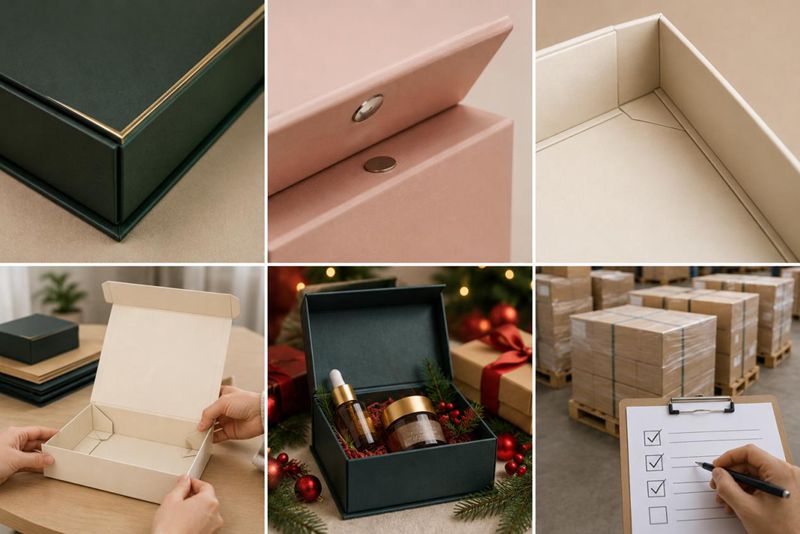
Common Buyer Concerns During Long-Distance Shipping
B2B buyers usually care about several practical issues:
- They want the box surface to arrive clean and scratch-free.
- They need the magnets, folding lines, paper wrapping, and corners to remain stable.
- They also need the boxes to be easy to assemble after arrival, especially when the packaging is used for seasonal campaigns or retail launches.
For example, a European skincare brand may order collapsible rigid boxes from an overseas supplier three months before a Christmas gift set launch. If the boxes arrive with crushed corners or warped panels, the brand may not have enough time to remake them.
This is an easy but useful step for checking product quality before shipment.
Step 1: Confirm the Box Structure Before Packing
Before choosing the packing method, the supplier and buyer should confirm the exact box structure.
Different collapsible rigid boxes may have different folding methods, closure systems, and inner supports. Some use magnetic closures. Some use adhesive corners. Some are designed with ribbon pulls, paper sleeves, or inserts.
The packing method should match the structure.
For example, Flat packing is suitable for buyers who have local assembly teams or co-packers. It is also useful for large orders where freight cost is a key concern.
Pre-assembled packing may be used for small premium orders, urgent projects, or products that require immediate retail display. However, it usually increases carton volume and shipping cost.
Step 2: Use Protective Wrapping for Surface Protection
Surface treatment plays a key role in the overall quality and appearance of a rigid collapsible box.
Many collapsible rigid boxes can be customized with surface finishes such as matte film, soft-touch coating, foil stamping, raised or recessed logos, spot UV effects, textured wrapping paper, and other premium specialty papers.
These decorative finishes help enhance the brand image and premium feel, but they may also be easily affected by rubbing or surface friction.
If boxes rub against each other during shipping, the surface may show scratches, marks, or color transfer.
Recommended Surface Protection
- For premium orders, each box or each small group of boxes can be protected with tissue paper, OPP bags, PE bags, or paper sleeves.
- For eco-conscious brands, paper wrapping may be preferred instead of plastic bags.
- For boxes with dark colors, soft-touch surfaces, metallic paper, or foil stamping, extra protection is strongly recommended because these finishes can show marks more easily.
The buyer should ask the supplier to confirm whether the box surface will be separated during stacking.
Step 3: Control the Stacking Quantity
Collapsible rigid boxes are usually stacked in layers inside master cartons.
If too many boxes are stacked together, the bottom layers may be compressed. This can cause bending, uneven folding lines, or corner deformation.
The correct stacking quantity depends on the box size, board thickness, surface material, and shipping distance.
Avoid Excessive Compression
- For small boxes, more pieces can be packed per carton.
- For large gift boxes, luxury packaging boxes, or boxes with thick inserts, fewer pieces should be packed in each carton.A lower carton quantity may increase carton cost slightly, but it can reduce the risk of damage during international transportation.
For B2B buyers, this is a practical balance between freight efficiency and quality control.
Step 4: Add Corner and Edge Protection
Corners are the most vulnerable part of collapsible rigid boxes.
Even when the box is shipped flat, the edges and folded parts can still be damaged by carton pressure, dropping, or rough handling.
Corner protection is especially important for premium retail packaging, where small defects may affect brand presentation.
Useful Protection Materials
Suppliers may use paper corner guards, corrugated pads, foam sheets, honeycomb paper, or reinforced carton dividers.
For luxury packaging orders, a top-and-bottom protective board can also be added inside the master carton.
This helps distribute pressure and protect the surface from direct impact.
Step 5: Choose the Right Master Carton
The outer carton protects the boxes during storage, loading, shipping, customs inspection, and warehouse handling.
For long-distance shipping, the master carton should be strong enough for stacking and container transport.
A weak carton may collapse during sea freight or warehouse storage, even if the boxes inside are well made.
Master Carton Requirements
A good master carton should match the box weight and shipping route.
- For sea freight, stronger corrugated cartons are usually recommended because the goods may stay in containers for several weeks.
- For air freight, carton weight and size should be controlled carefully because air shipping is more expensive.
- For e-commerce or mixed logistics, drop resistance may be more important.
Buyers should ask suppliers for carton dimensions, gross weight, net weight, and packing quantity before approving shipment.
Packing Method Comparison for Buyers
| Packing Item | Recommended Practice | Why It Matters |
| Box packing style | Flat-packed or semi-flat packed | Saves shipping volume and warehouse space |
| Surface protection | Tissue paper, paper sleeve, OPP bag, or PE bag | Prevents scratches, dust, and surface marks |
| Layer protection | Corrugated pads or paper sheets between layers | Reduces friction and pressure damage |
| Corner protection | Paper corner guards or reinforced pads | Protects edges during handling and transport |
| Master carton | Strong export-grade corrugated carton | Improves stacking strength and shipping safety |
| Moisture control | Desiccants and dry storage instructions | Reduces humidity risk during sea freight |
| Carton labeling | Product code, quantity, size, and handling marks | Helps warehouse teams identify goods quickly |
| Pallet packing | Wrapped and strapped pallets for bulk shipment | Improves loading stability and reduces carton damage |
Step 6: Protect Boxes from Moisture
Long-distance shipping often includes humidity risk.
This is especially true for sea freight, tropical routes, rainy seasons, and long warehouse storage.
Since collapsible rigid boxes are made with paperboard, wrapping paper, glue, and sometimes magnets, moisture can affect flatness, adhesion, and surface appearance.
Moisture Control for Sea Freight
For sea shipments, buyers can request desiccants inside cartons or containers.
The supplier should also keep finished boxes in a dry warehouse before shipment.
If the product will be shipped to Europe or North America during winter, condensation may happen when goods move between different temperature environments.
Good moisture control can reduce warping, mildew, odor, and paper swelling.
Step 7: Confirm Pallet Packing for Bulk Orders
For large B2B orders, pallet packing is often safer than loose cartons.
Pallets make loading and unloading easier. They also reduce the risk of cartons being thrown, squeezed, or misplaced.
This is useful for buyers who import full container loads or large seasonal packaging orders.
Pallet Packing Details
- Cartons should be stacked evenly on the pallet.
- The pallet should be wrapped with stretch film and secured with straps if needed.
- Edge protectors can be added to improve stability.
- The supplier should avoid overhanging cartons because overhang can increase the risk of carton deformation.
- For premium collapsible rigid boxes, pallet height should also be controlled to avoid too much pressure on bottom cartons.
Step 8: Check Carton Labeling and Shipping Marks
Clear labeling helps buyers manage receiving, inspection, and warehouse distribution.
This is important when one order includes multiple sizes, colors, designs, or SKUs.
For example, a North American gift brand may order the same foldable rigid box in three sizes and four color versions. Without clear carton labels, the warehouse may mix the boxes during repacking or product assembly.
Useful Label Information
Each carton label can include product name, item code, box size, color, quantity, gross weight, net weight, carton number, and destination information.
Handling marks such as “Keep Dry,” “Do Not Crush,” and “This Side Up” may also be useful.
For retail packaging projects, barcode labels can help improve warehouse efficiency.
Step 9: Request Packing Photos Before Shipment
Before mass shipment, B2B buyers should ask the supplier to send packing photos.
This is a simple yet practical quality check that helps reduce potential packaging defects.
Photos should show the box stacking method, inner protection, carton sealing, carton label, pallet packing, and final loading condition.
Why Packing Photos Are Useful
Packing photos help buyers confirm that the agreed packing method has been followed.
They also create a record in case shipping damage happens later.
For repeat orders, packing photos can be used as a reference standard, making future production more consistent.
Step 10: Carry Out Final Inspection Before Shipping
For bulk orders, it is advisable to arrange a pre-shipment inspection to confirm quality, packaging, and order details before delivery.
The inspection should not only check product appearance, but also review packing quality.
Many buyers focus on color, size, logo, and finishing, but packing quality is equally important for long-distance shipping.
What to Inspect
Inspectors can check whether the collapsible rigid boxes are clean, flat, correctly folded, and properly protected.
They should also check carton strength, carton quantity, labeling, sealing, and pallet condition.
If the order includes inserts, ribbons, magnets, sleeves, or accessories, these parts should also be counted and packed separately or securely.
Common Packing Mistakes to Avoid
- One common mistake is packing too many boxes in one carton to save freight cost.This may reduce carton count, but it can increase compression damage.
- Another mistake is using weak outer cartons for sea freight. Long-distance shipping requires stronger cartons than domestic delivery.
- A third mistake is ignoring moisture protection. Even well-made rigid collapsible box packaging can be affected by humidity if it is stored or shipped incorrectly.
Buyers should also avoid confirming shipment before seeing packing photos, especially for first-time suppliers.
What Buyers Should Tell the Supplier
To get the right packing plan, buyers should share key project details with the supplier.
These include order quantity, box size, destination country, shipping method, warehouse requirements, and whether the boxes will be assembled by hand or by a packaging line.
- If the boxes are for luxury retail, buyers should clearly mention surface protection requirements.
- If the goods will be shipped by sea, moisture control should be discussed early.
- If the order is urgent, the buyer should confirm whether the supplier can pack, label, and palletize the goods according to the required delivery schedule.