
Fragile products need fitted inserts, not just attractive boxes.
A well-designed insert keeps items stable, reduces shaking and impact, separates accessories, and protects delicate surfaces. For Custom packaging, the insert should match product size, shape, weight, material, and opening style, helping fragile items arrive safer and look more carefully presented.
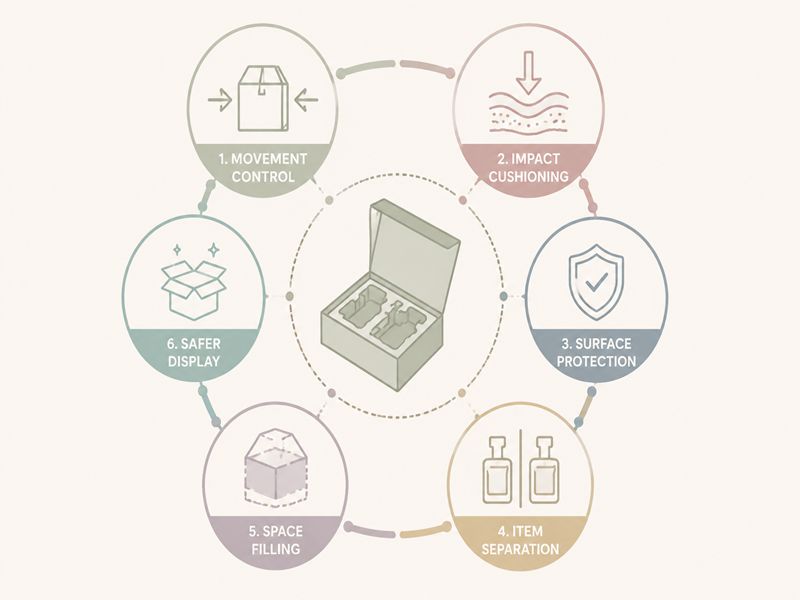
Why Inserts Matter for Fragile Products?
Factors you should consider:
- Movement Control
- Impact Cushioning
- Surface Protection
- Item Separation
- Space Filling
- Safer Display
Fragile products can break, scratch, or shift when spacing and support are poor. A fitted insert holds each item securely, cushions impact, separates accessories, and protects delicate surfaces.
It also makes perfume, candles, jewelry, cosmetics, watches, and ceramics look neater, safer, and more premium inside the Custom box.
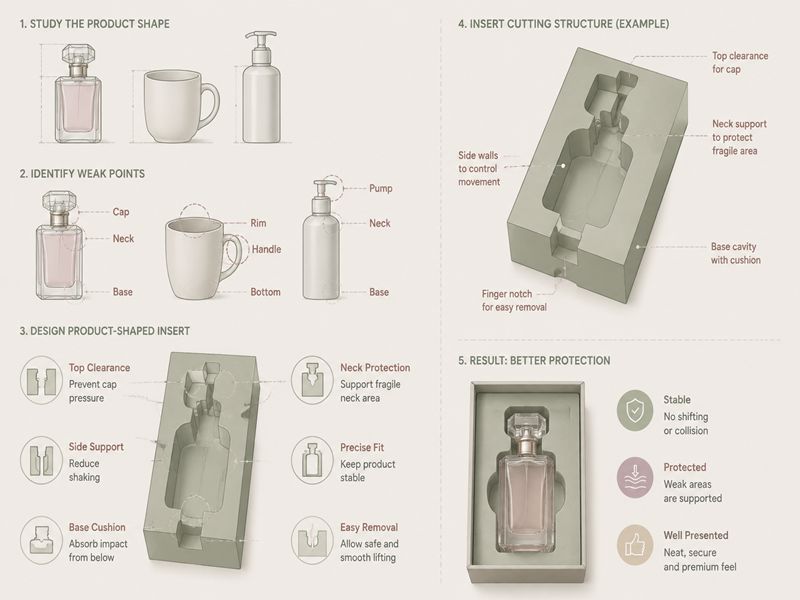
Start with the Product Shape
The best insert design always starts with the product itself. Before choosing foam, EVA, sponge, paperboard, molded pulp, velvet, or fabric lining, the product shape should be studied carefully.
A product-shaped insert should not only hold the largest part of the item. It should protect weak areas such as caps, handles, rims, pumps, and decorative parts.
Control Movement
Movement is one of the main causes of fragile product damage. A fitted insert keeps the item stable, reduces shaking, and prevents scratches, cracks, or label damage.
The product should fit firmly within the insert, staying stable without being overly compressed. If the box makes noise when gently shaken, or the product shifts from side to side, the insert needs adjustment. Good protection means the product stays stable during transport and still feels easy to remove.
Choose the Right Insert Material
Different insert materials offer different levels of cushioning, structure, appearance, and cost. The most suitable option depends on product weight, fragility level, surface quality, and overall brand positioning.
| Insert Material | Main Feature | Best For | Notes |
| Foam | Soft cushioning | Glass, ceramics, electronics | Strong impact absorption |
| EVA | Firm support | Perfume, watches, jewelry | Premium display |
| Sponge | Flexible cushioning | Ornaments, handmade gifts | Better for light items |
| Paperboard | Light structure | Skincare, candles, tea | Good for separation |
| Molded Pulp | Natural support | Jars, candles, ceramics | Needs surface check |
| Velvet / Fabric-Lined | Soft surface | Jewelry, perfume, watches | Often used as lining |
The right insert material should balance protection, appearance, and cost. For fragile products, structure and cushioning are more important than appearance alone.
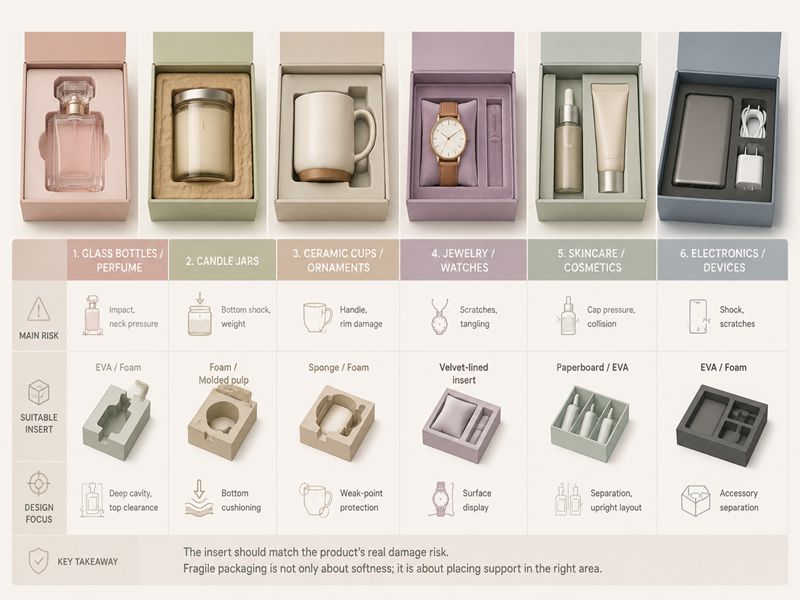
Match Inserts with Different Fragile Products
Different fragile products need different insert logic. A perfume bottle, candle jar, ceramic cup, watch, skincare bottle, and electronic device should not share the same protection method.
| Product Type | Main Risk | Suitable Insert | Design Focus |
| Glass Bottles / Perfume | Impact, neck pressure | EVA / Foam | Deep cavity, top clearance |
| Candle Jars | Bottom shock, weight | Foam / Molded pulp | Bottom cushioning |
| Ceramic Cups / Ornaments | Handle, rim damage | Sponge / Foam | Weak-point protection |
| Jewelry / Watches | Scratches, tangling | Velvet-lined insert | Surface display |
| Skincare / Cosmetics | Cap pressure, collision | Paperboard / EVA | Separation, upright layout |
| Electronics / Devices | Shock, scratches | EVA / Foam | Accessory separation |
The insert should match the product’s real damage risk. Fragile packaging is not only about softness; it is about placing support in the right area.
Consider the Outer Box Structure
Insert design should match how the box opens. Drawer, magnetic, hinged lid, book style, round, and collapsible boxes all create different movement and display needs.
| Box Structure | Opening Style | Insert Design Focus |
| Custom Drawer Rigid Box | Tray slides out | Prevent shifting during pulling |
| Custom Magnetic Rigid Box | Lid opens upward | Clean first impression and firm hold |
| Custom Hinged Lid Rigid Box | Lid opens like a case | Lid clearance and elegant reveal |
| Custom Book Style Rigid Box | Book-like opening | Layered display and ribbon lift |
| Custom Round Rigid Box | Lid lifts vertically | Prevent product rotation |
| Custom Collapsible Rigid Box | Foldable structure | Easy assembly and stable insert placement |
The insert should work with the box structure, not against it. Opening movement, lid depth, drawer sliding, and assembly method all affect product stability.
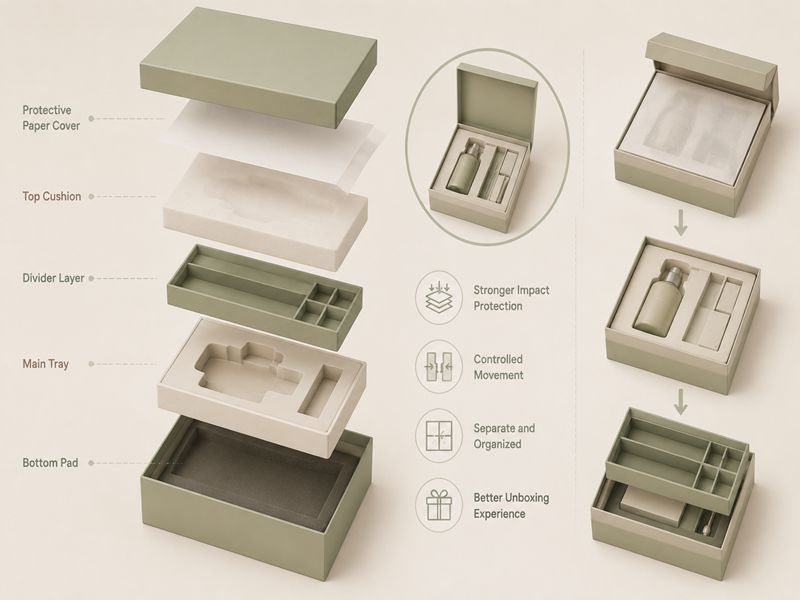
Use Layered Inserts for Extra Protection
Layered inserts improve both protection and presentation. A package can include a bottom pad, main tray, divider layer, top cushion, or protective paper cover. Bottom cushioning helps reduce drop impact, side support controls movement, and divider layers keep accessories away from the main product.
For gift sets, layered inserts also create a more organized unboxing experience. The main product can appear first, while cards, tools, samples, or accessories are placed underneath. The key is to keep the layers clear, simple, and easy to remove.
Think About Color and Presentation
Insert color affects the first impression. White or cream feels clean, black looks premium, grey feels modern, kraft looks natural, and pastel colors feel soft and friendly.
| Insert Color | Feeling | Best For |
| White / Cream | Clean, soft | Skincare, candles |
| Black | Premium, strong contrast | Jewelry, watches, perfume |
| Grey | Modern, versatile | Cosmetics, tech gifts |
| Kraft / Pulp | Natural, warm | Candles, lifestyle gifts |
| Pastel | Gentle, friendly | Beauty, handmade gifts |
For fragile products, the insert should show care and protection. Also consider lint, stains, dust, and material compatibility, especially for candles, cosmetics, or oily products.
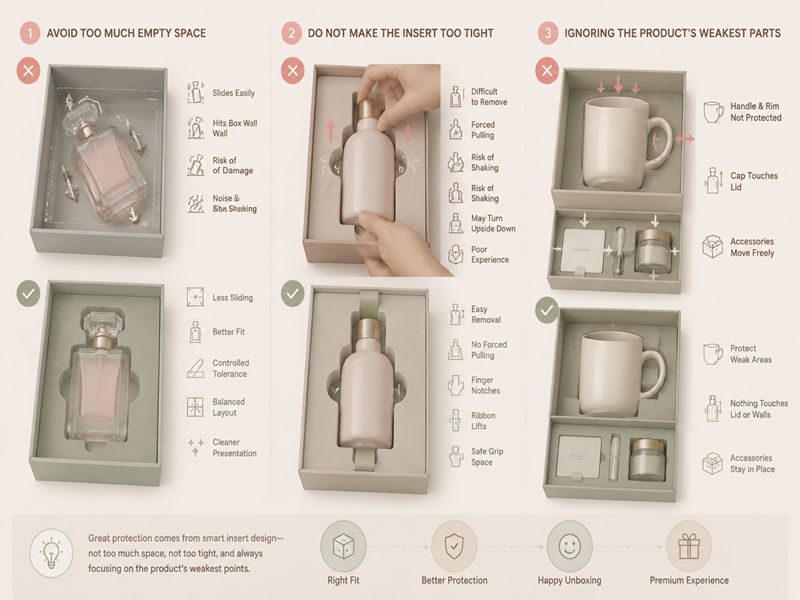
Common Insert Mistakes to Avoid
1. Avoid Too Much Empty Space
It allows:
- Less Sliding
- Better Fit
- Controlled Tolerance
- Balanced Layout
- Cleaner Presentation
Too much empty space does not mean better protection. It often allows the product to slide, tilt, and hit the box wall during transport.
A better solution is controlled spacing. The insert should fit closely enough to keep the product stable, while still allowing easy removal. For small products, Custom cavities, cards, accessories, or layered layouts can make the box look fuller and more premium.
2. Do Not Make the Insert Too Tight
It allows:
- Easy Removal
- No Forced Pulling
- Finger Notches
- Ribbon Lifts
- Safe Grip Space
A tight insert may look secure, but it can make the product difficult to remove. Customers may pull too hard, shake the box, or turn it upside down.
Fragile products should feel protected, not trapped. Candles may need side finger spaces, perfume bottles need exposed gripping height, watches may need removable pillows, and jewelry pieces may need soft lift tabs.
3. Ignoring the Product’s Weakest Parts
For example, a ceramic mug may look protected, but the handle may still be under pressure. A perfume bottle may look stable, but the cap may touch the lid.
Forgetting accessories is another mistake, Cards, tools, samples, cables, lids, or small gifts can damage the main product if they move freely.