
Quality inspection for a two piece rigid box needs to cover visual details as well as practical performance. Lid fit, box shape, edge wrapping, surface paper, printing, board strength, glue quality, insert fit, opening experience, and final packing all affect the final customer impression.
The Significance of Quality Control for Two Piece Rigid Boxes
1. Small Defects Change the Premium Feel
Two piece rigid boxes are used for products that need a stronger presentation than ordinary folding cartons. If the lid is loose, the edges are rough, or the surface has scratches, the package may feel less valuable.
This matters for rigid gift boxes, jewelry boxes, candle boxes, and rigid gift boxes with lids. Customers usually judge the product quality before they even see the item inside.
2. QC Helps Avoid Bulk Order Problems
Even when the approved sample looks fine, bulk production may still bring size deviation, color inconsistency, visible glue, or poor lid fit. Buyers should inspect samples and bulk goods using the same standards.
For custom printed rigid boxes, the inspection should cover both structure and surface appearance. A beautiful design still needs clean production to look premium.
QC Overview for Two Piece Rigid Boxes
| Inspection Detail | What to Check | Why It Matters |
| Lid and Base Fit | Lid tightness, smooth opening, stable closing | Affects the full unboxing experience |
| Box Shape | Square corners, flat panels, no deformation | Keeps the box premium and stable |
| Edge Wrapping | Clean edges, no lifting paper, no exposed board | Improves appearance and durability |
| Surface Paper | Scratches, dents, stains, bubbles, wrinkles | Directly affects customer impression |
| Printing Quality | Color, logo position, pattern alignment | Keeps brand image consistent |
| Board Thickness | Strength, hand feel, product support | Protects the product and improves value |
| Glue and Adhesion | No glue overflow, loose corners, or peeling | Prevents quality complaints after use |
| Insert Fit | Product position, removal space, insert stability | Keeps the product neat and protected |
| Opening Experience | Lid movement, resistance, sound, hand feel | Makes rigid box packaging feel premium |
| Final Packing | Carton strength, stacking, dust protection | Reduces damage during shipping |
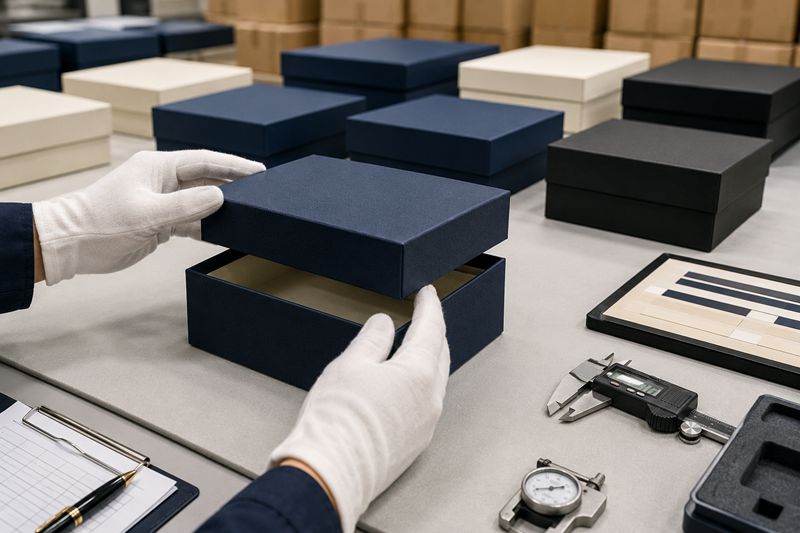
Detail 1: Lid and Base Fit
The lid and base fit is one of the first details customers notice when opening a two piece rigid box. The lid should move smoothly without feeling too tight or too loose.
Buyers should check:
- Smooth lid movement
• Slight opening resistance
• Stable closing effect
• Even lid coverage on all sides
• No shaking after closing
• Consistent fit across different cartons
For rigid gift boxes with lids, the best fit usually gives slight resistance when opening. If only one sample works well, the bulk order may still have size tolerance problems.
Detail 2: Box Shape Accuracy
A two piece rigid box should have a clean rectangular or square shape. The lid and base should sit flat on a table without obvious twisting or warping.
Shape details to inspect include:
- Square corners
• Flat top panel
• Straight side walls
• Stable bottom surface
• No twisting or warping
• Even lid and base alignment
• No visible deformation after stacking
Uneven panels can make the box look cheap, even when expensive wrapping paper is used. For premium rigid box packaging, a neat shape helps the product look more organized after opening.
Detail 3: Edge Wrapping Quality
Edges and corners are easy places to find quality problems. Buyers should check whether the wrapping paper is smooth, tight, and fully attached.
Common edge defects include:
- Exposed greyboard
• Lifted wrapping paper
• Cracked corners
• Uneven folding lines
• Loose seams
• Rough inner edges
• Visible glue near corners
A good rigid box maker should control edge wrapping during both manual and machine-assisted production. Clean edges make custom rigid boxes feel more durable and polished.
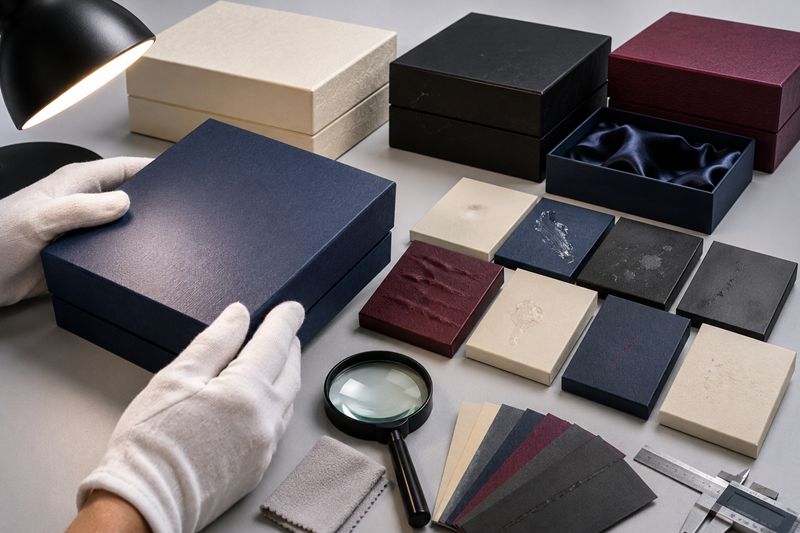
Detail 4: Surface Paper Condition
The surface of two piece rigid boxes should be clean because customers usually touch this area first. Scratches, stains, bubbles, dents, wrinkles, and glue marks can quickly reduce the premium feeling.
Surface defects to inspect include:
- Scratches
• Dents
• Stains
• Bubbles
• Wrinkles
• Glue marks
• Pressure lines
• Color marks
Custom printed rigid boxes need extra care because printed paper can show color marks or pressure lines more clearly. Matte lamination and soft-touch finishes may also reveal scratches under angled light.
Detail 5: Printing and Logo Position
Printing quality affects how customers see the brand. Logos, patterns, product names, and decorative lines should be clear, centered, and aligned with the box structure.
Branding details to compare include:
- Logo position
• Color consistency
• Pattern alignment
• Foil stamping location
• Embossing accuracy
• Debossing accuracy
• Spot UV registration
• Text clarity
For custom printed rigid boxes, color consistency matters across the full order. Before approving shipment, buyers need to check whether bulk boxes match the confirmed sample in size, color, structure, and finish.
Detail 6: Board Thickness and Structural Strength
Two piece rigid boxes usually use thick greyboard to create a firm hand feel. The board thickness should match the product weight, box size, and shipping method.
Strength details to confirm include:
- Board thickness
• Box size support
• Product weight capacity
• Hand feel firmness
• Stacking resistance
• Shipping pressure resistance
• No bending after product loading
Smaller jewelry boxes can use lighter board, while candle boxes, perfume packaging, and luxury gift sets usually need thicker material for better support. For rigid gift boxes, strength improves both protection and perceived value.
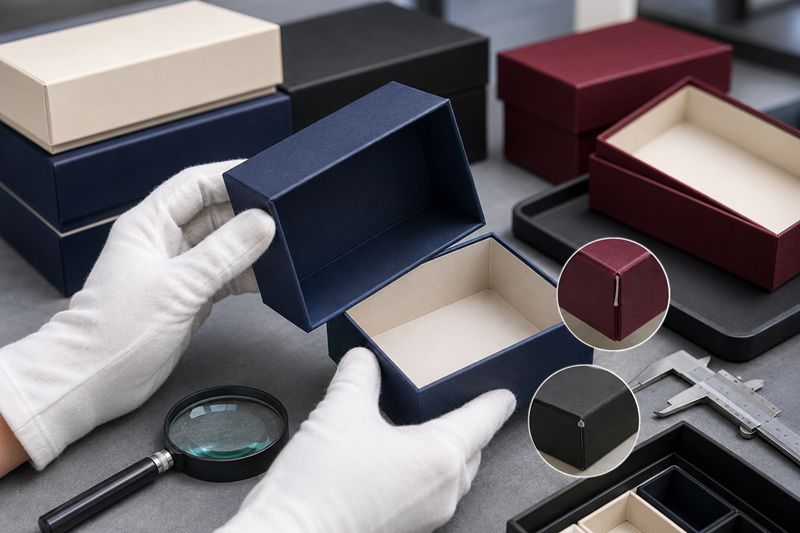
Detail 7: Glue and Adhesion
Glue quality is easy to ignore during sampling, but it affects long-term use. Loose corners, peeling paper, and glue stains can appear after storage or transport.
Glue areas to inspect include:
- Inside corners
• Bottom edges
• Lid folds
• Wrapped seams
• Inner wall joints
• Corner adhesion
• Surface glue overflow
A clean two piece rigid box should not have visible glue marks. The wrapping paper should stay flat and secure without bubbles, peeling, or lifting edges.
Detail 8: Insert Fit and Product Holding
Inserts help the product sit neatly inside the box. The insert should hold the product firmly but still allow customers to remove it easily.
Common insert options include:
- Paperboard insert
•EVA insert - Foam tray insert
- Velvet-covered insert
- atin-lined interior
- Molded pulp tray
- Fabric-covered insert
For rigid box packaging, the insert should be checked together with the actual product to confirm a secure and accurate fit. This is more reliable than checking only the box size or insert drawing.
Detail 9: Opening Experience
A two piece rigid box is not only a container. It is part of the customer experience.
Opening details to check include:
- Smooth lid movement
• Controlled resistance
• Stable base support
• Clean product reveal
• No rough friction
• No loose shaking
• Comfortable hand feel
This step is particularly useful for rigid gift boxes, jewelry packaging, candle boxes, and premium boutique sets. Although magnetic rigid boxes and rigid magnetic boxes use a different closure system, the opening action should still feel controlled and refined.
Detail 10: Final Packing and Shipping Protection
Even well-made boxes can arrive damaged if the final packing is poor. Buyers should check carton strength, stacking method, dust protection, and inner dividers.
Final packing should check:
- Carton strength
• Stacking direction
• Inner dividers
• Dust protection
• Moisture protection
• Carton weight limit
• Surface rubbing risk
• Export pallet planning
During international or long-distance shipping, two piece rigid boxes can suffer from crushing, scratches, corner damage, or shape deformation. This is also important for foldable rigid box and rigid collapsible box projects, because flat-packed boxes still need protection from pressure, moisture, and surface rubbing.
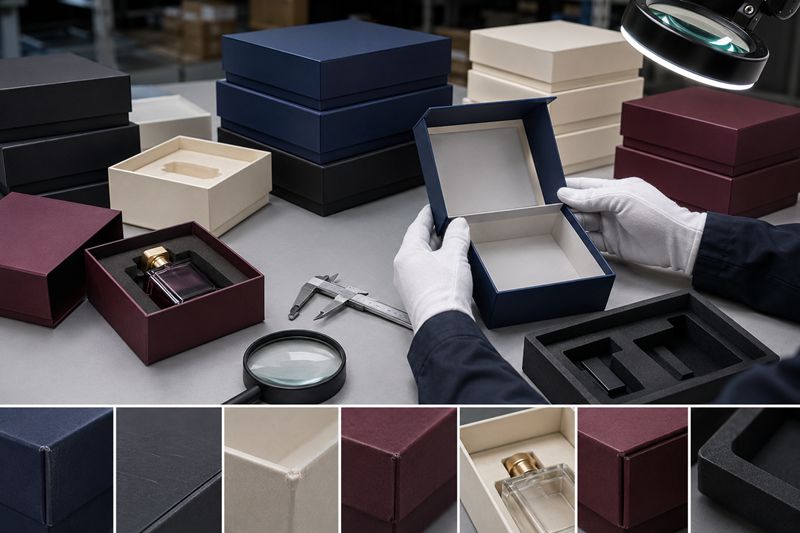
Quality Issues Buyers Often Miss
Some buyers focus mainly on the front surface, logo, and color. However, many quality problems appear in corners, inner walls, bottom edges, lid movement, and real product testing.
Often missed details include:
- Inner wall finishing
• Bottom edge wrapping
• Lid movement
• Insert removal space
• Product clearance
• Glue marks inside corners
• Surface scratches under angled light
• Bulk goods consistency
• Lid clearance with the real product
• Small shape differences after loading
A box with beautiful printing but poor lid fit may still create a weak customer experience. The safest method is to test the approved sample with the actual product before mass production.