
Achieving a stable and durable drawer rigid box is not simply a matter of aesthetics.
There are five key factors that determine the stability of drawer rigid boxes, including Material Quality and Board Thickness, Structural Design and Engineering Precision, Adhesive Strength and Manufacturing Precision, Drawer Fit, Sliding Mechanism, and Tolerance Control, Internal Support, Inserts, and Load Protection.
Overview Table
| Dimension | Key Factor | Stability Function |
| Material | Board thickness, density, moisture resistance | Improves strength and anti-deformation |
| Structure | CAD design, tolerance, reinforcement | Keeps sleeve and drawer stable |
| Bonding | Glue quality, curing, assembly accuracy | Prevents delamination and edge failure |
| Sliding | Fit, friction, ±0.5mm tolerance | Ensures smooth opening and prevents jamming |
| Inserts | EVA, pulp tray, dividers | Secures products and balances stress |
Custom drawer rigid boxes should be tailored according to different requirements.
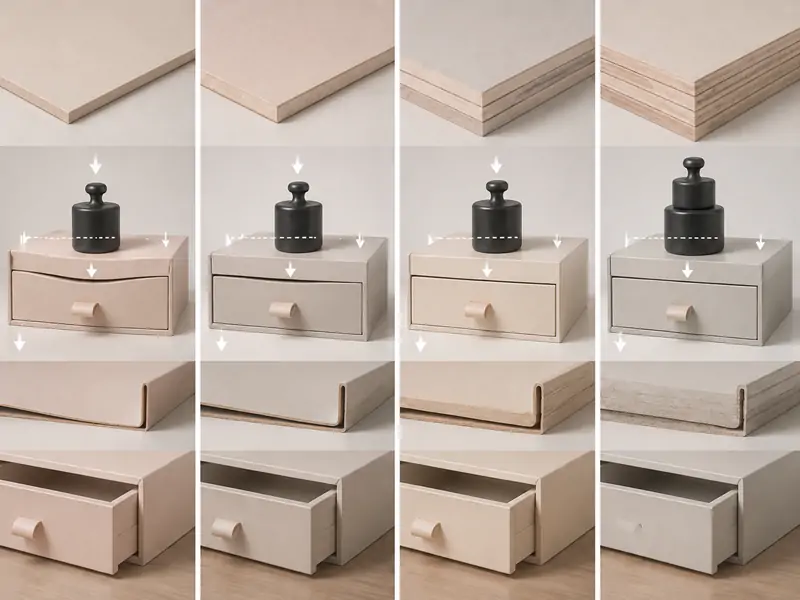
Factor1:Material Quality and Board Thickness
Drawer rigid box stability depends on material structure and board performance. The selection of grayboard, coated paper, or rigid board determines overall strength and durability.
Board thickness (1.5–3mm) is a key factor affecting compression resistance and rigidity. Insufficient thickness may cause deformation under stacking pressure, while excessive thickness can reduce sliding smoothness and increase friction.
Overview Table
| Greyboard Thickness | Typical Application | Stability Impact |
| 1.5 mm | Small lightweight boxes | Basic support; easier to deform under pressure |
| 2.0 mm | Standard gift boxes | Balanced rigidity, cost, and daily use stability |
| 2.5 mm | Premium drawer boxes | Stronger compression resistance and load-bearing |
| 3.0 mm+ | Heavy-duty luxury boxes | Maximum strength; requires precise sliding design |
Moisture resistance is critical for dimensional stability. Humidity absorption may lead to swelling, warping, and drawer misalignment. Laminated or coated surfaces help maintain stable performance under changing environments.
Higher-density board improves structural integrity, especially corner strength, ensuring a balanced combination of rigidity and smooth drawer operation.
- Materials:Grayboard,Coated paper, Rigid board
- Dimensions & Structure:1.5–3mm thickness,Density
- Performance Strength:Compression resistance,Corner strength, Sliding smoothness
- Environmental Resistance:Moisture resistance,Warping
- Surface Treatment:Laminated surface
Factor2:Structural Design and Engineering Precision
Drawer rigid box stability depends on precise structural alignment between the outer sleeve and inner tray. Any dimensional deviation can affect sliding smoothness and overall performance.
Structural reinforcement is needed in high-friction areas, especially corners, to reduce wear during repeated sliding. Load distribution must be even to prevent tilting or uneven stress on the drawer base.
CAD modeling and prototyping are often used to simulate structure and optimize precision before production.
Factor3:Adhesive Strength and Manufacturing Precision
Adhesive Strength and Manufacturing Precision provide transportation support for rigid boxes.It also affects the structural integrity and long-term performance of the box.
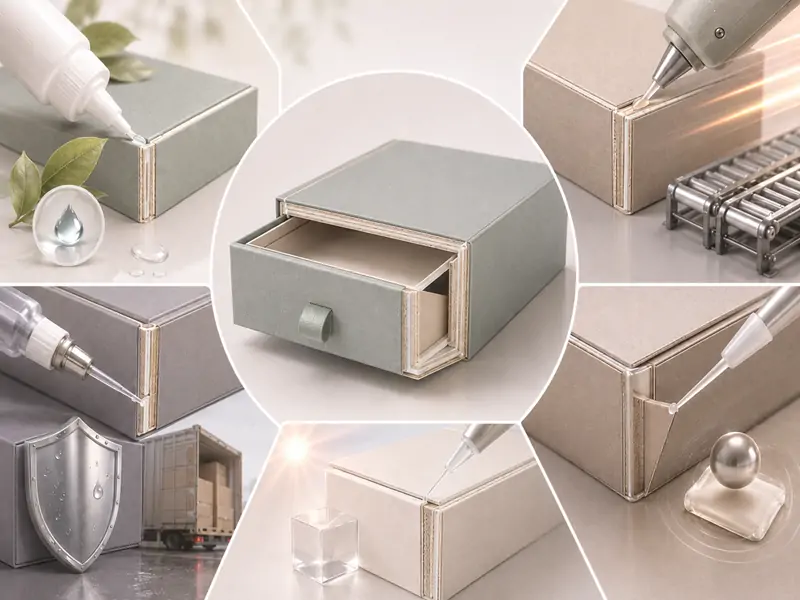
Selection of Adhesive
Adhesive strength directly affects the structural stability of drawer rigid boxes. High-quality glue ensures firm bonding between board layers, corners, and wrapped surfaces. Weak adhesion may lead to delamination, edge lifting, or structural failure during repeated use or transportation.
Overview Table
| Adhesive Type | Best For | Key Benefit | Stability Impact |
| Water-based | Eco / luxury boxes | Clean, low odor | Stable for light–medium use |
| Hot Melt EVA | Mass production | Fast, strong tack | Good for standard boxes |
| Solvent-based | Export / heavy-duty boxes | Strong, moisture resistant | Excellent for transport |
| PU Adhesive | Premium packaging | Flexible, durable | Prevents delamination |
| Acrylic Adhesive | Coated boxes | UV and aging resistant | Good long-term stability |
The selection of adhesives should take into account various conditions such as climate and transportation, rather than focusing solely on issues like slippage or detachment.
Control of Manufacturing Accuracy
Manufacturing precision also plays a key role. Uneven glue application creates weak bonding zones and air gaps, reducing durability. Controlled coating, accurate alignment, and proper curing time ensure consistent adhesion and long-term structural integrity.
Factor4:Drawer Fit, Sliding Mechanism, and Tolerance Control
This factor determines the user experience and overall structural stability of drawer rigid boxes, relying heavily on precision manufacturing and dimensional accuracy.
Tolerance Control
Tolerance control is critical for smooth sliding performance. Even small deviations can cause sticking, looseness, or unstable movement, affecting opening and closing feel.
Friction Control
Friction control affects sliding smoothness. Rough inner surfaces may cause resistance or inconsistency, while lamination, coating, or fine paper wrapping helps improve glide performance.
Structural Symmetry
Structural symmetry ensures balanced force distribution. Any misalignment can lead to uneven sliding, long-term deformation, or drawer tilt, especially in larger or heavier boxes.
Factor5:Internal Support and Load Protection
In premium packaging design, internal structure and load protection are often treated as equally important as external appearance.
Insert Structure
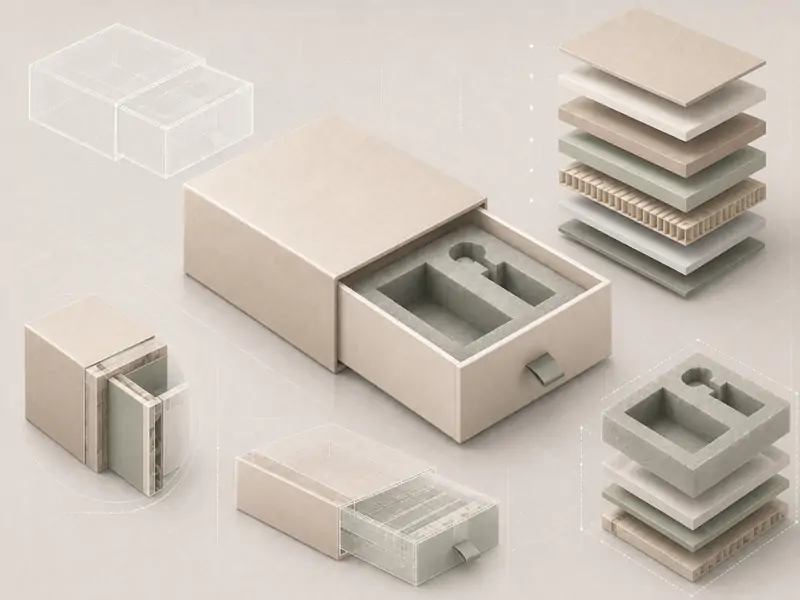
EVA foam / molded pulp / cardboard divider are commonly used to secure products inside the drawer box. These inserts reduce internal movement and improve overall packaging stability during transport and handling.
Different products require different levels of internal reinforcement. For example, jewelry and watches often require precision-cut EVA inserts to ensure zero movement, while cosmetic packaging may use lighter paperboard structures for eco-friendly positioning.
Load Distribution
Even weight distribution ensures the product pressure is spread across the drawer base. Poor distribution may create localized stress points, leading to structural deformation or tray imbalance over time.
Overview Table
| Dimension | Key Elements | Stability Effect |
| Insert Types | EVA, molded pulp, cardboard, velvet | Secures products and reduces movement |
| Product Stability | Vibration, shifting, pressure | Prevents damage and deformation |
| Applications | Jewelry, cosmetics, electronics | Matches protection to product needs |
| Load Distribution | Weight balance, base support | Reduces stress and structural failure |
| User Experience | Layout and visual alignment | Improves unboxing and brand value |
Before customizing drawer rigid boxes, the appropriate inserts or accessories should be selected based on the specific application scenario to enhance structural strength.
How to Solve Stability-Related Issues in Custom Drawer Rigid Boxes
When customizing drawer rigid boxes, buyers can improve overall stability and performance by making technical decisions early in the design stage. Proper planning helps reduce structural risks and ensures smooth production.
Useful stability-control solutions include:
- Select appropriate greyboard thickness based on product weight instead of usingthe thickest board by default.
- Optimize sleeve-and-tray tolerance to ensure smooth sliding without looseness or jamming.
- Use CAD structural design and prototyping to verify alignment and reduce dimensional errors.
- Choose suitable adhesive types (water-based, hot melt, or PU) based on durability and application requirements.
- Apply proper surface treatment to reduce friction and improve drawer sliding performance.
- Add reinforcement to vulnerable areas like corners and edges for better resistance to repeated handling.
- Design internal inserts according to product fragility to stabilize load and prevent movement.
- Control curing time and manufacturing precision to ensure consistent bonding strength.
- Test samples before mass production to identify structural or functional issues in advance.
Stability optimization does not mean over-engineering every component. The goal is to balance structure, function, user experience, and production efficiency while ensuring long-term durability and reliable performance.
How Should These Factors be Controlled in Different Application Scenarios?
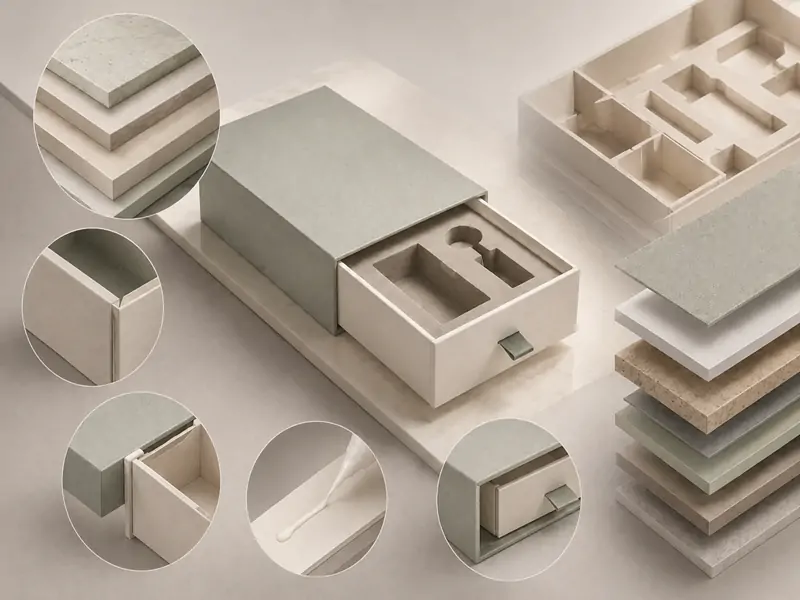
Luxury Cosmetics Packaging
Luxury cosmetics packaging requires a strong focus on visual presentation, tactile experience, and product protection. At the same time, structural stability must be maintained to prevent deformation during transportation and retail handling.
Overview Table
| Dimension | Solution | Purpose |
| Board | 2.0–2.5mm grayboard | Strength + smooth sliding |
| Surface | Coated / laminated paper | Better look + moisture resistance |
| Tolerance | Tight-fit design | Prevents jamming |
| Adhesive | Water-based / EVA / PU | Strong, durable bonding |
| Light Inserts | Molded paperboard | Eco, cost-effective protection |
| Fragile Inserts | EVA foam tray | Shockproof, precise fit |
Overall, the key for cosmetics packaging is to balance visual luxury, smooth usability, and moderate structural reinforcement.

Jewelry and Watches Packaging
Jewelry and watches represent high-value, fragile products that require extremely stable and precise packaging systems. In this scenario, internal protection becomes more important than external structure alone.
Overview Table
| Dimension | Solution | Purpose |
| Board | 2.5–3.0mm grayboard | Maximum strength and deformation resistance |
| Reinforcement | Corners + sliding edges | Reduces wear and improves durability |
| Adhesive | PU adhesive | Strong bonding, prevents delamination |
| Inserts | EVA foam / velvet tray | Precise fit and premium protection |
| Tolerance | ±0.3–0.5mm control | Smooth sliding with luxury feel |
Jewelry packaging prioritizes precision, zero movement protection, and long-term structural stability.
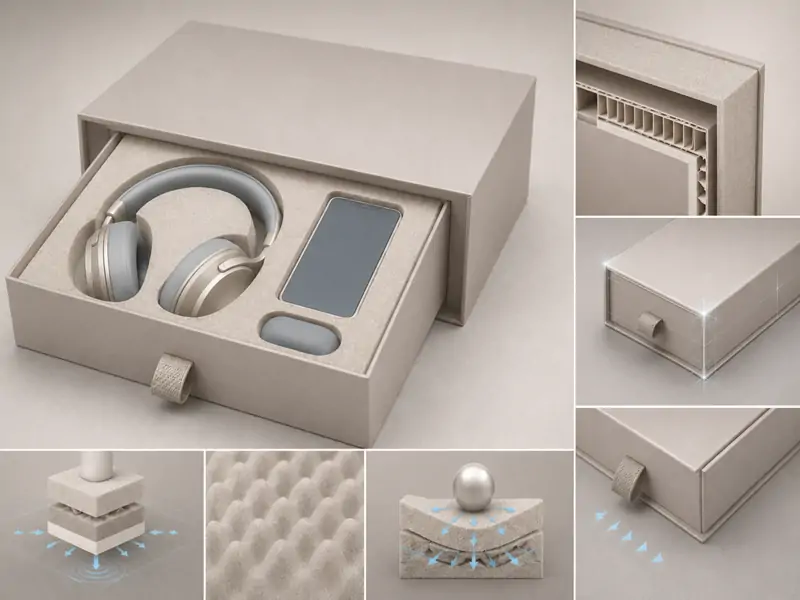
Electronics and Tech Products Packaging
Electronics packaging requires a balance between protection, structural strength, and functional accessibility.
Overview Table
| Dimension | Solution | Purpose |
| Board | 2.0–2.5mm reinforced grayboard | Supports weight and shipping vibration |
| Structure | Reinforced tray base | Prevents pressure deformation |
| Adhesive | Hot melt EVA / solvent-based | Maintains transport durability |
| Inserts | EVA foam / molded pulp | Absorbs shock and protects electronics |
| Sliding | Smooth-fit coated design | Ensures easy opening and low friction |
Electronics packaging focuses on impact protection, structural reinforcement, and functional usability.
Industrial and High-End Custom Applications
For industrial products or highly customized packaging solutions, requirements vary significantly depending on product type, weight, and environmental conditions.
Overview Table
| Dimension | Solution | Purpose |
| Board | ≥3.0mm reinforced board | Maximum heavy-duty strength |
| Adhesive | Solvent-based / PU adhesive | Strong bonding in harsh conditions |
| Support | Foam / modular inserts / partitions | Secures complex or heavy products |
| Load Design | Load distribution analysis | Prevents pressure concentration |
| Validation | CAD simulation + prototyping | Confirms stability before production |
Industrial applications focus on engineering precision, maximum durability, and environmental adaptability.