
A book-style rigid box is a particular kind of hinged box: its tray sits within a cover assembly that has a spine-like side. A standard hinged-lid box usually connects the lid more directly to the base. The useful difference is therefore the arrangement of the cover, hinge and tray—not simply whether the lid stays attached.
Seven Rainbow makes that distinction in its product range, listing standard attached lids, book-style constructions and shoulder-neck hinged formats separately. For a buyer choosing packaging for a fragrance, beauty tool or small gift set, those details change how the package closes, where the artwork folds and how much room the product needs during opening.
What Should You Look at Before Naming the Box?
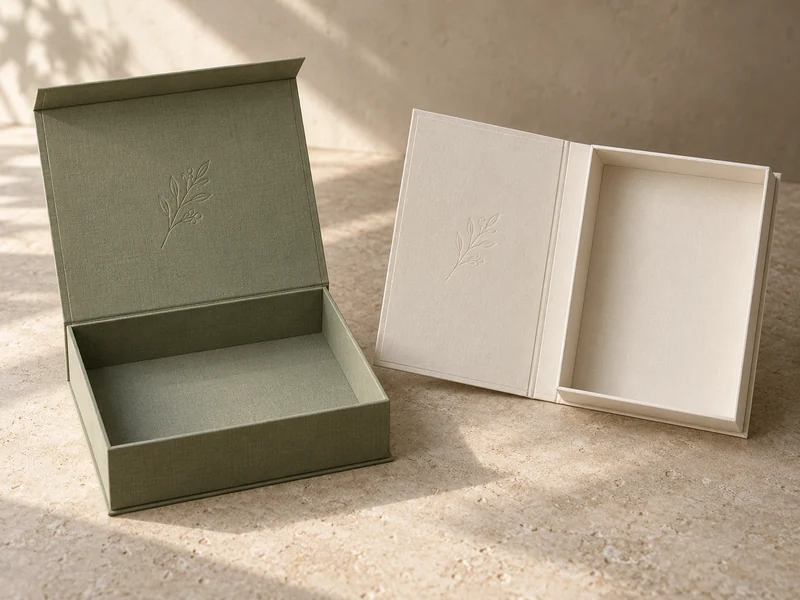
Look at the open side profile first. A closed sample can conceal the very feature you are trying to specify, particularly when both versions use the same textured paper and hidden magnets.
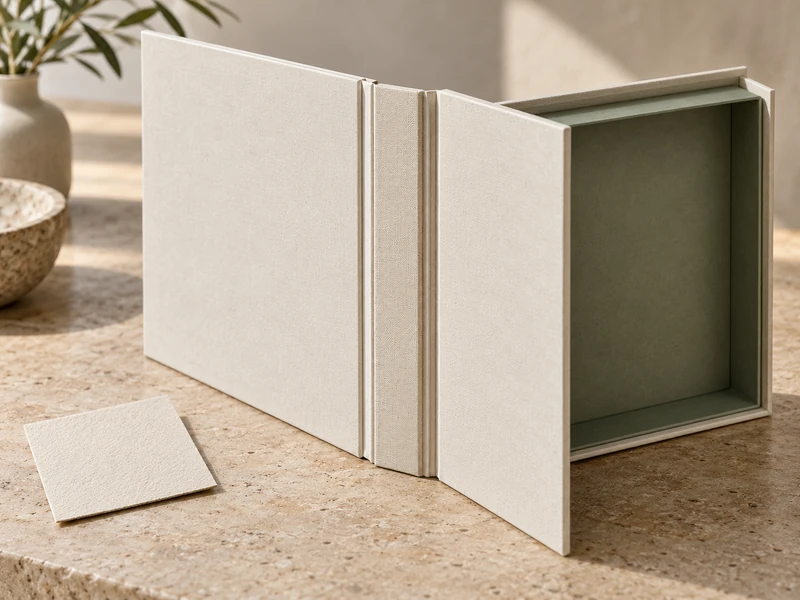
In a standard attached-lid construction, follow the rear edge from the base to the lid. In a book-style construction, look for a distinct spine zone and a tray mounted within the covering assembly. Neither description determines the closure: magnets, ribbon ties and other arrangements can be specified independently.
This is why a photograph labelled “magnetic gift box” leaves several questions unanswered. It tells you something about how the package stays closed, but relatively little about its underlying panel arrangement.
Seven Rainbow’s hinged-lid rigid box options include more than one opening architecture. Marking the requested version on an open-view reference is a better starting point than relying on a style name alone.
How Does the Construction Change the Opening?
A direct attached lid can produce a compact, contained reveal. The base remains the visual centre, while the lid rises behind it; depending on the design, lid walls may overlap or locate around the base.
A book-style assembly introduces a more pronounced cover-and-spine relationship. As the cover moves away, its inner face can become a separate visual surface beside the tray, giving room for a short fragrance note, a sequence of products or an understated printed illustration.
That extra surface is useful only if the intended opening position exposes it comfortably. A cover that looks attractive laid completely flat in a rendering may need more counter space than the retailer can spare.
Does a Book-Style Box Always Open Flat?
No. The opening angle depends on the panel layout, hinge allowances, wrapping material and any restraint built into the design. “Book-style” is not a promise of a particular opening angle.
If the box will be used as a display, tell the manufacturer whether the cover should rest beside the tray, stand behind it or simply move out of the way. Ask for that position to be demonstrated with the actual product inside, rather than approving an empty box held open by hand.
Which Parts Need Separate Dimensions?
For either construction, distinguish the usable tray cavity from the external box size. The product does not occupy the board thickness, wrapped edges or hinge space, even though all of them contribute to the finished dimensions.
For a book-style version, the brief should also identify the spine width, cover overhang and tray placement. A wider spine may suit a deeper tray, but its dimensions must follow the assembled layers rather than a visual guess.
| Detail to Confirm | Standard Attached Lid | Book-Style Assembly |
| Rear Connection | How the lid joins and clears the base | How the cover panels move around the spine |
| Product Space | Usable base cavity and lid clearance | Usable tray cavity and cover clearance |
| Closed Appearance | Lid overlap and edge alignment | Spine profile, cover overhang and tray position |
| Printed Interior | Visible inside-lid area | Inside-cover area and its relationship to the tray |
These checks become especially important with a tall cap or a sculpted tool head. A product may fit the cavity when the box is open yet interfere with the lid as it closes.
Include the removal movement, too. A bottle that can only be lifted by its cap may need a finger recess or a revised insert, even when the cover and tray are otherwise correctly proportioned.
Why Does the Hinge Material Matter So Much?
The hinge must bend while the adjacent board panels remain rigid. Changes to covering paper, lamination, lining and adhesive can therefore affect the same structural layout differently.
Seven Rainbow offers textured papers, soft-touch finishes and several rigid-board options. Those choices should be sampled as an assembly: a paper selected for a beautiful broad surface may behave differently where it repeatedly folds over a narrow hinge channel.
Watch the hinge while opening the sample slowly. Look for local whitening, lifting at the paper edge, bunching of the lining or a cover that pulls the tray out of position.
Do not solve every tight hinge by enlarging the gap. Excess space can make the spine look loose, expose an untidy channel or shift the relationship between the cover and base.
Where Should the Branding Sit?
Start with the surfaces a customer actually sees in sequence: closed cover, opening edge, inner cover and product tray. A restrained design can feel richer when each surface has a clear role.
On a book-style format, continuous artwork crossing the spine needs particular attention. The image crosses folds and changes direction, so a fine border or a tiny line of type can make a small alignment variation conspicuous.
A botanical motif, broad colour field or deliberate blank spine may be more forgiving. Keep critical lettering away from hinge channels unless the production sample shows that it remains legible and correctly positioned.
Seven Rainbow’s rigid box artwork checklist is a useful next step once the structure has been agreed. Artwork should be built on the approved construction, rather than used to hide unresolved panel dimensions.
Does a Magnetic Closure Make Either Version Stronger?
A magnetic closure helps hold matching surfaces together; it does not automatically strengthen the hinge, secure the insert or protect a glass bottle. Its effect depends on placement and on the structure carrying the load.
Check the opening force with the product fitted. An aggressive closure can encourage the user to jerk the cover, while a weak or poorly aligned closure may leave the front edge sitting proud.
For a heavy gift set, also consider what happens when someone carries the package by the cover. The tray attachment and base support deserve attention even if the magnets close with a satisfying click.
Shipping suitability needs a separate assessment of the packed product and its transport packaging. The ISTA test-procedure guide distinguishes early integrity screening from distribution simulation; selecting an appropriate assessment requires knowing how the finished pack will travel.
Which Structure Suits Your Product Presentation?
Choose a straightforward attached lid when the brief calls for a compact reveal focused on the base cavity. Consider a book-style cover when the spine profile and the relationship between the inner cover and tray contribute something specific to the experience.
For example, a fragrance set might place the bottle in the tray and a concise scent introduction inside the cover. A beauty-tool kit may benefit more from immediate access and a cover position that leaves both hands free to remove the tool.
These are design directions, not fixed rules by product category. Seven Rainbow’s custom book-style rigid boxes can be developed around different tray layouts, finishes and accessories, so the decision should follow the intended use.
If surface texture is central to the brief, the article on tactile perfume packaging offers a complementary way to think about the material experience. Structure should establish the movement before finishes give that movement its character.
How Will the Box Be Used After the First Opening?
Consider the package on a dressing table or retail counter, with the cover moving repeatedly around nearby objects. A broad book-style cover needs a different clear area from a compact lid that rests behind its base.
If the insert will be removed for reuse, examine the uncovered tray as well. Exposed attachment areas, an unfinished base or an awkward cover balance can undermine an otherwise thoughtful design.
Discuss those intentions during sampling. A storage role may justify an interior finish or a revised restraint detail, whereas a display role may put greater emphasis on the cover’s resting position.
What Should You Approve Before Production?
Ask for an open view, a closed side view and a sample containing the real product. Together they reveal more than a polished front-facing image.
- Confirm the tray cavity and product-removal space.
- Agree on the intended opening position and hinge behaviour.
- Check cover alignment, spine appearance and closure force.
- Review wrap and lining performance across the moving areas.
- Record the accepted sample and any remaining revisions.
Use the appropriate stage in Seven Rainbow’s white, printed and pre-production sample process to settle each question. A white sample can establish geometry, while the finished material combination needs its own review.
A clear request might read: “Book-style rigid box with a separate spine zone, mounted tray, hidden front closure and an inner cover intended for printed storytelling.” That sentence gives the sampling team considerably more to work with than “luxury hinged box.”