
A rigid candle box protects a glass jar through a coordinated system: support beneath the base, control around the body, separation from hard surfaces and a suitable transport pack outside the retail presentation. The five structural approaches below address different parts of that system; none should be treated as a universal guarantee against breakage.
Seven Rainbow offers candle packaging with custom inserts and several rigid-box formats. For a glass jar, choose the internal support concept before concentrating on foil, texture or the opening flourish, because the loaded jar determines what the construction must carry.
Can a Fitted Collar Control Sideways Movement?
A fitted collar can locate the jar body and reduce movement within the cavity. Its opening should follow the jar’s relevant dimensions while leaving suitable access for removal.
Locate the contact around a robust body area rather than assuming the glass rim or decorative lid is the best restraint point. A tapered jar may need a different collar profile from a straight-sided tumbler.
The collar also needs support beneath it. A neat circular opening in a thin sheet can look convincing from above while flexing or dropping under the loaded jar.
Within Seven Rainbow’s custom rigid candle box range, ask the sampling team to show the collar as a complete folded or supported assembly. The unseen structure is part of its function.
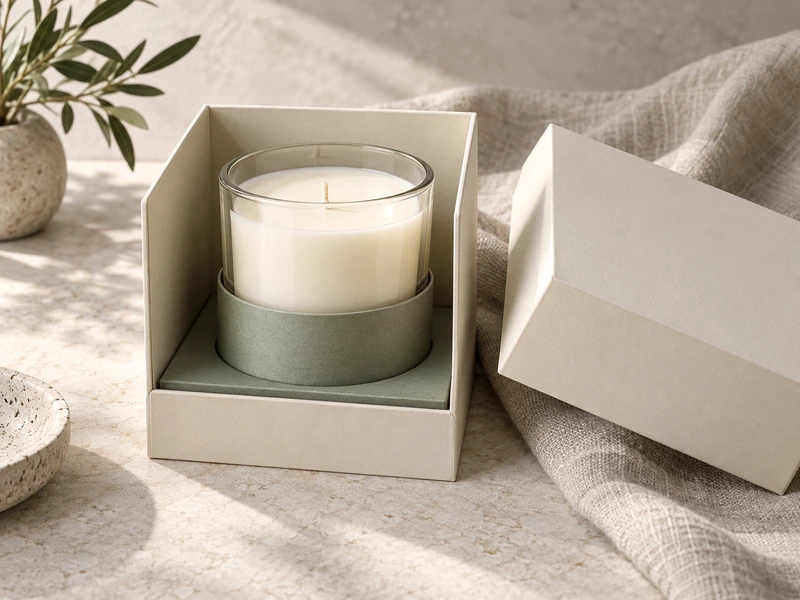
What Should the Collar Sample Demonstrate?
Place the actual filled jar into the cavity and check whether the collar distorts, scratches a finish or allows rocking. Confirm that normal removal does not require pulling on a loose candle lid.
A finger recess may be needed at the jar body. Add it where it gives a useful grasp without removing so much support that the jar can move sideways.
Does a Raised Base Platform Protect the Jar Bottom?
A raised platform can separate the glass base from the outer box floor and create room for a designed support structure beneath it. Its performance depends on material, geometry and the load it carries.
Do not confuse a raised presentation surface with an effective cushioning system. A rigid spacer may improve positioning while transmitting substantial force unless the surrounding design addresses impact behaviour.
For a heavy jar, examine the platform’s unsupported spans and folded walls. The jar should not sit on a narrow bridge that gradually sags or collapses during handling.
As an illustrative concept, a folded paperboard platform might support the jar on several load paths while keeping it centred within the box. The actual dimensions and material must be developed around the jar and assessed in the finished pack.
How Does It Affect the Outer Box?
Raising the jar consumes vertical space and changes lid clearance. Check the complete stack, including any candle lid, collar, liner and instruction card.
Increasing the outer height should follow a support review, rather than serve as the first reaction to a tight stack. The platform, collar and cover should be proportioned together so useful support does not become unnecessary empty height.
When Is a Formed or Shaped Cradle Useful?
A shaped cradle can support selected areas of an irregular or heavy jar. It may be useful when a simple circular collar cannot adequately control the product’s profile.
Possible concepts include formed fibre, folded paperboard or a shaped foam-based insert, subject to the project’s material requirements. Each should be evaluated for how it contacts the jar and responds to loading.
Material names alone do not establish performance. Density, thickness, support area and the complete geometry all influence the result.
Keep visible contact surfaces compatible with the jar’s decoration. A label, painted finish or metallic surface may require a different interface from plain glass.
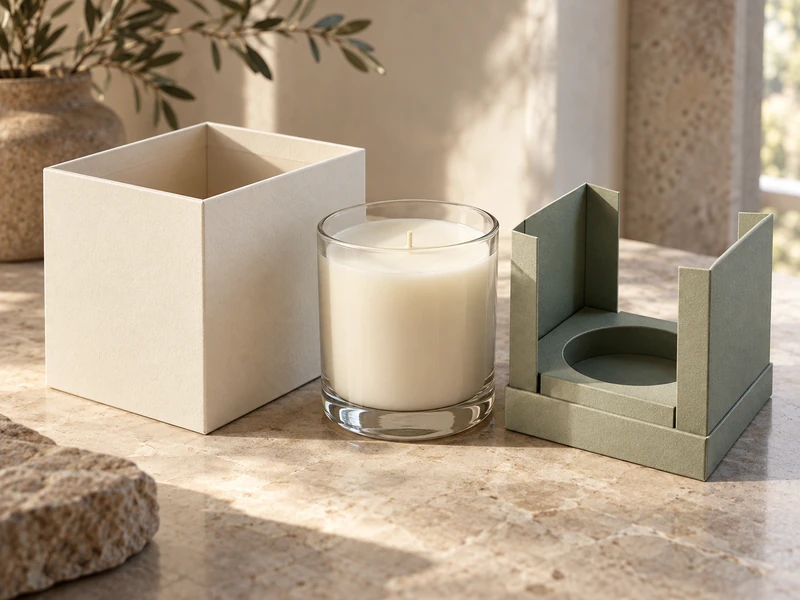
Can a Multi-Point Insert Separate the Jar From Accessories?
A gift set needs defined compartments so that accessories cannot strike the glass. A wick trimmer, match container or diffuser bottle should not share an uncontrolled void with the candle.
Use the insert to establish both individual location and separation between items. Check whether a divider is supported along its height or can fold towards the jar under movement.
For several candle jars, avoid relying on the outer rigid walls as the only separation. Each jar should have a clear position that remains meaningful when the package is tilted.
Seven Rainbow’s candle and diffuser gift-box article explores a coordinated presentation. The structural version of that idea is equally important: the products should tell one story while occupying separate, controlled spaces.
What if the Set Uses a Drawer?
A drawer rigid box introduces a moving tray beneath the load. Confirm that the insert does not bow into the sleeve and that the tray remains controllable as it extends.
Check drawer retention independently from jar restraint. A perfectly fitted candle insert does not stop the entire loaded tray from sliding out of an unrestrained sleeve.
How Should the Retail Box Work With an Outer Shipping Pack?
The retail rigid box and the shipping pack should be designed as a system. The outer carton, cushioning and arrangement inside it must suit the distribution route and the filled retail package.
A premium wrapped box may protect the presentation and help locate the jar without being a complete parcel-shipping solution. Leaving it loose inside a large corrugated carton creates another uncontrolled movement around an otherwise careful insert.
Define whether the candle ships individually, in a multipack or on a pallet. Those conditions can require different transport arrangements even when the retail box stays the same.
The ISTA test-procedure overview distinguishes screening methods from tests representing distribution environments. Choose a relevant assessment with the testing provider rather than assuming one drop demonstration proves every shipping route.
How Do These Five Approaches Work Together?
They address different paths through which movement or loading can reach the glass. Several may be combined, but each added component should have an identifiable role.
| Structural Approach | Main Design Task | Key Limitation to Check |
| Fitted Collar | Locate the body laterally | Contact pressure and support beneath the collar |
| Raised Platform | Support and separate the base | Load capacity and actual impact behaviour |
| Shaped Cradle | Support a specific jar profile | Material performance and surface compatibility |
| Separated Compartments | Keep products from contacting one another | Divider movement and accessory escape |
| Outer Shipping System | Address distribution hazards | Fit and validation of the complete pack |
A larger quantity of packaging is not necessarily a better solution. The useful question is whether the support and separation remain effective under the loads the pack will encounter.
Which Jar Details Should Be Sent for Sampling?
Provide the filled weight, maximum dimensions, base shape, taper and lid arrangement. Include details of any fragile decoration or surface that should avoid contact.
Supply representative jars and explain how they will be packed and transported. If breakage has occurred before, photographs of the damaged jar and surrounding packaging can help identify the relevant contact or movement.
Do not infer the failure mechanism solely from the crack location. The assessment should consider the whole package, including how the jar was supported and where other components moved.
For smaller sets, Seven Rainbow’s mini candle discovery box article gives useful presentation context. A small jar still needs its own support review; reduced size does not make loose glass-to-glass contact acceptable.
How Should a Failed Sample Be Revised?
Record what moved, where contact occurred and which support changed shape. A useful revision responds to those observations rather than simply adding a thicker material everywhere.
If the jar rocks, review the locating geometry. If the platform collapses, review its load paths and material; if two products meet, revise separation and restraint. An insert may lose base support and lateral control during the same handling event, so inspect both before choosing a revision.
Keep the jar and shipping configuration consistent when comparing a revised sample with the previous version. Otherwise, a change in product weight or outer cushioning can obscure whether the retail insert improved.
Agree with the testing provider which changes require another assessment. The final approval should correspond to the actual combination that will be manufactured, packed and shipped.
Retain photographs and a short description of each revision. That history is particularly useful when a later seasonal set introduces a heavier jar into a familiar-looking box.
What Should Approval Include Beyond an Attractive Open Box?
Review packing, lifting, replacement and closure with the final components. Inspect the jar surfaces and insert after the agreed handling checks.
Use Seven Rainbow’s sample-development stages to resolve structural questions before approving the finished artwork. Record the jar and insert versions so later changes can be assessed against a clear reference.
The finished package should make protection feel unobtrusive: a jar held calmly in place, enough room to lift it and no loose parts competing for space. That appearance becomes credible when the hidden supports and the shipping system have been designed with equal care.