
A mini candle discovery gift box becomes a guided experience when each fragrance has a clear identity, the assortment follows an understandable theme, and the recipient can explore it at their own pace. A simple map connecting the jars, their positions and a short guide turns a row of small candles into a collection. The aim is to invite discovery without making the gift feel like an examination.
Think of the box as a small shelf of possibilities. Someone may begin with a familiar scent, follow the suggested route, or save one candle for another week. Good packaging supports all three choices while making it easy to remember which fragrance is which.
What Gives a Discovery Set a Reason to Exist?
A discovery set needs a unifying question, not simply several miniature products. That question might be “Which garden note feels most familiar?” or “How does this collection move from bright citrus to warm wood?” The answer becomes the theme that connects the assortment.
Seven Rainbow’s candle gift box formats include mini and multi-candle combinations, providing a relevant starting point for this kind of presentation. The design task is to give the assortment a readable identity. Smaller vessels alone do not explain why the fragrances have been grouped.
Choose a Theme With Enough Contrast
A collection based on one broad setting can still contain distinct personalities. An illustrative garden set could move through citrus peel, green leaves, soft petals and dry wood. These are hypothetical fragrance directions, not a claim about any existing candle formulation.
Too much similarity can make the written descriptions repetitive, while unrelated themes can leave the assortment feeling accidental. A useful middle ground is one setting with several recognisable details. The package then helps the recipient notice those details without declaring which scent they ought to prefer.
Let the Number of Candles Serve the Story
The assortment size can grow from the particular story being told, with each additional candle introducing a distinct part of that story. A compact trio can tell a simple progression, while four candles can represent contrasting facets of one theme. More items need more navigation space and more time from the recipient.
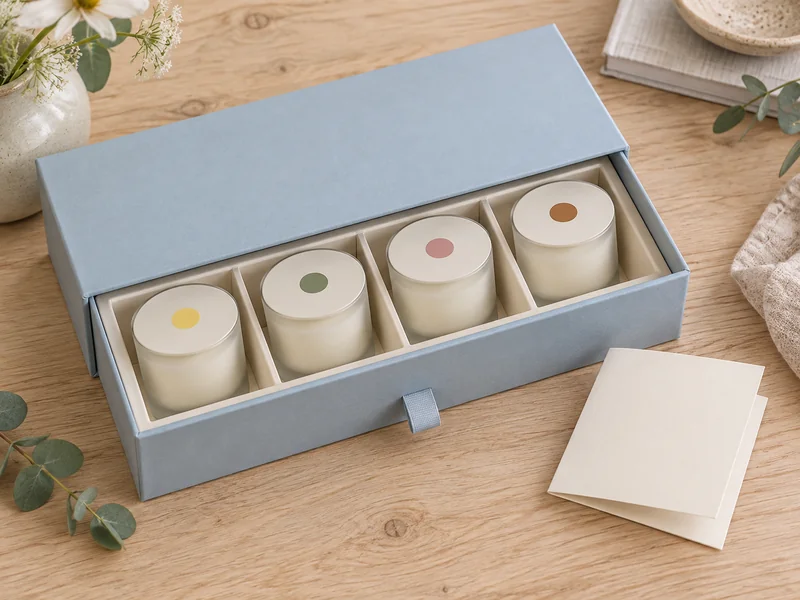
For the four-candle example in this article, each fragrance receives the same physical space and a separate identity. Equal presentation suggests that every scent deserves a moment of attention. It avoids making the last jar look like a bonus tucked into spare room.
How Can the Box Make the Collection Easy to Navigate?
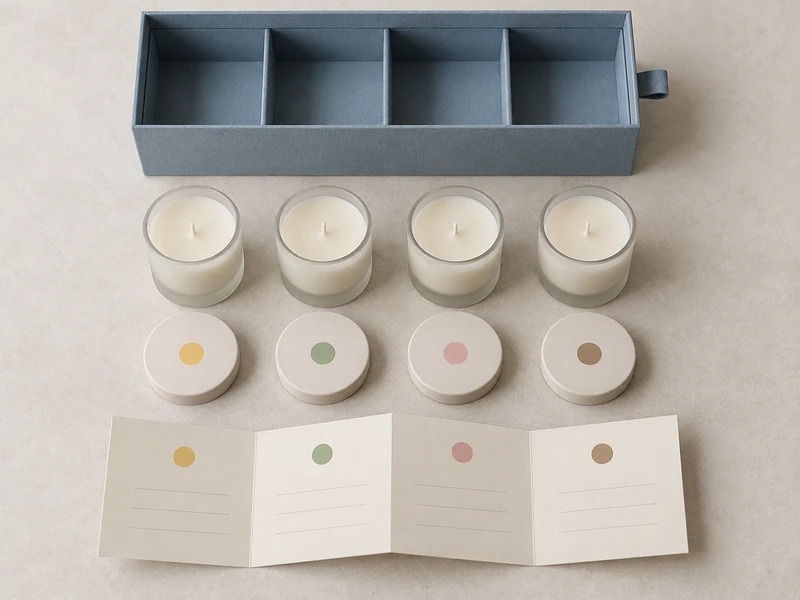
Use a consistent mapping system across the vessels, tray and guide. A fragrance name paired with a simple number or symbol is more useful than a colour alone, especially when the recipient removes several jars from the box.
A muted colour can still provide a quick visual cue, but it should support readable names. The same cue should remain on the vessel, not only on its removable lid. Otherwise, setting the lids aside breaks the connection that the packaging was meant to establish.
A drawer rigid box can reveal a row of candles progressively as the tray slides out. Keep the identities visible once the tray is open, and make the pull direction obvious. The movement should introduce the collection, not hide the information needed to use it.
A Four-Part Map for an Illustrative Garden Collection
The following map is a writing and layout example. The descriptive words would need to reflect the actual fragrances in a real collection; they are not a universal scent classification or an instruction to burn the candles in this order.
| Collection Chapter | Guide Prompt |
| Citrus Peel | What feels bright or sharp to you? |
| Green Leaves | Which leafy detail comes to mind? |
| Soft Petals | Does this suggest a familiar flower? |
| Dry Wood | What kind of warm setting do you imagine? |
These prompts invite personal language rather than a correct answer. A recipient who writes “my grandmother’s hallway” has engaged with the gift just as meaningfully as someone who uses a fragrance vocabulary. Leave enough blank space for that kind of response.
What Belongs on the Scent Guide?
A useful guide answers three questions quickly: what is in the box, how can I recognise it, and where can I record an impression? Keep those functions separate from the detailed product instructions so that neither becomes lost in decorative copy.
- Collection introduction: one short explanation of the shared idea.
- Fragrance identity: the exact name and matching symbol used on the vessel.
- Descriptive cues: a few accurate notes supplied by the candle brand.
- Personal space: a small area for a memory, impression or favourite occasion.
- Care direction: a clear reminder to read the individual candle instructions.
A foldout can place the whole collection side by side, while individual cards allow a recipient to keep one note with one candle. Choose the reading experience that fits the story. Several loose cards may be charming, but they become frustrating if the names and jars cannot be matched quickly.
The guide to gift box insert cards offers background on organising these different information types. For a discovery set, the strongest use of the card is often to make participation easy. A long brand history can wait until after the recipient has met the fragrances.
How Could Someone Explore the Set at Home?
Offer a flexible route with a clear pause between discovery and use. The recipient can read the guide and identify the candles first, then enjoy individual fragrances on separate occasions according to their instructions. Opening day can be devoted entirely to meeting the collection on paper, leaving the actual candle experiences for later moments chosen by the recipient.
- Meet the collection. Read the short introduction and locate the name on each jar.
- Choose a starting point. Follow curiosity or the optional route printed on the guide.
- Make room for one experience. Remove the chosen candle from its packaging and prepare it as its maker directs.
- Record a personal impression. Note a setting, association or descriptive word after the experience.
- Return another day. Keep the guide with the remaining collection so the next choice feels connected.
This sequence is an invitation, not a performance test. The gift does not need a score sheet, winner or fixed timetable. Someone who discovers only one favourite has still found something useful.
Keep the physical box and paper guide away from a burning candle. The National Candle Association’s candle safety advice calls for a stable, heat-resistant surface away from combustible materials and attention while the candle burns. The tray is for presenting the set, not a stand for using it.
Which Small Design Details Keep the Experience Comfortable?
Clear access, durable identification and restrained decoration support repeated visits to the collection. The recipient should be able to remove one candle, recognise it outside the box and return to the guide without reconstructing the original arrangement.
Finger access beside the vessels matters more here than a perfectly uninterrupted tray surface. A pull tab should be easy to distinguish from decoration, and a card pocket should reveal enough of the guide to show that it is removable. These details quietly tell the person what to do next.
Seven Rainbow’s overview of drawer rigid box styles shows how opening arrangements can vary. For a discovery experience, the most relevant feature is how comfortably the whole assortment becomes visible. Elaborate movement is useful only when it helps introduce the contents.
The interior also needs to respect the vessels as separate objects. The article on common rigid box inserts explains different approaches to supporting and separating contents. In a multi-candle layout, a clear individual place for each jar also makes the collection easier to read.
Questions That Often Shape the Experience
Must the Candles Be Explored From Light to Rich?
No; that can be an optional editorial route, but it should not be presented as a rule that every fragrance follows. Descriptions such as “light” or “rich” are contextual, and personal impressions differ. A clear starting suggestion is helpful; permission to choose another is equally useful.
Can Colour Replace the Fragrance Name?
Colour is best used as a supporting cue. Names or symbols preserve the connection when colours look similar, lighting changes, or the recipient finds colour distinctions difficult. Consistency between the jar and guide matters more than the number of colours used.
Does a Discovery Gift Need a Favourite at the End?
No; a favourite can emerge naturally, but the collection can also become a record of different occasions. A space labelled “When I would enjoy this” gives the recipient another way to respond. With that invitation, the recipient can imagine a place for several fragrances in everyday life instead of feeling obliged to select a single winning candle.
What Makes the Collection Memorable After the First Opening?
A memorable discovery box leaves a simple trail from each candle to a name, a story and a personal impression. The tray provides order, the guide provides context, and the recipient supplies the meaning. When those roles stay clear, a small assortment can support many separate moments without needing a complicated package.