
Protect long diffuser reeds in their own straight, supported compartment, separated from the bottle and clear of the closing lid. Restrain the bundle gently so it cannot slide into an end wall. The reeds often determine the box footprint even when the bottle appears to be the main product.
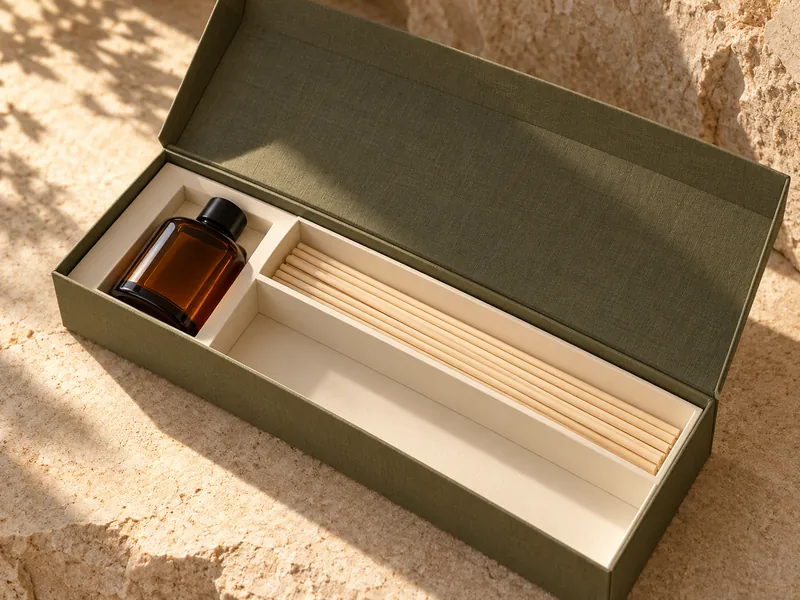
SevenRainbowpack’s candle packaging range includes candle-and-diffuser sets with bottles and reeds, making this a layout issue as much as a protection issue. A compact bottle seat can be well resolved while the long accessory is left across a gap or tucked diagonally into spare space. Draw the reed compartment at the same time as the bottle cavity.
Start With the Longest Reed, in Its Packed Form
Measure the actual reed bundle, including its sleeve, end protection and keeper if these will be supplied. Record the longest piece rather than relying only on the nominal cut length. Also establish whether the reeds are natural rattan, another plant material or manufactured fiber.
Those materials can differ in stiffness, surface feel and response to packing pressure. Confirm the handling expectations with the reed supplier. Do not assume that a bundle which springs back after one bend will remain straight after storage and shipment.
- Record maximum packed length and bundle cross-section.
- Keep any supplied sleeve or band in place while measuring.
- Note decorative tips or uneven ends that need separate clearance.
- Identify which reed lengths share the same gift-box format.
Then measure the usable internal route in the assembled box. Wrapped walls, dividers and end folds reduce the space available to the bundle. An outside dimension greater than the reed length does not prove the compartment is long enough.
Where Should the Reed Channel Sit?
Along a straight edge beside the bottle is usually the clearest first layout to explore. It gives the bundle a defined route and lets the customer recognize it immediately. The bottle and reed compartments can share a visual language without sharing their load-bearing surfaces.
SevenRainbowpack’s candle and fragrance gift-box options include rectangular formats for mixed sets. Use that flexibility to compare the bottle beside the reeds with a supported arrangement on another level. Neither arrangement should leave the bottle resting on the bundle.
A diagonal position can look economical on a sketch but introduces awkward corners and a less obvious lifting direction. If it is being considered, examine the full bundle envelope and both ends in a physical sample. Do not bend the reeds to make the diagonal drawing fit.
For the wider presentation of two fragrance products, our article on candle and diffuser gift boxes looks at the shared story. Here the structural priority is keeping the long component straight while the heavier pieces remain independently located.
Support the Length, Then Add Gentle Retention
A continuous shallow trough gives the bundle a resting surface across its length. Add broad keeper bands or another suitable restraint to limit migration. Two narrow ties suspended over an empty gap provide a different, less forgiving support condition.
Check the trough itself for stability. A long folded paper component can bow, lift at one end or collapse where it bridges a bottle cavity. Support its underside or revise the surrounding construction rather than asking the reeds to hold it straight.
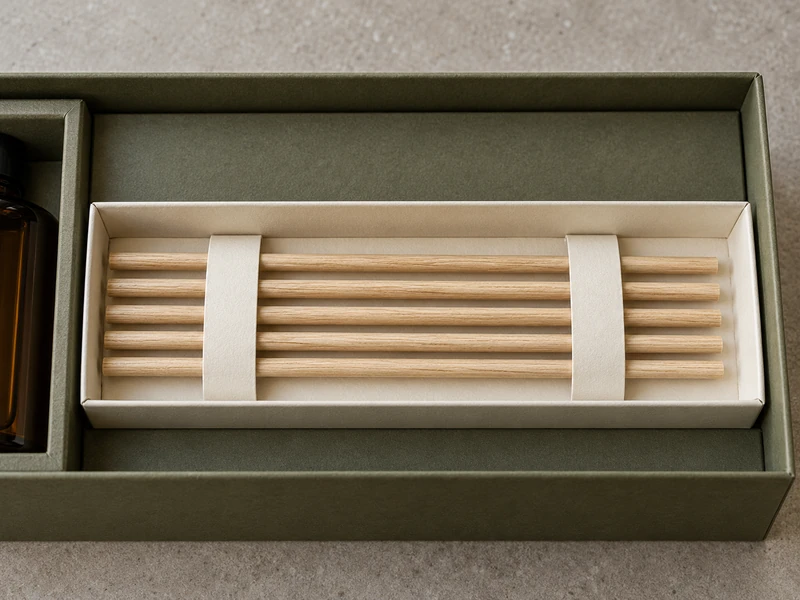
A paper keeper should retain without pressing a sharp fold into the bundle. Confirm that the shortest reeds cannot slip free while the longest remain comfortably contained. Place the release where fingers can reach it without pulling the reeds through a tight band.
Does a Sleeve Replace the Trough?
Only if its construction provides the required support and is itself located within the box. A thin sleeve can contain loose pieces and protect their surfaces, yet offer little resistance to bending. Specify what role the sleeve performs before removing another support component.
If the bundle is enclosed, make the opening direction apparent and accessible. The recipient should not need to lever a reed tip out of a tightly packed end. Keep enough room to grasp the sleeve or release the keeper as a complete assembly.
Protect Both Ends Without Clamping the Bundle
Leave a deliberate end allowance and stop the bundle from gathering speed toward the wall. Simply making a longer empty channel gives it more room to slide. Use a seated sleeve, a gentle keeper or another tested locating detail to control that travel.
Inspect the end folds for hard ridges, exposed adhesive and contact with reed tips. Decorative tip shapes may need a wider pocket than the main bundle. There is no useful universal end-clearance figure without the actual reed, carrier and dimensional variation.
| Observed Problem | What to Inspect / Possible Revision |
| Tips press into an end wall | Internal length and bundle migration / Revise end space and retention together |
| A permanent curve appears midway | Unsupported span or pressure from above / Support the trough and restore lid clearance |
| Outer reeds catch during unpacking | Keeper edges and release direction / Use a broader, accessible release |
| Bundle moves toward the bottle | Divider height and local gaps / Separate and locate the two compartments |
Keep Bottle Loads Out of the Reed Compartment
The filled bottle needs its own appropriate seat and restraint. A divider is useful only if the bottle cannot override it during handling. Examine the cap, shoulder and base as well as the body outline.
Our guide to bottle dimensions and box size explains why stated liquid volume is insufficient for a packaging drawing. The same logic applies to a diffuser: two bottles with the same fill volume can require different cavities and produce different loads beside the reed channel.
For a set including a candle jar, review all three components together. The glass candle jar protection guide provides related structural choices, but protecting the jar does not settle the reed support. Each item needs an acceptance check of its own.
Keep the diffuser’s intended sealed transport closure in place during development. A retail gift box does not replace bottle leak containment or any product-specific shipping requirements. Confirm those with the fragrance supplier before approving the complete pack.
What Changes With a Book-Style Opening?
An attached lid gives a broad opening view, but its hinge sweep must clear the reed compartment. SevenRainbowpack’s book-style rigid boxes can be developed with separate internal zones. Decide whether the bundle should lie beside the bottle or beneath a supported removable layer.
Check the closed condition with the keeper, sleeve and printed card included. A care card tucked above the reeds may introduce pressure that was absent from the empty prototype. Keep lid pockets and decorative folds out of the bundle’s space.
Review Straightness After the Complete Pack Has Been Handled
Photograph the reeds before packing against a straight reference, then compare them after the agreed handling and storage review. Also record split ends, surface scuffs, keeper marks and difficulty releasing the bundle. A box that still looks square can conceal damaged reeds.
Use the intended shipping carton when assessing delivery protection. ISTA’s e-commerce fulfillment testing overview identifies vibration, shock, compression and environmental hazards as part of the transport challenge. Select the appropriate procedure for the route with a qualified lab; the overview is not a reed-specific certification.
Check the Packing Motion as Well as the Finished Layout
A channel can hold the bundle correctly once loaded yet be awkward to fill. Watch whether the packer inserts one end beneath a keeper and bends the other end down to make it fit. A releasable keeper or top-loading sleeve may offer a cleaner sequence.
Keep the packing surface clear of bottle closures and loose cards while the reeds are handled. Long bundles are easy to catch against a nearby component even before the lid closes. Inspect the first loaded pieces for fresh tip damage rather than assuming all marks arose during transport.
Include the reed count in the packing reference and choose a presentation that makes a missing piece detectable. A densely wrapped bundle may require a separate count check before loading. The completed gift box should preserve the supplier-approved arrangement without demanding another bend at the final step.
Send SevenRainbowpack the filled bottle sample, sealed closure, longest reed bundle, all sleeves and the intended opening order. Approve the supported channel with those parts fitted. A slightly longer, calmer interior is often a better result than a compact box that asks the reeds to flex around everything else.