
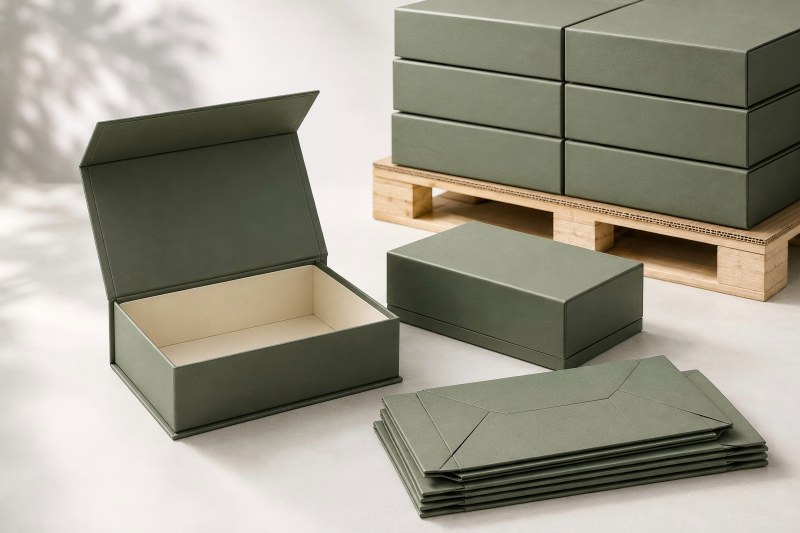
Flat-pack packaging changes the way rigid boxes are produced, transported, and managed. By using collapsible structures, brands can maintain the premium appearance of rigid packaging while significantly improving logistics efficiency.
Compared with traditional rigid boxes, collapsible rigid boxes can reduce transportation volume by approximately 60%–80%, helping companies lower shipping costs, save warehouse space, and improve supply chain flexibility.
What Is Flat-Pack Packaging?
Flat-pack packaging refers to a packaging design where products are transported and stored in a flattened or partially folded condition before final assembly.
Unlike conventional rigid boxes that are manufactured and shipped as complete structures, flat-pack packaging separates the production process from the final shape. The box remains compact during transportation and can be quickly assembled when needed.
Collapsible rigid boxes work through a simple folding concept:
Production → Flat Packing → Transportation → Storage → Assembly → Final Rigid Box
The folding mechanism allows the box panels to collapse without damaging the outer material or reducing structural performance.
This approach is especially valuable for rigid packaging because rigid boxes traditionally rely on thick paperboard, wrapping paper, and reinforced corners, which create a strong but bulky structure.
Why Traditional Rigid Boxes Require More Space
Traditional rigid boxes are known for their premium quality, but their fixed structure creates several logistics limitations.
A fully assembled rigid box contains large empty spaces inside. During transportation, manufacturers are not shipping only the packaging material — they are also shipping the air inside the box.
For example:
Assume a luxury gift box has an assembled size of:
300 mm × 220 mm × 100 mm
The external volume is:
300 × 220 × 100 = 6,600,000 mm³
or approximately:
6.6 liters per box
However, the actual material used to produce the box may only occupy a fraction of this volume. The remaining space is mainly the internal cavity required for the product.
When thousands of empty rigid boxes are transported, this unused space becomes a significant cost factor.
A shipment containing:
- 10,000 assembled rigid boxes
- Average volume: 6.6 liters per box
would require approximately:
66 cubic meters of shipping space
before considering pallet gaps and protective packaging.
For international shipments, where container space is calculated by volume, reducing this unused space can create substantial savings.
How Collapsible Rigid Boxes Save Shipping Space
The main advantage of collapsible rigid boxes comes from their ability to transform from a three-dimensional structure into a compact flat format.
Instead of shipping fully assembled boxes, manufacturers can fold the box panels together and reduce the overall package height.
The transportation volume reduction of collapsible rigid boxes depends on the folding structure and design efficiency.
60%–80% compared with assembled rigid boxes
The exact reduction depends on:
- Box dimensions
- Folding structure
- Material thickness
- Assembly method
- Packaging arrangement
For example:
| Packaging Type | Space Required for 10,000 Boxes | Space Reduction |
| Traditional assembled rigid box | Approx. 66 m³ | — |
| Collapsible rigid box | Approx. 15–25 m³ | 60%–75% |
This difference becomes particularly important for overseas shipments.
A smaller shipping volume means:
- More boxes per container
- Lower freight cost per unit
- Easier warehouse handling
- Reduced packaging waste

The Role of Folding Structures in Space Efficiency
Not all collapsible rigid boxes use the same design. The folding structure determines how efficiently the box can be compressed while maintaining rigidity after assembly.
One-Piece Collapsible Structure
A one-piece design integrates the main panels into a single structure.
Advantages:
- Faster assembly
- Fewer components
- Stable box shape
- Good user experience
This structure is commonly used for premium gift packaging where quick setup is important.
Side-Wing Folding Structure
The side-wing design allows the box panels to open outward and fold flat.
Advantages:
- Efficient space utilization
- Simple assembly process
- Suitable for large-volume packaging
This design is often selected when brands need to balance premium appearance with transportation efficiency.
Two-Piece Collapsible Structure
Two-piece structures separate the box components into two folding sections.
Advantages:
- Easy production
- Flexible customization
- Convenient storage
This option is suitable for brands requiring different lid and base designs.
Magnetic Folding Rigid Boxes
Magnetic collapsible boxes stand out in luxury packaging by offering:
- Premium opening experience
- Strong closure
- Foldable transportation design
Although magnetic components add complexity, the structure still provides significant space savings compared with fixed rigid boxes.
Cost Benefits Beyond Transportation
Space reduction does not only influence shipping costs. It affects the entire supply chain.
Lower Freight Cost
International freight is usually calculated according to container volume or dimensional weight.
Reducing package volume means manufacturers can ship more units in the same container capacity.
For example:
- A container that previously carried:
- 15,000 assembled rigid boxes
- may potentially carry:
- 40,000–50,000 collapsible rigid boxes
- depending on the design and packaging method.
This creates a direct improvement in transportation efficiency.
Reduced Warehouse Requirements
Limited storage space increases costs throughout packaging management. Traditional rigid boxes require large warehouse areas because they cannot be compressed.
Collapsible rigid boxes allow brands and distributors to store more packaging inventory within the same space.
For example:
If a warehouse shelf stores:
- 1,000 assembled rigid boxes
the same area may hold several times more flat-packed boxes.
This is especially useful for:
- Seasonal products
- Promotional packaging
- Limited edition gift boxes
where inventory demand changes throughout the year.
Improved Inventory Flexibility
Many brands need different packaging quantities for different campaigns.
With collapsible packaging, companies can maintain larger packaging inventory without occupying excessive storage space.
This allows businesses to:
- Prepare packaging in advance
- Reduce emergency production
- Respond faster to market demand
Are Collapsible Rigid Boxes Still Strong?
A common concern is whether foldable packaging can provide the same premium feeling as traditional rigid boxes.
The answer depends on the engineering of the structure.
A well-designed collapsible rigid box still uses:
- High-density greyboard
- Premium wrapping paper
- Reinforced folding areas
- Accurate magnetic or locking systems
After assembly, the box regains its rigid three-dimensional structure.
The key difference is not the final strength, but the transportation method.
Traditional rigid boxes are:
Rigid during production → Rigid during shipping → Rigid during use
Collapsible rigid boxes are:
Flat during shipping → Rigid after assembly → Rigid during use
This makes them more efficient without sacrificing the final packaging experience.
Applications of Flat-Pack Collapsible Rigid Boxes
Because of their balance between luxury appearance and logistics efficiency, collapsible rigid boxes are used in many industries.
Cosmetics and Beauty Products
Cosmetic brands often require premium packaging with:
- Attractive appearance
- High-quality materials
- Efficient global distribution
Collapsible rigid boxes help reduce international shipping costs while maintaining luxury presentation.
Electronics Packaging
Electronic products require protective and professional packaging.
Foldable rigid boxes can provide:
- Strong protection
- Customized inserts
- Compact transportation
They are suitable for:
- Headphones
- Smart devices
- Accessories
- Premium consumer electronics
Jewelry and Luxury Gifts
For luxury products, packaging is part of the customer experience.
Magnetic collapsible rigid boxes provide:
- Premium opening feeling
- Elegant appearance
- Efficient storage before use
E-commerce Packaging
E-commerce drives demand for smarter packaging logistics. Since products are shipped individually to customers, packaging volume directly affects transportation costs.
Collapsible rigid boxes allow brands to offer premium packaging without creating unnecessary shipping volume.
Sustainability Advantages of Flat-Pack Packaging
Space efficiency also creates environmental benefits.
When more boxes can be transported in fewer shipments, companies can potentially reduce:
- Transportation frequency
- Fuel consumption
- Carbon emissions
For example, if a company reduces shipment volume by 70%, fewer transportation resources may be required for the same packaging quantity.
In addition, collapsible packaging can help reduce unnecessary warehouse construction and energy consumption by requiring less storage space.
While sustainability depends on many factors, efficient logistics is an important part of responsible packaging design.
How to Select Your Collapsible Rigid Box
The ideal folding structure depends on product and packaging requirements.
| Consideration | Recommended Focus |
| Product weight | Board thickness and reinforcement |
| Shipping distance | Higher space-saving structures |
| Assembly frequency | Easy folding mechanisms |
| Brand positioning | Magnetic closure and premium materials |
| Storage requirements | Maximum flat-pack efficiency |
Brands should consider not only the appearance of the final box but also the entire packaging lifecycle.
A successful packaging solution needs to work from manufacturing to transportation, storage, and customer use.