
A mixed-format tea gift box works best when the tins have firm support and the sealed sachets have their own pocket, row or tray. Use the layout to show how the assortment is meant to be explored, while keeping heavy tins from loading the flexible packs. The five ideas below offer different ways to achieve that within SevenRainbowpack’s rigid-box formats.
Here, “sachets” means individually sealed outer packets containing tea bags or portions of tea. The rigid gift box organizes those packets and the closed tins; freshness protection still depends on the primary packaging. An elegant divider cannot make an unsealed tea portion airtight.
What Needs to Be Settled Before Choosing a Layout?
Put the actual filled tins and sealed packets on the table. Record the tin’s widest diameter, lid shape and packed weight, then measure the sachets with their contents inside. Empty envelopes lie flatter and can make a proposed row seem more generous than it will be.
Decide whether the tins and sachets represent the same blends, different serving formats or a discovery set followed by a larger supply. That relationship should influence what sits beside what. Color alone is an uncertain guide when two flavors use similar artwork.
The Harvard Nutrition Source’s tea storage guidance identifies light, heat, moisture, odor and air as concerns. For this project, that supports retaining suitable sealed inner packs and reviewing unwanted odor from the finished packaging; it does not establish a shelf-life claim for the gift box.
1. Can a Side Pocket Make the Whole Assortment Readable?
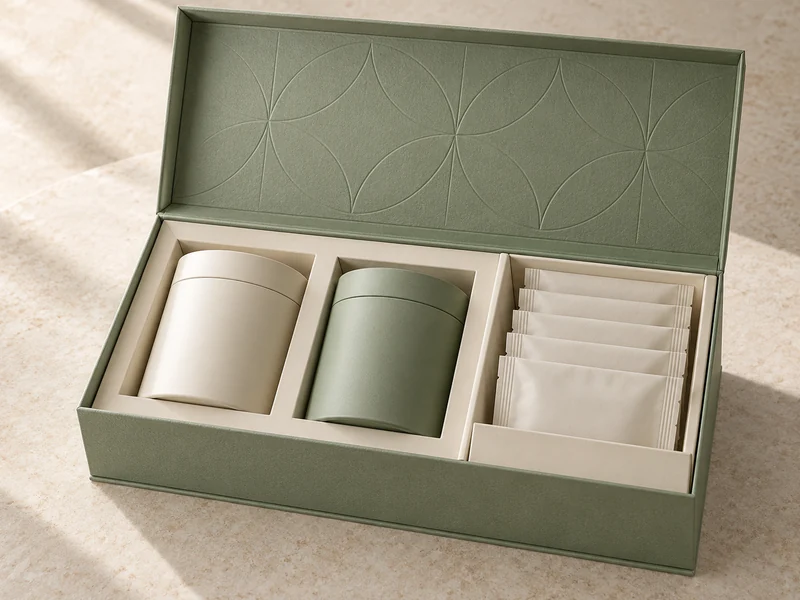
Place one or two tins in fitted wells on one side and the sachets in a separate upright pocket on the other. This arrangement makes both formats visible at the first opening and lets a retailer check the assortment without lifting out a layer.
A book-style rigid box gives this layout a useful stage: the base holds the products while the inside lid can carry the blend map or brewing information. Keep the lid information readable in the actual opening position.
The sachet pocket needs enough support to prevent the packets collapsing into the empty space after the first few are removed. A modest forward-facing step or individual channels may help, but do not make the pocket so tight that the sealed edges scrape against the board.
When Is This the Right Choice?
Choose it when customers should understand the entire set immediately. It is less convincing when a single tiny tin is placed beside a large empty-looking sachet bay simply to create symmetry. Adjust the proportions around the real quantities.
2. Should a Discovery Layer Lift Away to Reveal the Tins?
A shallow upper tray can present the sachets as a tasting sequence, with the tins below. This suits an assortment in which the smaller portions introduce the larger packs, provided the customer can see how to lift the tray.
Support the upper tray on the box structure or a designed internal frame. Do not let it rest on the tin lids, and do not use a bulging sachet as a spacer. The tray should return to its intended height even after several portions have been removed.
A pair of accessible lifting points can make removal steadier than a single narrow tab. Review where the lifted tray will be placed: if it has an uneven underside, it may rock on the table and scatter the packets.
SevenRainbowpack’s article on balancing full-size products and miniatures addresses a related presentation problem. For tea, the useful adaptation is to make the relationship between the discovery portions and the larger tins explicit.
3. Would Two Drawers Make the Box Easier to Keep Using?
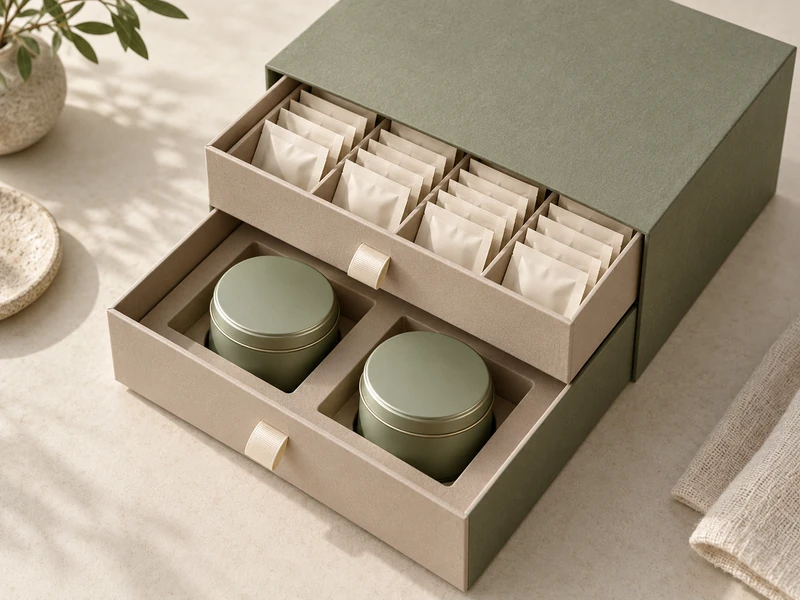
Put the sachets in a shallow drawer and the tins in a deeper one when each format should remain accessible independently. The customer can choose a portion without dismantling the rest of the presentation.
The custom drawer rigid box format offers room to develop this separation, but the loaded construction needs more attention than the empty shell. Tin weight, drawer support and sleeve rigidity belong in the same sample review.
For a stacked design, placing the heavier tins in the lower drawer is a sensible starting arrangement. Still check stability with one drawer open and the other closed. A visually balanced elevation does not establish that the box remains steady on a narrow counter.
Before selecting the pull detail, read our comparison of ribbon pulls and thumb notches. The tea version should be assessed with the filled tins fitted, because the handling effort changes with the contents.
4. Can Paired Blend Bays Explain Two Serving Formats?
Group each tin with the sealed sachets of the same blend in its own bay. This is useful when the set deliberately offers a familiar flavor in both a larger pack and a portable portion, rather than treating all sachets as a separate miscellaneous collection.
Use a firm tin well within each group and a nearby sachet channel with an independent floor. The packets should be neighbors of the tin, not cushioning packed around its sides. A divider between blend groups also makes replenishing the display less confusing.
Keep the front-facing blend name visible on at least one item in every bay. If the tin lid carries the only readable name, check whether the lid is visible from the intended viewing angle. A printed blend key can help without repeating the entire product label.
What Is the Tradeoff?
Repeated paired bays can use more space than one shared sachet pocket. Choose them when the pairing adds meaning to the set. If the tins and sachets contain unrelated teas, separate format zones will usually make the assortment easier to understand.
5. Can a Replaceable Sachet Module Support Seasonal Changes?
Keep a fixed tin area and use a removable, fitted sachet module for changing assortments. This can suit a continuing gift-box design where the tin format remains consistent but the packet count or seasonal selection changes.
Define the module’s outside fit and the range of approved contents. A new packet may share the old width while being thicker when filled, so a simple artwork change can still require a fit review. Avoid claiming one module fits every assortment.
Let an exterior band or a replaceable printed card communicate the season while the main structure stays coherent. Our article on changing a gift box’s seasonal visual story explores this approach; the tea-specific task is to keep the displayed quantities and blend information accurate.
Which Layout Deserves a Physical Sample?
Shortlist the arrangement that explains the assortment with the fewest awkward handling steps. Then test the most demanding approved combination, including the heaviest tin, thickest sachet row and all printed cards.
| Design Idea | Best Presentation Role | Sample Priority |
| Side pocket | All contents visible immediately | Packet support as the pocket empties |
| Lift-out discovery tray | Tasting portions before larger packs | Tray support and steady removal |
| Independent drawers | Repeated access to either format | Loaded stability and drawer movement |
| Paired blend bays | One blend in two serving formats | Readable labels and separate tin support |
| Replaceable sachet module | A changing selection within one box family | Fit of every approved packet configuration |
Check tin removal, packet seal clearance and whether any loose item crosses into another compartment during ordinary handling. Inspect the set again after removing half the sachets. A box kept on a shelf should still make sense after the first serving.
For SevenRainbowpack, provide the full assortment, a blend relationship map and the desired opening sequence. Ask to review the loaded structure before finalizing the wrap and finishing. The right layout should make choosing tea feel natural while leaving the protective job to the appropriate sealed packs.