
Uneven edges on collapsible gift boxes with lids often result from inaccurate folding, unstable corners, or poor lid alignment. Correcting these problems starts with the box design, not assembly.
Why Do Collapsible Gift Boxes Develop Uneven Edges?
A collapsible gift box may look perfectly straight when laid flat, yet develop uneven corners once assembled. The problem becomes especially noticeable when the lid meets the box body.
Unlike traditional rigid boxes, foldable designs depend on several panels returning to their intended positions. Even slight variations in fold angles or corner thickness may change the box’s final shape.
Common signs of poor alignment include:
- Uneven lid overhang: One side extends farther than the opposite side.
- Raised corners: Folded panels prevent the lid from sitting flat.
- Slanted side walls: The assembled box leans slightly in one direction.
- Irregular gaps: Spaces between the lid and base vary around the box.
- Twisted front edges: The closing flap sits higher on one corner.
The underlying causes of these issues can vary. A poorly fitted lid requires a different correction from a box whose side panels have not been secured properly.
Different Foldable Gift Box Structures Need Different Alignment Checks
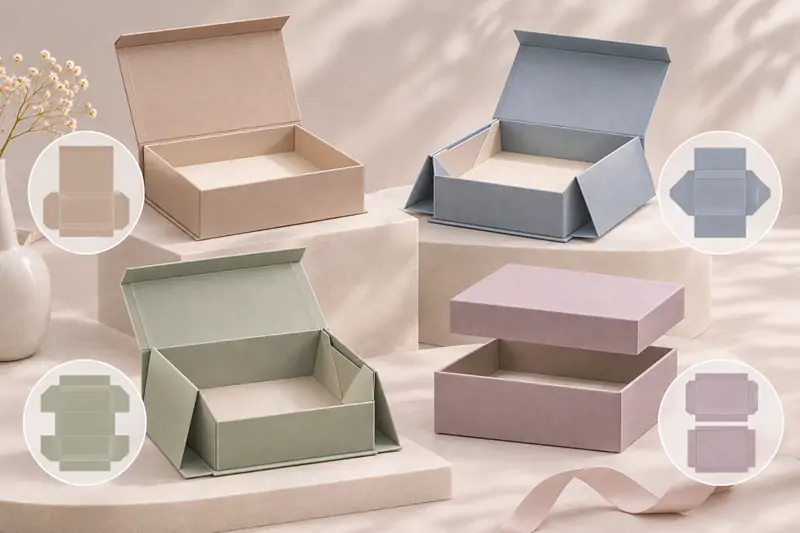
Seven Rainbow offers several structures within its custom collapsible rigid boxes range, including one-piece, side-wing, double-side-wing, and two-piece folding designs. Each creates different alignment concerns.
For buyers ordering custom foldable gift boxes, identifying the structure first makes it easier to locate the source of uneven edges and choose the appropriate correction.
| Folding structure | Where uneven edges may appear | What to check first |
| One-piece foldable gift box | Connected lid or flap sits at an angle | Fold positions and panel squareness |
| Side-wing opening box | One side wall protrudes outward | Wing overlap and corner fastening |
| Double-side-wing box | Reinforced corners become uneven | Layer thickness and wing positioning |
| Two-piece foldable gift box | Separate lid and base fit unevenly | Assembled dimensions and lid clearance |
A double-side-wing design, for example, has additional folded sections that support the box walls. Those overlapping sections need enough room to settle without pushing the corners outward.
With a two-piece structure, the main concern shifts to the relationship between the assembled lid and base. Both parts may look correct individually but fit poorly together.
Getting the Lid-to-Base Fit Right in Collapsible Gift Boxes with Lids
A lid should fit closely enough to look neat without pressing against the box walls. If the clearance is too small, the lid may catch on folded corners.
Too much clearance creates another problem. The lid can shift sideways, leaving a wider overhang on one edge and an unusually narrow border on the other.
For custom rigid boxes with lids, confirm these dimensions before production:
- Inner lid dimensions: Allow for the assembled base and wrapping thickness.
- Outer base dimensions: Measure after the side panels are secured.
- Lid depth: Match the intended coverage and opening style.
- Corner thickness: Account for folded and overlapping board layers.
- Fit allowance: Leave sufficient clearance for smooth opening and closing.
Seven Rainbow’s two-piece rigid box options include partial-telescope, full-telescope, and shoulder-neck lid styles. These provide useful lid-coverage references, although a collapsible version requires its own structural design.
For a foldable lid-and-base box, measure both pieces after assembly. Flat dimensions alone cannot confirm whether the finished edges will align.
Check the Collapsible Rigid Box Dieline Before Printing
A collapsible rigid box dieline determines where the board is cut, folded, and joined. Small inaccuracies in these positions become more visible when multiple panels are assembled.
For this reason, checking the flat layout is only the first stage. The assembled sample must also form straight walls and matching corners without excessive pressure.
Pay particular attention to:
- Panel widths: Keep opposite sides consistent.
- Fold positions: Match the intended box dimensions.
- Corner allowances: Leave room for overlapping layers.
- Wing lengths: Prevent unnecessary material buildup.
- Lid connections: Allow smooth movement without pulling the box sideways.
For square or rectangular foldable gift boxes, checking the diagonals of the assembled base can help identify whether the structure has become skewed.
The dieline should be approved only after the complete sample has been assembled. A correct-looking flat template does not automatically produce a correctly shaped box.
How Board Thickness and Wrapping Paper Affect Edge Alignment?
Rigid board and wrapping paper work together to form the finished box. Seven Rainbow offers greyboard or chipboard with coated, art, kraft, and textured paper coverings.
Thicker board can improve the firmness of a large collapsible gift box. However, folded corners also become bulkier, making accurate grooving and sufficient folding clearance increasingly important.
Several material details deserve attention:
- Greyboard thickness: Balance wall rigidity with folding requirements.
- Wrapping paper: Check for excess buildup at folded corners.
- Adhesive application: Avoid uneven bonding around edges.
- Groove consistency: Keep the intended folding angle uniform.
- Corner wrapping: Prevent loose or bulky paper overlaps.
Surface finishing also deserves a separate check. The appearance and texture of folded edges may vary depending on whether matte, gloss, or soft-touch finishes are applied.
For custom printed collapsible rigid boxes, assess the actual finished sample rather than an unfinished board prototype. The final wrapping and surface treatment may affect folding behavior.
Assemble Foldable Gift Boxes in the Correct Order
Sometimes the structure is accurate, but the folding sequence creates uneven edges. A side panel secured too early may prevent the remaining panels from reaching their intended positions.
The solution is not to press harder. Start with a flat surface, follow the approved assembly sequence, and check alignment before permanently securing any adhesive-backed sections.
A practical assembly sequence is:
- Lay the box flat. Identify the base, side panels, corners, and lid.
- Raise opposite walls. Bring both sides upright without twisting the board.
- Position the remaining panels. Keep the corners aligned before fastening.
- Fold the corner wings. Follow the designed overlap direction.
- Secure the structure. Engage magnets, tabs, or adhesive fixing points.
- Close the lid gently. Check the edge alignment without applying force.
For side-wing and double-side-wing designs, the corner folds need particular attention. A wing trapped in the wrong position can push the adjacent wall outward.
Seven Rainbow’s collapsible rigid box assembly guide explains the basic folding and fastening sequence for different structures.
Once assembled, place the empty box on a level table. If it rocks or leans, check the wall positions before testing the lid.
Why a Collapsible Gift Box with Magnetic Closure May Close Unevenly
A collapsible gift box with magnetic closure should close with a gentle pull. If one corner meets the front panel before the other, the closure may be exposing an existing alignment problem.
Seven Rainbow offers magnetic closures with hidden magnets in the flap and side panels. Their positioning must match the assembled structure rather than merely the flat layout.
Check three details before adjusting the magnets:
- Magnet placement: Confirm opposing magnets meet in the intended positions.
- Flap movement: Ensure the lid can close without twisting.
- Corner stability: Check that the box walls remain square during closure.
If the flap sits unevenly before the magnets engage, changing magnet strength alone will not correct the underlying problem.
Snap-lock and Velcro closures require different checks. Tabs must enter their slots without bending the walls, while hook-and-loop surfaces should meet without pulling the flap sideways.
Custom Rigid Boxes with Inserts: Prevent Pressure on Folding Walls
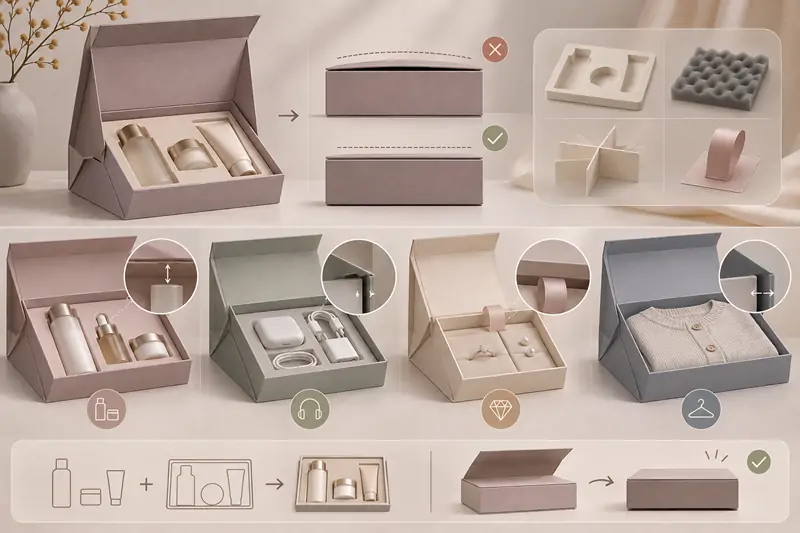
An empty box may close evenly but develop a raised lid after the products are inserted. This often indicates that the contents or insert are interfering with the box structure.
Seven Rainbow offers EVA and sponge inserts, paper dividers, and ribbon pull tabs for its collapsible rigid packaging. Their dimensions should be tested alongside the assembled box.
For different packaging applications:
- Cosmetic gift sets: Check whether tall bottles lift the lid.
- Electronics accessories: Keep protective inserts from pressing against folding walls.
- Jewelry packaging: Ensure pull tabs do not become trapped beneath the lid.
- Apparel gift boxes: Leave room for the contents without forcing the sides outward.
For multi-item gift sets, test the actual arrangement rather than relying only on individual product dimensions. An insert that fits empty may shift when loaded.
Uneven Edges After Folding: Identify the Cause Before Making Adjustments
Not every irregular edge requires a change to the box dimensions. The location and timing of the problem often provide a useful indication of its cause.
Use this table when inspecting a collapsible gift box sample:
| Visible problem | Likely cause | Recommended check |
| Lid extends farther on one side | Unequal lid clearance or skewed base | Measure the assembled lid and base |
| One corner sits higher | Excess folded material | Inspect wing overlaps and wrapping |
| Front flap closes diagonally | Misaligned fold or closure position | Check the fold and magnetic contact points |
| Side wall bends outward | Incorrect corner fastening | Reassemble and inspect the fixing method |
| Edges become uneven after filling | Insert or product pressure | Test the box with its actual contents |
| Shape changes after storage | Flat-pack pressure or material movement | Compare samples before and after storage |
The first useful question is when the defect appears: during folding, after closure, after filling, or following storage.
That distinction helps determine whether the appropriate correction belongs in the dieline, materials, assembly instructions, insert design, or packing arrangement.
Test Collapsible Gift Boxes Before Wholesale Production
A single attractive sample is not enough to confirm that an entire order will assemble consistently. Sampling should reproduce the conditions under which the customer will actually use the packaging.
For collapsible gift boxes wholesale, request several samples made with the proposed board, wrapping, closure, and inserts. Assemble each independently and compare the finished edges.
A useful inspection checklist includes:
- Opposite walls remain straight after folding.
- All corners reach the intended height.
- The lid closes without sideways movement.
- Edge gaps remain visually consistent.
- Inserts fit without deforming the walls.
- Repeated opening does not loosen the structure.
- Samples remain usable after flat-pack storage.
Also check whether different people can assemble the boxes with similar results. A design that requires constant manual correction may create problems during large-volume packing.
If the samples behave differently, record photographs and measurements before revising the structure. Avoid changing the lid dimensions and corner construction simultaneously without identifying the actual cause.
Keep Foldable Gift Boxes Straight During Flat-Pack Shipping
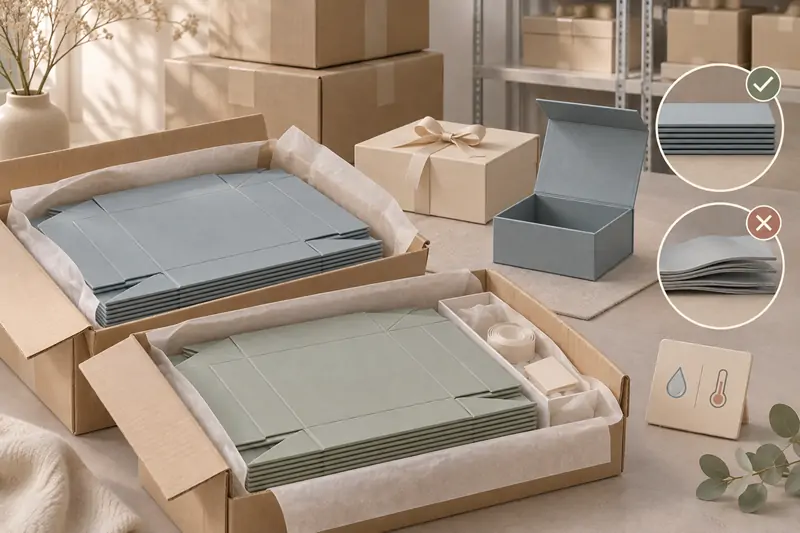
Collapsible rigid boxes are intended for flat-pack transportation, but improper stacking can still affect their condition before assembly. Excessive pressure near foldable sections may leave unwanted bends.
Storage conditions matter as well. Paper and board respond to changes in temperature and humidity, as reflected in TAPPI’s paper conditioning guidance.
Before shipment, confirm:
- Flat-packed boxes lie evenly inside master cartons.
- Heavy accessories do not press against folding sections.
- Carton quantities avoid excessive compression.
- Stored packaging remains protected from moisture.
After delivery, assemble samples taken from different carton positions. This helps distinguish manufacturing inconsistencies from changes introduced during transportation or storage.
What Should Buyers Confirm Before Ordering Custom Collapsible Gift Boxes?
When requesting custom foldable rigid boxes, provide more than the preferred exterior dimensions. The packaging brief should also specify assembly expectations and the desired lid appearance.
Share these details with the manufacturer:
- Required length, width, and height
- Preferred folding structure and closure
- Intended lid coverage and edge appearance
- Product dimensions, weight, and insert requirements
- Board, wrapping paper, and surface finishes
- Flat-pack delivery and assembly expectations
Ask the manufacturer to demonstrate the fully assembled sample and confirm the acceptable edge variation before bulk production.
For projects requiring different lid structures, reinforced corners, or custom inserts, explore Seven Rainbow’s custom collapsible rigid box options and discuss the assembly requirements before approving production.
Even edges depend on accurate folding, stable corners, suitable materials, and proper lid clearance. Testing complete samples before production helps custom collapsible gift boxes retain their intended appearance after assembly.