
Silk scarf gift boxes reduce added creasing when they let the scarf rest in broad, gently supported folds without pressure from the lid, ribbon or insert edges. Start with the scarf’s packed shape, then size the usable interior around it. A beautiful shallow box becomes a poor choice if the silk must be pressed flat to make it close.
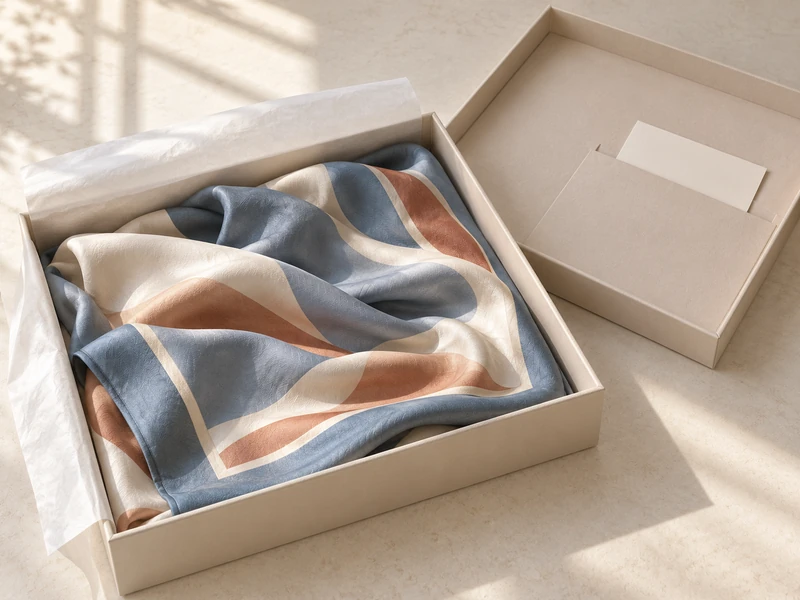
The aim is a scarf that opens gracefully and can be removed without snagging. Packaging cannot promise to erase existing creases, and different silk constructions will respond differently to folding. The sample needs to represent the actual fabric, hem and print used in the order.
Which Fold Should Determine the Box Footprint?
Begin by laying the scarf out and finding a broad fold that shows a useful section of its design. Avoid choosing a small square box first and repeatedly halving the scarf until it fits. Each extra fold adds another bend and can concentrate bulk where several layers overlap.
For a border print, showing one corner and a run of the border may communicate more than exposing a random central patch. A narrow scarf may suit a long, shallow format; a large square can need a wider footprint to keep the packed layers relaxed.
Prepare two plausible folding arrangements before asking SevenRainbowpack to develop the structure. Photograph each from above and from the side. The side view reveals whether an apparently flat presentation hides a thick ridge underneath.
- Use the intended scarf size and fabric, including the finished hem and care label.
- Note where the thickest overlap sits and whether it touches a wall.
- Leave the fold relaxed while measuring its length, width and height.
- Check how easily the recipient can lift the scarf without dragging it across an edge.
How Much Room Does the Lid Need Above the Silk?
Enough for the completed scarf-and-tissue arrangement to close without being compressed. There is no reliable universal allowance because a light silk square and a heavier twill scarf can build very different stacks.
Place the scarf in a prototype, close the lid naturally and reopen it. If closure requires smoothing the bundle down, tightening a ribbon or forcing the lid past a bulge, change the interior height or fold. Increasing board thickness alone does not remove that pressure.
SevenRainbowpack’s custom two-piece rigid box is a useful starting point for a quiet, shallow presentation. Decide the base depth and lid relationship with the scarf loaded, since the visible silhouette of the empty box tells little about the space available above the textile.
Can a Folding Box Work for a Scarf Collection?
A collapsible rigid box can be considered where empty-box storage matters. Once assembled, however, its interior corners, folds and closure still need to be checked against the scarf. The flat-pack advantage does not settle the fabric-contact details.
Inspect a fully assembled production-material sample, including its wrapping seams. A loose flap or exposed adhesive near the base can interfere with a delicate hem even if the overall dimensions are correct.
What Should Support the Fold?
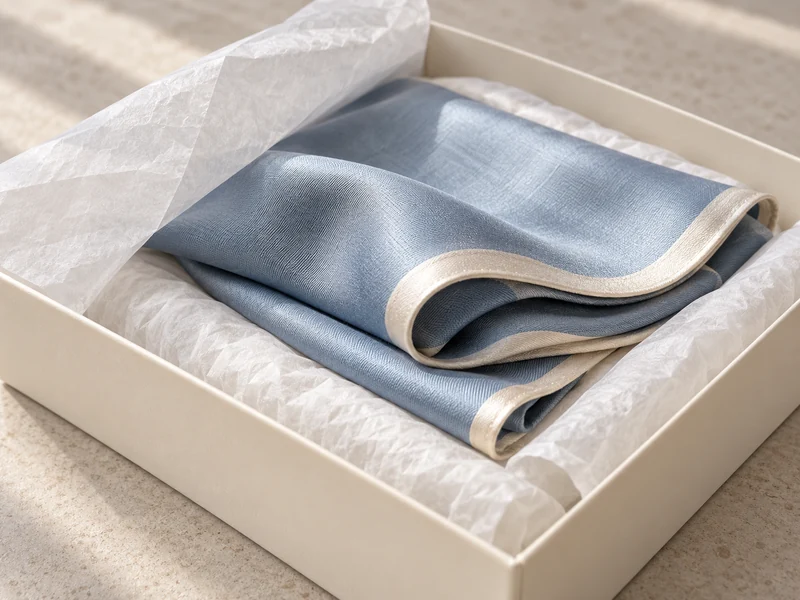
A soft, broad support can keep a folded edge from being squeezed into a hard line. A small roll of suitable tissue placed inside the turn is one development option; it should round the bend gently without producing a conspicuous lump under the display surface.
The Smithsonian’s textile storage guidance favors minimizing folding, abrasion and pressure, and describes padding unavoidable folds. That guidance concerns preservation rather than a commercial gift-box performance test; its practical relevance here is to avoid making the box itself a pressing tool.
Keep support consistent along the fold. A tiny wad at each end leaves the middle unsupported, while a dense roll may make the scarf sit higher than the lid clearance allows. Review the complete arrangement rather than approving tissue and box dimensions in isolation.
Which Tissue Belongs Next to Silk?
Ask for the tissue specification, not simply the word “premium.” The Smithsonian Museum Conservation Institute distinguishes buffered from unbuffered papers and recommends neutral-pH, unbuffered acid-free tissue for general textile storage, noting particular concerns for silk and wool with buffered papers.
Use that distinction when choosing a contact layer, especially if the gift box may be kept. Do not assume that a decorative tissue, a translucent sheet or paper advertised only as acid-free has the same composition. Check any printing, dyes and coatings as well as the base sheet.
A restrained white contact layer often leaves more freedom for the exterior. SevenRainbowpack can develop the brand expression through the wrapped lid and surface detail while the material beside the scarf remains selected for its contact role.
Where Do Unwanted Pressure Lines Come From?
They may come from items that appear decorative or harmless when the box is empty. A narrow ribbon tied firmly around the folded scarf, a care card with a thick edge, or an insert corner directly beneath the fabric can create a local pressure point.
| Detail | What to Look For | Possible Revision |
| Ribbon around the textile | A narrow indentation across several layers | Move the ribbon to the box exterior or loosen the presentation method |
| Care card on the scarf | A card edge pressing into the silk | Use a separate pocket or place the card away from the loaded fabric |
| Exposed insert edge | A hard ridge beneath a fold | Change the support shape and cover the contact edge suitably |
| Overfilled base | A lid that needs downward pressure | Revise the fold, footprint or interior height |
A paper band can carry seasonal graphics without tightening around the scarf itself. Our discussion of gift-box belly band options is useful when the decoration can sit around the closed box instead.
How Should a Scarf Packing Sample Be Compared?
Compare arrangements with equivalent scarves in the same starting condition. Photograph the textile before packing, agree a holding period that represents the project, then unpack each version using the same inspection method. Otherwise an existing crease can be blamed on the new box.
Record fold lines, edge marks, snagging and whether the scarf slips into a corner. Include the intended outer carton and stacking arrangement in the development review when those conditions may affect the closed box. A brief showroom opening is a different situation from a stored and shipped gift set.
Do not invent a standard “safe” fold radius or a universal crease-free storage duration. Choose acceptance conditions with the textile supplier and examine the actual samples. If the scarf needs care after unpacking, the care instruction should follow the scarf maker’s advice.
What Happens After the First Unboxing?
If the recipient is expected to keep the box, make repacking forgiving. A design that works only when a trained packer creates an exact sequence of tissue folds is less useful for everyday storage.
Our article on giving rigid gift boxes a second life offers the wider design context. Here, the relevant test is simple: can the scarf go back in with relaxed folds and can the lid still close freely?
What Makes a Useful SevenRainbowpack Brief?
Send the scarf, the preferred visible pattern area, the folding photographs and the complete contact-material plan. Include the care card and any ribbon, since those small additions can change the packed height or create a hard line.
Use the different sample stages to settle different questions: the early structure can establish space, while the later material sample should confirm the seams, tissue and finished fit. Approve the box with the scarf inside, not as an empty object.
The strongest presentation may be a little broader, a little less tightly folded and quieter inside than the original sketch. That restraint gives the silk room to carry the visual interest, which is precisely what the gift box is there to present.