
Prevent accidental dispensing by keeping the pump in its approved transport state, restraining the bottle body and leaving the actuator clear of the lid and insert. The pump head should never become a support point for the package. A snug bottle cavity alone cannot stop a free actuator from being pressed.
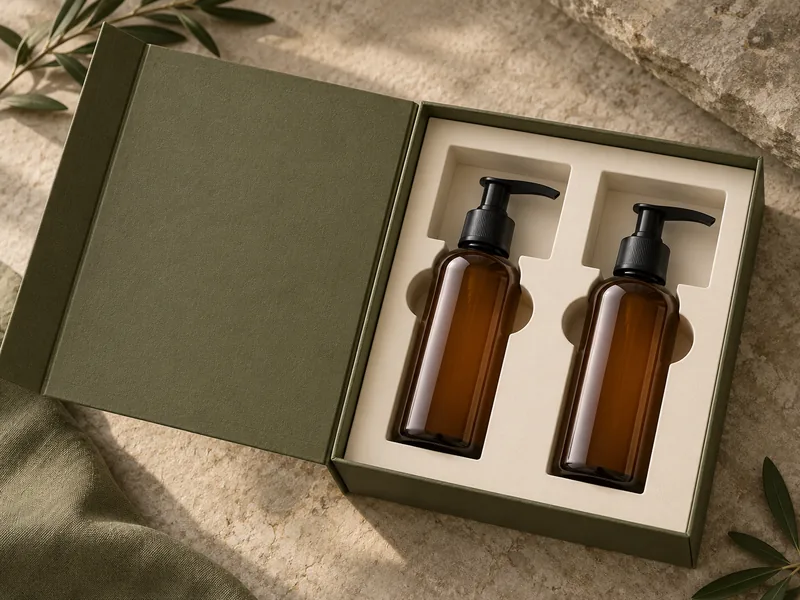
In a SevenRainbowpack cosmetic rigid box, the pump, bottle, insert and lid need to be reviewed as one assembly. The most attractive front view can hide a nozzle that touches the wall or an actuator sitting just below the cover. Start with those hidden contacts before refining the foil and paper texture.
1. Is the Pump in the Correct Transport State?
Use the closure supplier’s specified shipping position and locking method. Some pumps lock down, some lock up and some need a dedicated clip or overcap. The mechanism must be identified on the actual closure; appearance alone is an unreliable guide.
Confirm whether locking changes the overall height, nozzle direction or the way the bottle must be filled and packed. A lock-down action may involve a different handling sequence from an external stem clip. Have the closure and filling teams establish that sequence before sizing the gift box around it.
Keep a photograph of the accepted state at the packing station. “Pump locked” is too vague if several similar closures are used across a collection. Identify the closure revision and the visible feature that confirms correct locking.
Can the Gift Box Replace a Pump Lock?
It should not be assumed to do so. A cavity may limit movement of the bottle while leaving the actuator free to travel. Ask the closure supplier what the primary package requires for transport, then develop the gift box around that requirement.
2. Where Should the Insert Restrain the Bottle?
Support the bottle at appropriate body and base areas, with any neck support agreed for the primary pack. Keep restraint away from the moving actuator. A collar that sits under the wrong part of the head can interfere with the lock or direct handling loads into the pump.
Review the bottle’s shape rather than choosing a cavity from nominal capacity. A tapered body, broad shoulder or heavy base changes how it rests and moves. Our article on perfume-box dimensions explains why volume alone cannot define the needed space.
If the bottle can rotate, decide whether that changes pump safety or label presentation. The nozzle may swing toward a wall even when vertical clearance is generous. A shaped body seat or another suitable anti-rotation feature can address that, subject to sample review.
3. Is There Real Clearance Above and Beside the Actuator?
Reserve space around the complete pump head, including the nozzle in its packed orientation. Measure the locked production assembly and its dimensional variation. A height taken from an unlocked display bottle can lead to the wrong cavity and cover relationship.
Check lid deflection as well as the static gap. The lid should bear on the intended box structure under expected handling, rather than reaching the actuator first. A decorative lining or card placed above the bottle also consumes clearance.
| Potential Contact | Question for the Loaded Sample |
| Lid lining above actuator | Can the cover or an inserted card press the moving head? |
| Sidewall beside nozzle | Can rotation or lateral movement bring the nozzle into contact? |
| Insert near pump stem | Does the insert interfere with the specified lock or clip? |
| Neighboring product | Can a jar, tool or accessory enter the pump’s free space? |
SevenRainbowpack’s book-style rigid boxes offer a controlled reveal with custom compartments. Use the section drawing to check cover clearance across the entire closing arc. A head can be clear when the box is closed but still catch the cover as it swings.
4. Would a Clip or Overcap Add Useful Protection?
A closure-specific protective component can help where the supplier recommends it. Confirm its fit, retention and effect on overall dimensions. A generic clip that merely looks similar may fail to block travel or may load the stem incorrectly.
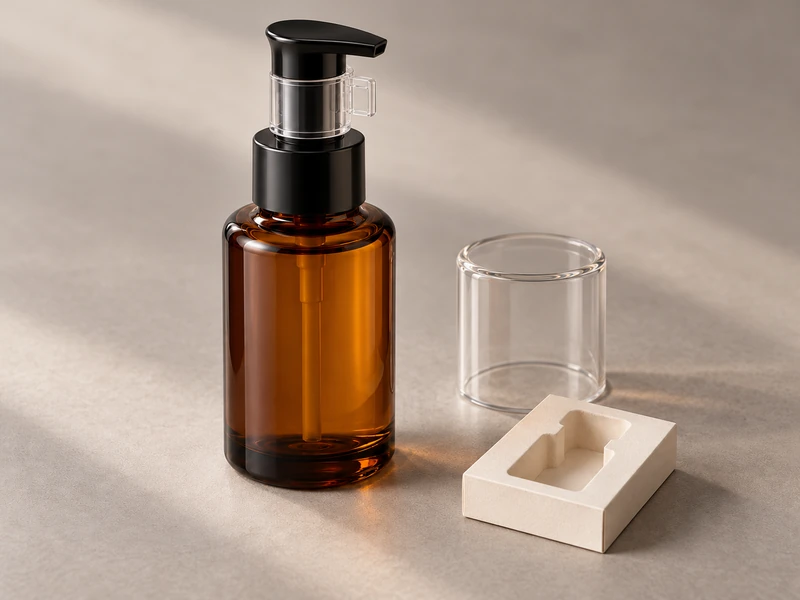
Keep the component in place through the agreed packing sequence. If the gift presentation calls for its removal before delivery, the protection it provides has also been removed. Resolve that conflict with the product and closure teams instead of quietly changing the packing instruction.
For an overcap, check that the insert does not dislodge it during loading. Provide enough access for the customer to remove it deliberately. A cap that is trapped so tightly that the user pulls on the pump assembly creates an awkward final step.
Should the Customer Receive an Unlocking Instruction?
Yes, when the intended opening action is not self-evident. Keep the instruction specific to that pump and place it where it appears before the first attempt to dispense. A short diagram or line on an insert card can be more helpful than a long paragraph on the box bottom.
If a loose clip is removed, provide a clear disposal or storage instruction appropriate to the component. Do not call it a child-resistant feature unless that claim is specifically established. Its role here is the supplier-defined transport function.
5. Can the Packing Process Activate the Pump?
Watch the bottle enter the insert. A packer may naturally push on the top when a body cavity feels tight, activating or stressing the closure before the lid is even fitted. Give them a way to seat the bottle using approved body contact.
The unloading path deserves the same review. Finger recesses beside the bottle body or a removable carrier can prevent the recipient from gripping the head as a handle. Our beauty gift-box removal guide helps plan that access.
Keep instruction cards, ribbons and accessory bags away from the actuator. A loose item may migrate into the top clearance during handling. A dedicated pocket is more dependable than carefully arranging it beside the pump for the approval photograph.
6. Does the Complete Shipment Keep the Protection Intact?
Evaluate the filled primary package, gift box and outer transport pack together. Record pump state, component seating and bottle position before the evaluation. Inspect for dispensing, seepage, movement and damage afterward as separate outcomes.
Accidental actuation is only one possible cause of wet packaging. A closure seal issue, damaged bottle or other primary-package problem needs its own investigation. Do not report every leak as proof that the insert pressed the pump.
ISTA’s retesting guidance identifies product, package and process changes as reasons to reassess performance. A different pump head or insert can therefore matter even when the exterior box is unchanged. Confirm the appropriate evaluation with the responsible product and packaging specialists.
Can One Insert Serve Several Pump Bottles?
Only after comparing the extremes of the range in their transport states. The tallest bottle may govern lid clearance, while a shorter bottle with a longer nozzle governs lateral space. The heaviest bottle may expose an entirely different support problem.
Use our multi-SKU packaging system guide to decide which parts can remain common. A shared exterior with identified variant inserts may be more sensible than one permissive cavity. Keep the correct insert and pump-lock reference easy to match during packing.
Where Should You Look First if a Sample Dispenses?
Start by documenting the condition before moving anything. Photograph the pump position, lock or clip, wet areas and neighboring components. Then inspect the lid lining and insert for contact evidence that corresponds to the actuator or nozzle.
A mark directly above the head suggests a different investigation from a bottle that has rotated into a sidewall. In the first case, review vertical clearance and lid support; in the second, review body location and lateral freedom. Keep the primary-package supplier involved if the leak path itself remains uncertain.
Change one relevant feature in the next development sample where practical. A revised cavity, taller box and new pump introduced together may improve the result while obscuring which change mattered. A traceable revision helps later assortment changes receive the right review.
Do not clean the only failed sample before recording it. The pattern of product residue and displaced parts can provide useful evidence that disappears once the presentation is restored for a photograph.
What Should Accompany the Pump-Bottle Sample?
Give SevenRainbowpack bottles prepared in the intended filled and locked condition, together with the closure instructions and planned transport carton. Photograph the nozzle direction and fitted protective components so the packing state can be reproduced. Add the customer’s intended lifting and unlocking sequence to the same reference.
The finished gift can still look simple: a quiet wrap, a clean insert and a neatly aligned product face. The protective detail belongs around the body and in the planned clearances. When those are right, the pump head remains a dispensing control rather than an unintended load-bearing part.