
To keep a drawer tray from sliding out during handling, specify a retention feature for the closed position and check it with the fully loaded box. A snug sleeve can improve the feel, but friction alone is an uncertain safeguard; a travel stop serves a different purpose by limiting how far an already opened tray can move.
That distinction matters for Seven Rainbow’s drawer-style gift packaging. A miniature candle collection, chocolate assortment and beauty-tool kit may share the same sliding format, yet their weight, inserts and opening habits place very different demands on the sleeve and tray.
Is the Drawer Moving While Closed or While Opening?
Identify the exact movement before choosing a remedy. A tray creeping forward when the sleeve is tilted needs a different response from one that drops free at the end of an enthusiastic pull.
For the first problem, look at closed-position retention: a suitable magnetic arrangement, locking detail, removable transit band or other feature developed for the actual construction. For the second, assess a stop or tether that limits travel.
A tether can prevent complete separation while still allowing the drawer to drift several centimetres inside a tilted sleeve. Conversely, a closure that releases cleanly may do nothing to keep the drawer attached after the customer opens it.
Seven Rainbow’s custom drawer rigid box is a starting architecture. The retention requirement belongs in the brief alongside size, insert layout and opening direction, rather than being assumed from the product name.

Why Is a Tighter Sleeve an Incomplete Fix?
A tighter fit increases sliding resistance, but it also makes deliberate opening harder. The customer may grip the sleeve more firmly, distort its walls or pull abruptly once the tray begins to move.
The fit is also affected by the assembled materials. Wrapping paper, lining, adhesive build-up and the condition of the board all contribute to the finished contact surfaces.
Evaluate the production-intent combination, not just an unwrapped white sample. If a textured wrap or soft-touch finish is part of the Seven Rainbow brief, the sliding behaviour should be checked after that finish is included.
What Does Uneven Resistance Tell You?
A drawer that catches at one corner may have an alignment or local build-up problem rather than a uniformly undersized sleeve. Making the entire opening larger can hide the snag while introducing excessive movement elsewhere.
Slide the loaded tray slowly and note where resistance changes. Check the sleeve mouth, wrapped corners, insert bulges and tray squareness before revising the overall clearance.
Also watch how the tester holds the box. A firm squeeze across the sleeve can create a problem that disappears on a flat table, which is precisely why a tabletop demonstration is insufficient.
Which Retention Features Are Worth Sampling?
Choose the feature according to the handling stage and the intended opening ritual. There is no single accessory that reliably solves every form of unwanted movement.
| Proposed Feature | Main Job | Question for the Sample |
| Closed-Position Magnet | Resist initial movement | Does it remain aligned under the loaded tray? |
| Paper Locking Detail | Provide deliberate engagement | Can the user release it without damaging the wrap? |
| Removable Band or Sleeve | Restrain the drawer before first opening | Is it clearly removable and appropriate for the presentation? |
| Internal Stop or Tether | Limit outward travel | Does it stop the loaded tray before balance is lost? |
These are concepts to review with the sampling team, not a statement that every detail fits every box. A very shallow tray may leave little room for a concealed mechanism; an elaborate lock can also complicate a deliberately quiet, minimal design.
A removable band may work well for the first delivery but provides no continuing protection once discarded. If the customer is expected to keep the package, specify how the drawer should behave during reuse as well.
Where Should a Travel Stop Engage?
The stop should engage at a position that gives access while keeping the loaded assembly controllable. Maximum product visibility is only one part of that decision.
As the tray moves outward, more of its weight sits beyond the sleeve. A heavy candle near the front can change the balance much earlier than a lightweight card set occupying the same footprint.
Move the actual contents through the proposed opening sequence. Check whether the customer can reach the rearmost item without pulling against the stop or lifting the whole package awkwardly.
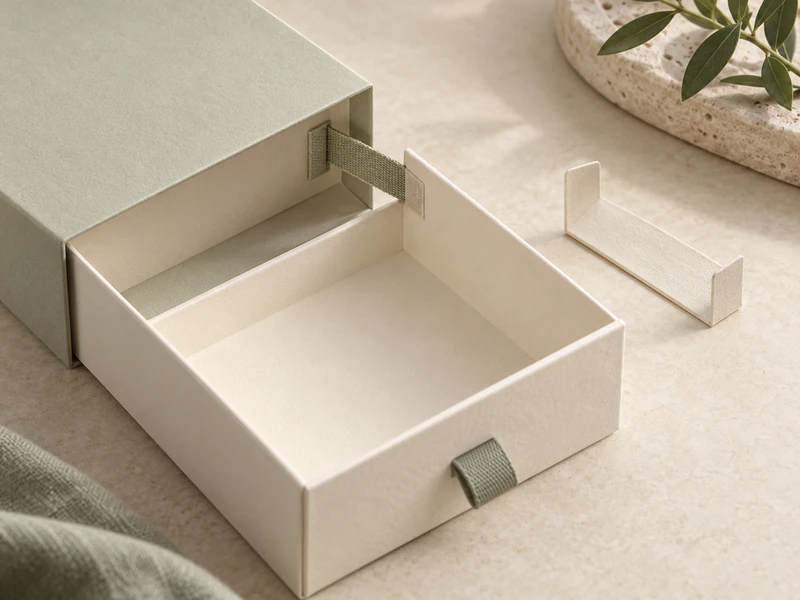
For a tether concept, review the attachment areas as carefully as the ribbon itself. A narrow strip bonded to a delicate lining can transfer the stopping load into a small, vulnerable patch.
How Does the Insert Affect Drawer Movement?
The insert controls the load inside the tray, which changes how the drawer behaves. A loose product can move forward during tilting and strike the front wall, even when the drawer itself remains attached.
Fit the insert so that it cannot migrate or bow into the sleeve’s sliding path. A raised edge of paper or fabric can create intermittent drag, prompting the user to pull harder than the construction needs.
For several products, map the load rather than simply arranging a pleasing row. Keep heavier pieces supported, separate fragile surfaces and check the drawer’s balance at its intended stopping point.
The existing mini candle discovery gift box article explores the presentation side of a sequence. The retention review adds a practical question: can that sequence be opened and handled without the tray changing position unexpectedly?
Can a Ribbon Pull Prevent the Drawer From Falling?
A front ribbon pull is normally an opening aid, not an internal restraint. Its visible loop gives the user something to grasp; it does not necessarily connect the drawer to the sleeve.
If the design uses both a pull and a tether, identify them separately on the drawing. Record where each attaches, what it is intended to do and how the assembly should look when fully opened.
The same care applies to a thumb notch. It can improve access to the tray front without adding any retention at all.
Seven Rainbow’s discussion of details for easier gift-box opening is useful when balancing access with control. An opening should be understandable without relying on a hard pull to overcome a poorly resolved fit.
What Should a Loaded Handling Review Include?
Begin with the ordinary movements the package will encounter before and after sale. Tilt it, pick it up from the sleeve, set it down and open it in the orientation the customer is likely to use.
- Observe whether the closed tray creeps when tilted.
- Check initial opening effort and any sudden release.
- Pull to the intended stop with all contents fitted.
- Inspect stop attachments, wrapped corners and lining after repeated openings.
- Try removal and replacement of the individual products.
These practical checks help refine a sample; they do not replace an appropriate transport assessment. The ISTA procedure overview separates integrity screening from tests intended to represent distribution hazards, so the shipping route and complete packed system should guide formal validation.
Define success before the review. “Feels premium” is useful feedback, but “the closed tray stays engaged during the agreed handling sequence” gives the team something more concrete to assess.
How Should the Accepted Fit Be Recorded?
Keep a loaded reference sample and describe the way it was assessed. Note the paper, finish, insert version, contents and orientation, so a later comparison does not accidentally pair an empty white sample with a fully finished production box.
Ask the sampling team to record the agreed construction dimensions and retention detail. If opening effort will be measured, agree on a method and acceptance range for this project rather than borrowing an unsupported universal number.
For a set sold in several combinations, identify the heaviest and most unevenly loaded versions. An approved lightweight assortment does not establish how the same tray will behave with a large glass jar concentrated near its front.
Photographs of the drawer at closed, partly opened and stopped positions provide useful context. They should accompany the physical reference, since an image alone cannot communicate drag, release or the feel of the stop engaging.
What Should You Send Seven Rainbow?
Provide the product weights, loaded layout, opening direction and the stage at which restraint is needed. Include a short description or video of the unwanted movement if you already have a problematic sample.
Use the sample-development stages to resolve geometry first, then confirm the finished paper, lining and retention detail together. Changing a finish after approval can change sliding behaviour enough to warrant another review.
If the intended ritual still feels awkward, a sliding format may deserve comparison with a book-style rigid box. The purpose of sampling is to choose a controllable opening that suits the product, not to preserve a drawer mechanism at any cost.
A well-resolved drawer should remain composed while being handled and move deliberately when opened. Achieving both requires a defined restraint strategy, rather than asking tight friction to do every job.