
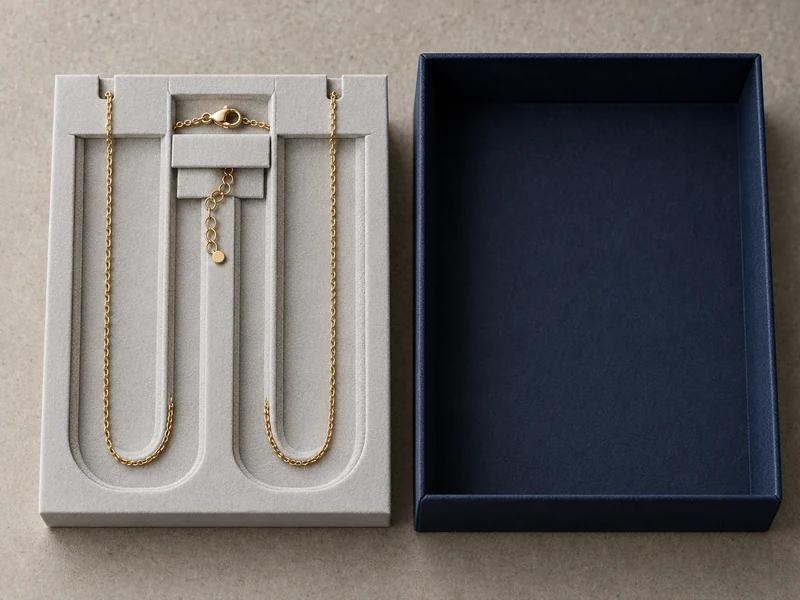
Keep the spare chain in a defined route behind the necklace insert, with the clasp and extender held apart from the main loops. Two slots at the top can arrange the necklace beautifully on the front while leaving a small knot factory on the reverse. The rear needs its own layout, depth and release method.
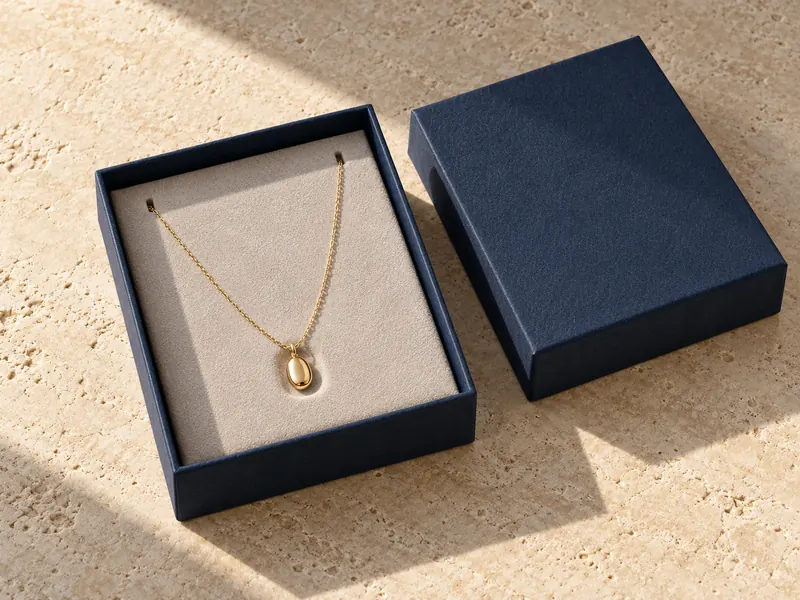
For a SevenRainbowpack necklace box, start by turning the loaded insert over. This is where a seemingly generous cavity can become an unrestrained pocket, or where a shallow base can press the chain against a rough board edge. Resolve that hidden space before choosing the foil color on the lid.
Where Does the Spare Chain Actually Go?
It should occupy shallow, separate paths rather than one loose heap. A divided rear recess or a removable back carrier can keep the two sides from crossing as the box changes orientation. A decorative lining alone does not establish those paths.
Sketch the necklace as one continuous line: pendant, left display length, rear storage, clasp, right storage and right display length. Mark every place where the chain changes direction. If the drawing requires one segment to pass over another, reconsider the route before making the insert.
Use the necklace in its intended packed condition, including its clasp and extender. A chain fastened at its shortest setting stores a different amount behind the card than one fastened at its longest setting. The packing instruction needs to name the setting.
- Separate the two rear chain runs with a low divider or independent lined channels.
- Reserve a small seat for the clasp rather than burying it under a loop.
- Contain the extender so its end cannot thread through nearby links.
- Keep excess chain away from the insert perimeter and box wall.
How Much Depth Belongs Behind the Insert?
Enough for the complete rear arrangement without flattening it when the card is seated. Measure the clasp as well as the chain; it may be the thickest part of the hidden assembly. A soft covering can disguise contact pressure during an empty-box inspection.
SevenRainbowpack’s two-piece rigid boxes allow the base depth, lid coverage and insert to be developed together. For a necklace, use that flexibility to provide a supported display surface above a planned rear cavity. Leaving an arbitrary void underneath is a different construction.
Check that the insert bears on a stable ledge or support, not on the stored chain. Once the loaded card is fitted, it should sit consistently around its perimeter. Rocking at one corner can indicate that a clasp, keeper or paper fold is acting as an unintended spacer.
Which Rear Arrangement Suits the Necklace?
Choose by how the chain bends and how much length remains unseen. A fine flexible chain may accept broad, separated loops; a flatter or stiffer chain may need a larger footprint and fewer changes of direction. Ask the jewelry supplier to confirm acceptable handling for the actual construction.
| Rear Arrangement | Useful Starting Point / Detail to Check |
| Two divided shallow channels | A flexible chain with modest spare length / Loops remain separate when the card is fitted |
| Broad back carrier with soft keepers | A longer chain needing a larger route / Keepers retain without squeezing links |
| Dedicated clasp pocket plus chain channel | A clasp or extender that migrates easily / Hardware releases before the necklace is lifted |
A tiny pouch can contain the rear length, but it still needs a position and an exit route. If both chain runs enter the same pouch and the clasp can tumble among them, the pouch may merely hide the tangle. Compare it with a divided carrier using the same necklace.
Should the Chain Be Pulled Tight?
No: use enough restraint to maintain the arrangement while leaving the necklace relaxed. The front should not depend on tension between narrow slots, the clasp and the pendant bail. Retention points need to control migration without becoming sharp anchors.
Broad, smooth turns are the starting direction, not a universal bend specification. There is no single safe loop size for every cable, snake, herringbone or decorative chain. Let the chain supplier’s advice and the loaded sample settle that detail.
What Should Touch the Metal?
Choose the actual contact covering as carefully as the visible lining. A velvet-looking face does little for a chain rubbing against an uncovered reverse edge. Inspect both sides of each slot and the concealed turn where the chain passes through.
GIA’s jewelry care and storage guidance emphasizes suitable padded storage and protection against scratching. That supports reviewing contact surfaces; it does not certify a particular foam, textile, adhesive or anti-tangle layout. Confirm compatibility with the jewelry finish separately.
Keep exposed adhesive out of the chain route. Also check whether a flocked or fabric covering sheds visible fibers onto fine links, and whether a printed contact paper transfers color. The approved material sample should include the reverse covering and slot treatment, not just the front swatch.
Can a Shoulder Neck Box Improve the Reveal?
It can frame the necklace attractively, provided the neck leaves access to the insert. SevenRainbowpack’s shoulder neck rigid box range includes different neck heights and insert choices. A taller surround may look more substantial while making a flush card harder to lift.
For a removable carrier, leave an obvious finger recess or a discreet tab that lifts the carrier itself. The customer should not have to use the pendant as a handle. Our article on small details for easier gift-box opening is relevant here: the next action needs to be visible.
Decide whether the recipient releases the necklace in the box or removes the complete carrier first. Both can work, but the keepers and rear access must match the chosen sequence. A permanently fixed insert with inaccessible rear restraints creates a frustrating last step.
What Does a Useful Loaded-Sample Review Look Like?
Photograph the front and reverse before seating the insert. Close the complete package, handle it in the orientations expected during packing and delivery, then reopen it without first straightening the necklace. Compare the rear arrangement with the starting photograph.
- Has the extender escaped its seat?
- Have the rear runs crossed or slipped around a divider?
- Does the clasp press into the card or box base?
- Can the customer release the necklace without a sudden pull?
- Does repacking require a skilled operator to recreate the route?
A hand-turned sample is an early design check, not a transport performance report. Use the intended outer pack for any agreed distribution testing. Inspect both chain condition and arrangement afterward, because an untarnished necklace can still arrive tangled.
Can One Insert Serve Several Chain Lengths?
Sometimes, but give the spare length a planned adjustment area. The longer necklace should not require a packer to add another tight turn, while the shorter one should not leave a keeper holding empty space. Compare the extremes of the collection before approving the middle size.
A replaceable rear carrier may preserve the same visible insert and box while changing the hidden route. Keep its part identification clear during packing. A carrier that looks identical from the front but takes a different route behind it needs an unmistakable loading reference.
Also examine what happens when the clasp is opened during unpacking. The chain should leave its keepers in an understandable order, with no concealed loop remaining trapped behind the card. Ask a person who did not pack the sample to demonstrate that release.
Our guide to white, printed and pre-production samples helps separate the decisions. Establish the rear space and release sequence early; confirm the real contact materials and finishing on the later sample.
What Should Go Into the SevenRainbowpack Brief?
Send the necklace, the intended clasp setting, the front presentation photograph and a clear reverse-side routing sketch. Include the shortest and longest chain variants if the same box will serve a collection. State which insert parts the customer may remove.
In the packaging design brief, describe what should happen after the carrier is lifted as well as what the customer sees when the lid opens. That small addition gives the hidden chain the same design attention as the pendant.
The finished box can remain visually quiet: textured paper outside, a restrained lining inside and very little visible hardware. The complexity belongs in the concealed routing, where it prevents an attractive necklace presentation from turning into an untangling exercise.