
Choose PET or PVC gift-box windows by comparing the actual film grades in the finished frame. Both names describe a material family, not a guaranteed level of clarity, stiffness or scratch resistance. A clear loose sheet can look quite different after it has been cut, bonded, packed and handled.
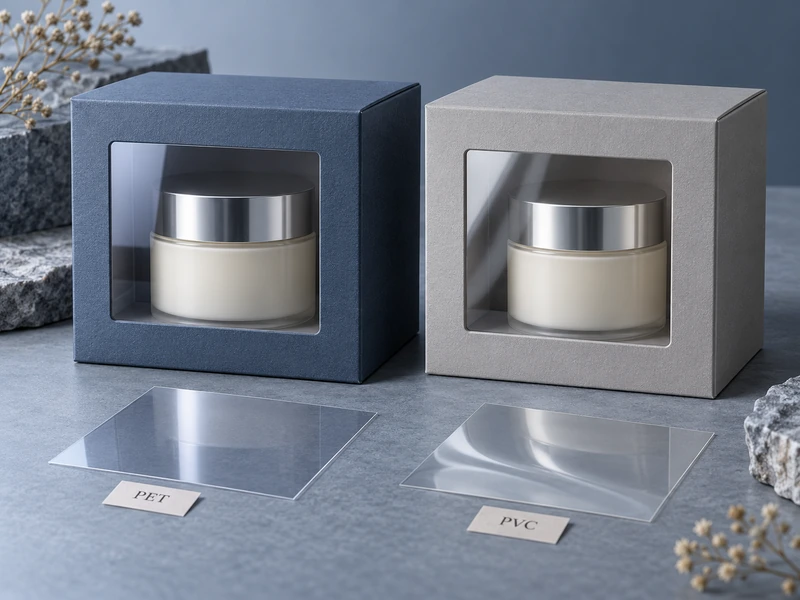
SevenRainbowpack lists PET and PVC as window options, alongside a choice of box structures and finishes. The useful question is therefore not which abbreviation sounds more premium. It is which proposed window keeps the product readable and the assembly tidy through the handling your gift box will receive.
What Does “Clear” Mean for This Particular Gift?
Define the detail the customer needs to see. A large bottle silhouette asks less of the window than a small shade name or fine metallic decoration. Put that detail behind each candidate at the intended distance from the film.
Assess haze, reflections and local surface defects separately. A reflection can hide a product even through an optically clear film; a bowed patch can distort it; a small scuff can become conspicuous against a dark insert. One broad word, “clarity,” tends to conceal those different causes.
ASTM’s D1003 method for haze and luminous transmittance provides a recognized way to describe relevant optical properties of transparent plastics. Ask what method, thickness and sample condition accompany any supplied figures. A film data sheet does not measure glare from your shop lighting or the quality of your assembled frame.
For a cosmetics set, use SevenRainbowpack’s cosmetic rigid box options to develop the product position and window together. The film cannot reveal a label hidden behind a deep paperboard border. Fix the sightline before paying for a different sheet.
Will PET Automatically Look Better Than PVC?
No automatic ranking is reliable without the grades and construction details. Compare proposed samples at a known thickness and record any differences. If the supplier recommends different thicknesses for the same opening, compare those finished proposals too, with the reason for each choice stated.
Use the full resin name on the schedule: polyvinyl chloride for PVC, or polyethylene terephthalate for PET. Record the proposed sheet grade alongside that polymer family, including the supplier’s information on treatments and protective layers. This gives a later replacement sample a defined reference beyond the three letters on its tag.
A side-by-side comparison is most revealing when the product, insert color, cutout and light remain unchanged. Otherwise, the darker insert or better camera angle can make one film appear superior. Keep a handled sample beside the untouched reference as well.
| Comparison | What to Hold Constant or Record |
| Product visibility | Same label, film distance, frame depth and viewing angle. |
| Flatness | Opening size, film thickness, bond pattern and time after assembly. |
| Handling feel | Cut edge, unsupported span and the way the lid is gripped. |
| Scuffs and dust | Same packing process, protection and handling sequence. |
| Bond appearance | Actual wrap, adhesive, overlap and drying or setting conditions. |
Which Handling Differences Matter at the Packing Table?
Look at how each sheet feeds, separates, cuts and lies flat in the proposed process. A film that curls or attracts visible debris can increase the care needed before bonding. Ask the factory to show the window after normal assembly rather than inspecting only a polished hand sample.
Watch where fingers naturally land when opening the lid. A large unsupported patch invites pressing, especially if the product looks close beneath it. Provide a rigid frame that gives the user an obvious grip away from the film.
For the location decision, our lid-window versus front-window guide separates viewing position from material choice. A front window may face different handling and shelf obstructions from a lid window. The preferred film should be assessed in that chosen position.
Is Thicker Film Always the Answer?
It may reduce some visible deflection, but it also changes the assembly. Review the cut edge, patch seating, adhesive interface and any increase in local thickness. A stiffer patch that lifts at a corner is not a successful improvement.
Do not let the window become a substitute for a product restraint. Leave planned clearance between the contents and film, and use the insert to control movement. A tall cap rubbing the patch can create marks that would occur with either polymer.
How Should the Window Be Bonded Into the Frame?
Specify the patch overlap and bonding method on the inside face. Keep adhesive out of the visible opening and away from the contents. Review the inside with the lid fully open, because the recipient sees that surface too.
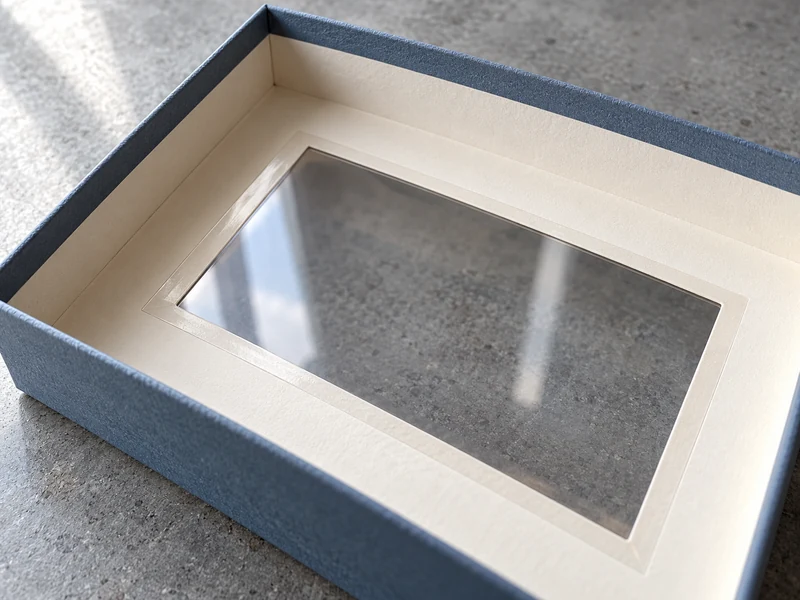
A neat exterior can conceal cloudy adhesive, an uneven border or a loose corner behind it. Compare the actual wrapped board and selected film after assembly has settled. Flat stock samples do not show the stresses introduced by a large cutout and a narrow frame.
SevenRainbowpack’s hinged lid rigid boxes allow the window to be considered alongside the lid and hinge. Keep the patch clear of the working fold and closure components. Confirm that the moving lid does not flex the window border unnecessarily.
What About Protective Films and Surface Marks?
If a temporary protective layer is proposed, define when it is removed and who removes it. A protective layer left on unintentionally may make a clear window appear cloudy. One removed too early may leave the patch exposed through later packing steps.
Record whether the optical reference is bare film or protected film. Also inspect the surface after the actual cleaning method, if cleaning is part of production. Avoid approving a solvent or wipe from habit; ask the material supplier to confirm suitability for the exact sheet and surface treatment.
Can a Window Change the Perceived Product Color?
It can change what the viewer perceives through reflections, haze and surrounding contrast. Check pale products, metallic details and the darkest variants behind the same frame. A window selected with an ivory jar may reveal a much more obvious reflection over a black compact.
Look under the intended retail light and in the photography setup. These are separate views with different glare patterns. Our guide to reviewing metallic, pearlescent and holographic wraps in real light is relevant when a reflective wrap surrounds the opening: the frame can compete with the product as much as the film does.
If shade accuracy is essential, be precise about what the window can show. An opaque lipstick case cannot reveal the lipstick shade merely because the window is clear. Printed shade information and a well-chosen visible product detail may be the more honest presentation.
Does Choosing PET Settle the Recycling Question?
No: the full box combines board, wrap, adhesive, film and potentially other components. Collection rules and separation practicality still matter. Do not transfer a recycling claim from a PET bottle to a bonded window in a rigid gift box.
If material separation is part of the proposal, test how the recipient actually removes the patch. A theoretical removable part can be difficult to separate without tools or without leaving several materials attached. State the verified construction and seek destination-specific guidance before making a broad environmental claim.
What Does a Useful Supplier Comparison Include?
Ask for a finished window assembly and a loose film reference for each proposed grade. Comparing the sheet with its mounted counterpart helps locate a difference that appears during assembly. Use matching cutouts and frame graphics so the comparison remains about the film and its bond, rather than two unrelated box designs.
For example, a buyer may notice a cloudy line near one window edge while the central view remains clear. That pattern calls for examining the bond and frame first. Replacing the polymer without understanding the local defect could preserve the same visible problem in a more expensive sample.
Conversely, if the whole window looks hazy under the same setup, examine the sheet and any protective layer before changing the cutout. Record what was altered between samples so an apparent improvement has an identifiable cause. A sequence of anonymous swatches is difficult to turn into a production instruction.
Approve the inside edge and the outside view together. The recipient sees both, and a gift window should look deliberately finished from either side.
What Should Be Approved Before Production?
Approve a specific film grade, thickness and assembled reference, with a photograph showing the intended viewing angle. Keep both an untouched sample and one that has followed the agreed handling sequence. Compare surface appearance, patch seating and product visibility rather than relying on a material name in the quotation.
- Inspect the closed view against the actual insert and product colors.
- Open the lid and inspect every bonded edge from inside.
- Confirm that the product remains clear of the film.
- Record the protective-layer removal stage, if applicable.
- Keep the film specification tied to the approved sample revision.
Use the white, printed and pre-production sample stages to avoid approving appearance before the construction is representative. Give SevenRainbowpack a clear visual task for the window and a realistic handling sequence. That produces a more defensible PET-versus-PVC decision than a generic list of material advantages.