
A straight neck gives a shoulder-neck box an even upper frame; a slanted neck changes that frame’s height around the product. When the front is lower and the rear higher, more of the product can be visible from the customer’s opening angle while the back retains a layered, architectural presence.
Seven Rainbow lists straight and slanted-cut options within its high-neck designs. The useful question is not which looks more luxurious in isolation, but how the neck profile works with the product’s height, the insert and the lid’s locating surfaces.
What Rises Between the Base and the Lid?
The neck is the inner structure rising above the base and engaging with the lid. It is distinct from the outer base wall and from the insert that locates the product.
Those parts may sit close together, but they do different jobs. The neck helps define the layered closure and visible frame; the insert determines where the product rests and how it is held.
Seven Rainbow’s shoulder-neck rigid box range includes different neck heights and lid styles. Specify the neck profile alongside those choices, since “high neck” alone does not indicate whether its upper edge is straight or slanted.
What Does a Straight Neck Do for the Reveal?
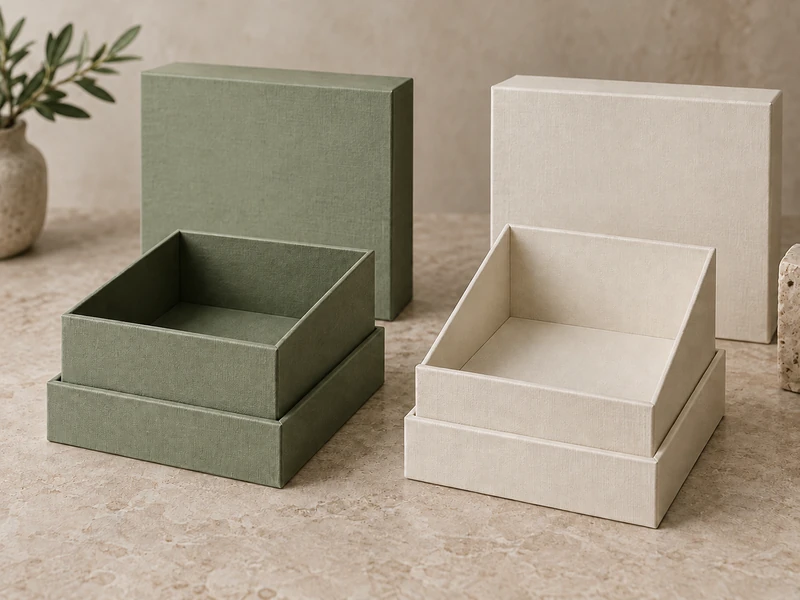
A straight upper edge creates a consistent frame around the cavity. It can suit a symmetrical product or a layout intended to be viewed from several sides.
The even line also gives colour contrast a clear role. An ivory lid lifting away from a sage neck produces a calm, continuous band before the product is fully exposed.
However, an even frame can obscure the lower part of a short bottle or small tool. If the product sits deep in the insert, raising the neck further can make the open package feel like a container being looked into rather than a product being presented.
Can the Product Simply Be Raised?
Sometimes, but raising the product changes more than visibility. It reduces lid clearance and can alter stability, removal and the support needed beneath a heavy object.
Review those consequences before adding a platform. The correct solution may be a lower neck, a revised insert depth or a different profile rather than elevation alone.
What Changes With a Slanted Neck?
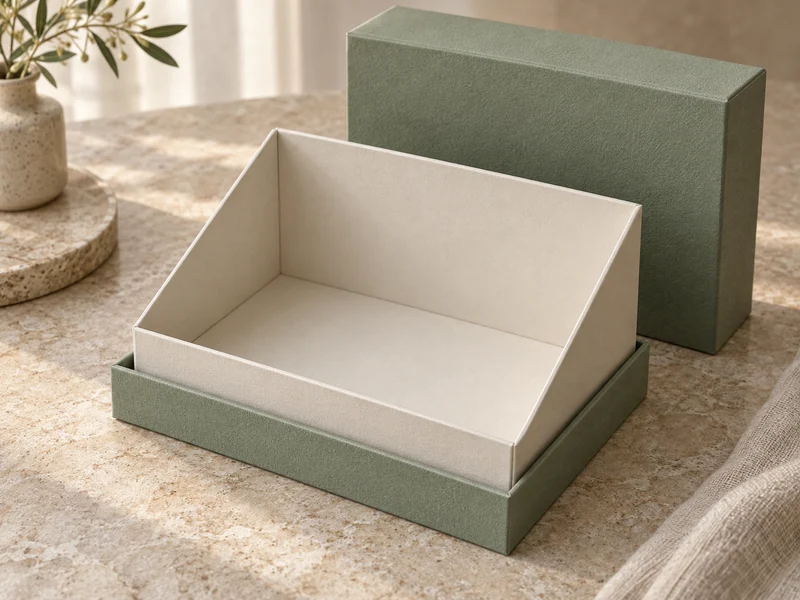
A slanted profile introduces a directional reveal. In a common concept, the side edges descend from a higher rear section towards a lower front, opening the view into the cavity.
That can help a bottle label, a decorative jar surface or a group of smaller pieces become visible earlier. The taller rear area still provides a background against which the product reads.
Mark the slope direction on the drawing. A slanted neck is not self-explanatory: the intended front, high point and low point need to be stated rather than inferred from a style name.
Does a Slanted Neck Automatically Improve Access?
No. A lower front may improve the approach, but fingers still need space beside the product and a suitable place to grip it.
If the insert grips a bottle tightly with no recess, reducing the front neck height may expose more glass without making removal easier. Consider the neck and insert as neighbouring parts of the same movement.
Where Should the Slanted Rim Begin and Finish?
Start with the product position and viewing angle, then establish the neck profile around them. Avoid selecting a dramatic slope first and forcing the contents into the remaining space.
For a fragrance bottle, place the label where it should be seen and check how much of the body remains behind the front edge. For a candle jar, look at the full silhouette and the area the customer needs to grasp.
A simple side-view mockup can make this relationship clear before finished sampling. Include the bottle, insert floor, neck and lid, rather than drawing the neck as an isolated decorative outline.
| Decision | Straight Neck | Slanted Neck |
| Visual Frame | Even height around the opening | Directional height change |
| Front Visibility | Depends strongly on overall neck height | Can expose more product with a lower front |
| Orientation | Can support a less directional presentation | Usually needs a clearly intended front |
| Sampling Focus | Continuous alignment and product depth | Slope, edge finishing and lid engagement |
What Happens to Lid Fit?
The lid still needs dependable locating surfaces and adequate clearance. A slanted upper edge does not remove that requirement, and the remaining engagement must be resolved in the complete construction.
Ask the sampling team to show where the lid contacts or clears the neck. Review the high rear corners and the transition into the lower front area, where geometry can become harder to interpret from a front photograph.
Do not assume a taller rear section always improves closure. Excessively tight contact can make opening abrupt or scuff the wrap, while excessive clearance can produce a loose feel.
For a removable lid, check lifting from the positions a customer is likely to use. For a hinged version, check the lid’s movement around the high points throughout opening and closing.
How Does Paper Texture Affect the Result?
The neck exposes a narrow edge and a visible vertical surface, so material choices are particularly noticeable there. A quietly grained wrap can make the neck feel layered even when its colour is close to the surrounding shell.
Slanted edges add transitions that deserve close inspection. Check whether the paper turns neatly, whether any raw board is visible and whether the slope looks consistent on both sides.
A fine printed border following the slant can make small variations prominent. If the intended look is quiet and natural, a solid tone or subtle texture may serve the geometry more gracefully.
Seven Rainbow’s tactile perfume packaging article explores the material side of that decision. Its approach works particularly well when the neck is meant to be a restrained supporting frame.
Can the Neck Replace a Protective Insert?
No. A neck may surround the cavity, but it does not necessarily locate the bottle, cushion a glass base or separate accessories.
Keep the product’s support requirements explicit. A high frame can conceal an inadequate fit just as easily as it can enhance a good one.
For perfume, review the bottle-specific packaging options alongside the neck design. Cap clearance, body support and safe lifting access must remain resolved even when the outer presentation changes.
For transport evaluation, use the finished packed system and an appropriate assessment. Clemson University’s Package Dynamics Lab describes protective-packaging research in relation to distribution forces; neck appearance alone cannot establish protective performance.
What Should a Comparative Sample Show?
Compare straight and slanted versions with the same product, cavity depth and material family. That isolates the effect of the neck profile rather than mixing several design changes together.
Review both from standing height and from the customer’s likely seated opening angle. Then remove the product, replace it and close the lid without repositioning the box for a photograph.
- Is the intended product surface visible?
- Can the customer reach a robust gripping area?
- Does the lid engage smoothly without scraping?
- Are the neck edges neat and balanced?
- Does the package still look composed from the sides?
The Seven Rainbow sample-stage guide provides a sensible framework for these reviews. Settle the profile on an early structural sample, then verify it again with the actual covering materials.
How Should the Intended Front Be Communicated?
A directional neck needs a consistent relationship with the product label, lid artwork and opening orientation. Mark the front on the structural drawing and on the insert layout so those elements do not drift apart during development.
For a set, check whether every item benefits from the same direction. A low front may expose the main bottle while a miniature at the rear remains hidden behind another product.
Use a simple loaded mockup to assess that line of sight before commissioning the finished wrap. Moving the small item or adjusting its seat can be more effective than making the entire neck slope steeper.
The closed box should also remain understandable. A customer should not have to rotate the package several times to discover the orientation in which its carefully designed reveal works.
Which Profile Should a Brand Keep Across a Range?
A shared profile can help several boxes feel related, but the product sizes must still work within it. Keeping the same visible proportion may be more useful than forcing an identical neck height onto every format.
Consider how the frame will behave when the box is used for storage. Seven Rainbow’s second-life rigid gift box article offers a reason to think beyond the first reveal: repeated access should remain comfortable after the launch moment has passed.
A straight neck brings continuity; a slanted neck gives the reveal a direction. Choose the one that frames the actual product well, then prove its closure and handling on the sample.